Agentic Commerce Protocol Shopify Merchants: What Changed
Did the agentic commerce protocol shopify merchants heard about in 2025 actually die in 2026? No, it did not. I went back through the primary sources myself, and the real story is narrower than the headlines suggest. OpenAI retired one product built on top of the protocol. The protocol itself kept shipping updates the entire time.
That distinction matters. However, if you skimmed a “ChatGPT checkout is dead” post sometime this spring, you likely have the wrong mental model. In fact, here is what I found once I checked the dates myself.
A few terms worth pinning down first:
- ACP is short for the Agentic Commerce Protocol. OpenAI and Stripe released this open standard in September 2025 so an AI agent can hand a merchant a scoped payment token.
- Instant Checkout is the retired ChatGPT feature that let a shopper finish a purchase without leaving the chat window, built on top of ACP.
- UCP is the Universal Commerce Protocol, a separate standard Shopify co-developed with Google, announced in January 2026.
- Shopify Catalog is the structured product feed that syndicates a merchant’s listings to ChatGPT, Copilot, and Google’s AI surfaces.
- Agentic Storefronts is Shopify’s name for the bundle that turns Shopify Catalog on by default for eligible merchants.
Key Takeaways
- ACP is still active. In fact, it shipped its fifth dated version on April 17, 2026, per the protocol’s own GitHub changelog.
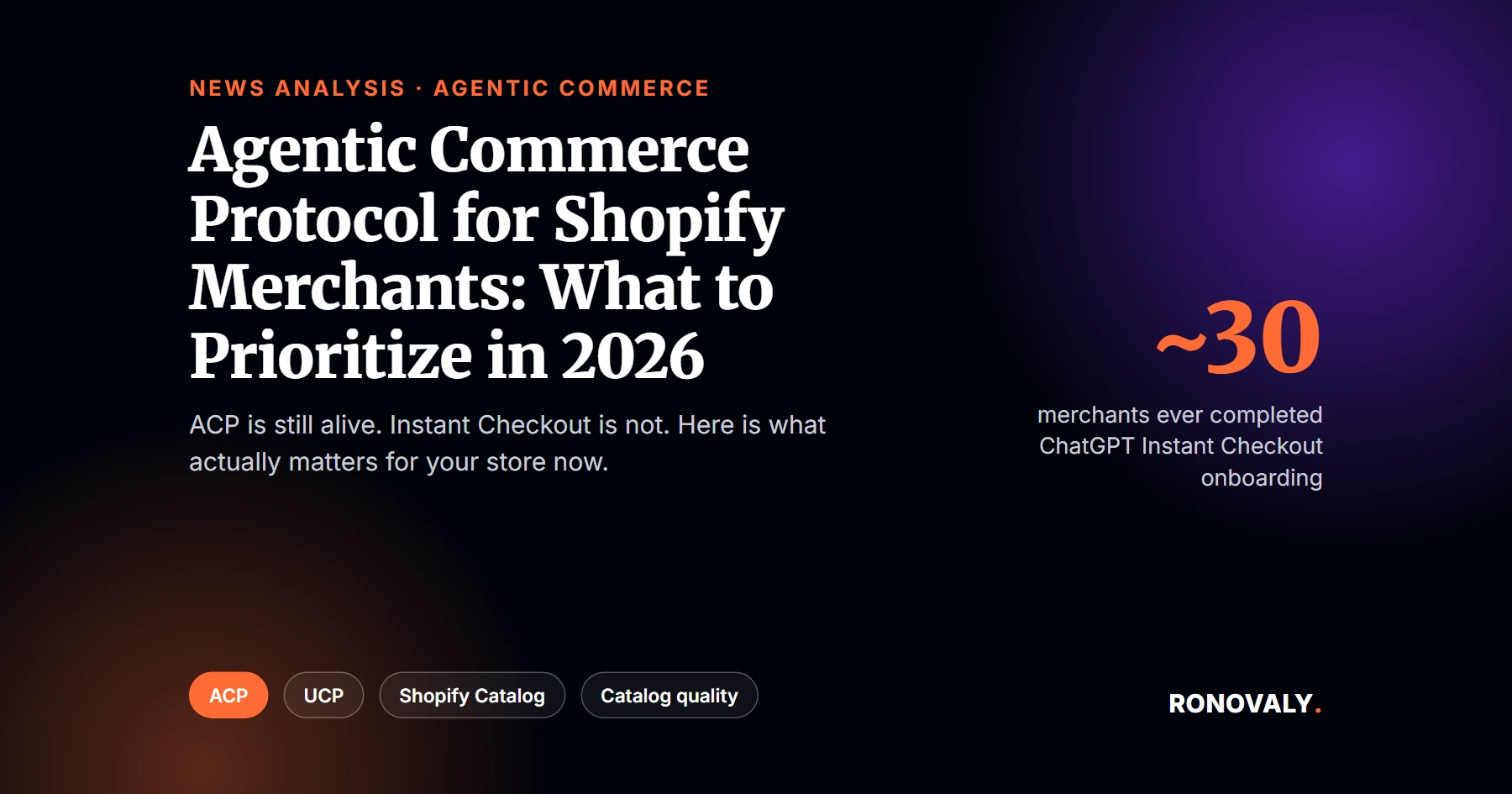
- Instant Checkout is what actually died, not ACP. Notably, real Shopify adoption stayed tiny (roughly 30 merchants onboarded) before OpenAI pulled it for weak conversion, not weak interest.
- Shopify’s real checkout bet moved to UCP, a second, separate protocol co-developed with Google.
- You likely do not need to build anything for ACP. Specifically, Shopify Catalog and Agentic Storefronts are on by default, at no added fee.
- The one thing worth checking this week is catalog data quality, not a checkout integration. See “What to Do Now” below.
What Happened
So what actually happened on March 24, 2026? OpenAI retired Instant Checkout, the feature that let ChatGPT users buy without leaving the chat. In its place, OpenAI repositioned ChatGPT as a discovery and comparison layer. Checkout now routes back to the retailer’s own site instead.
In fact, real adoption never reached scale. Roughly 30 Shopify merchants had completed onboarding, and fewer than 200,000 Walmart products were ever listed, before OpenAI pulled the feature (Enterprise DNA, citing CNBC reporting, March 31, 2026).
Key facts:
– Instant Checkout and ACP both launched September 29, 2025. Etsy went live immediately, and OpenAI announced “over one million” Shopify merchants as coming soon (Stripe, 2025; Marketing Dive, 2025).
– OpenAI said the initial version “did not offer the level of flexibility” merchants needed, per reporting corroborated by TechInformed and The Keyword (both March 2026).
– Notably, that same day, Shopify switched on Agentic Storefronts by default for 5.6 million eligible merchants. There was no app to install, no setup, and no added fee (Shopify Newsroom, March 24, 2026).
Why This Matters
Why does this matter to you specifically? Because two different things share the “agentic commerce” label, and only one of them ever really mattered to a Shopify founder. ACP is infrastructure. Instant Checkout was a single product built on that infrastructure, and it was the product that failed.
Context. ACP was never Shopify’s only agentic commerce bet, even at launch. In particular, Google announced the competing UCP on January 11, 2026, co-developed with Shopify. More than 20 retailers and payment networks endorsed it at launch, including Etsy, Target, Walmart, and Wayfair. In addition, Google updated UCP again on March 19, 2026, just five days before Instant Checkout’s retirement, adding cart, catalog, and identity-linking capabilities.
Significance. As a result, by the time Shopify shipped its Spring ’26 Edition on June 17, 2026, UCP, not ACP, was the protocol Shopify actually described as running “from discovery to checkout” by default. A wide consortium backs it, including Amazon, American Express, Mastercard, Meta, Microsoft, Salesforce, Stripe, Target, Walmart, and Visa.
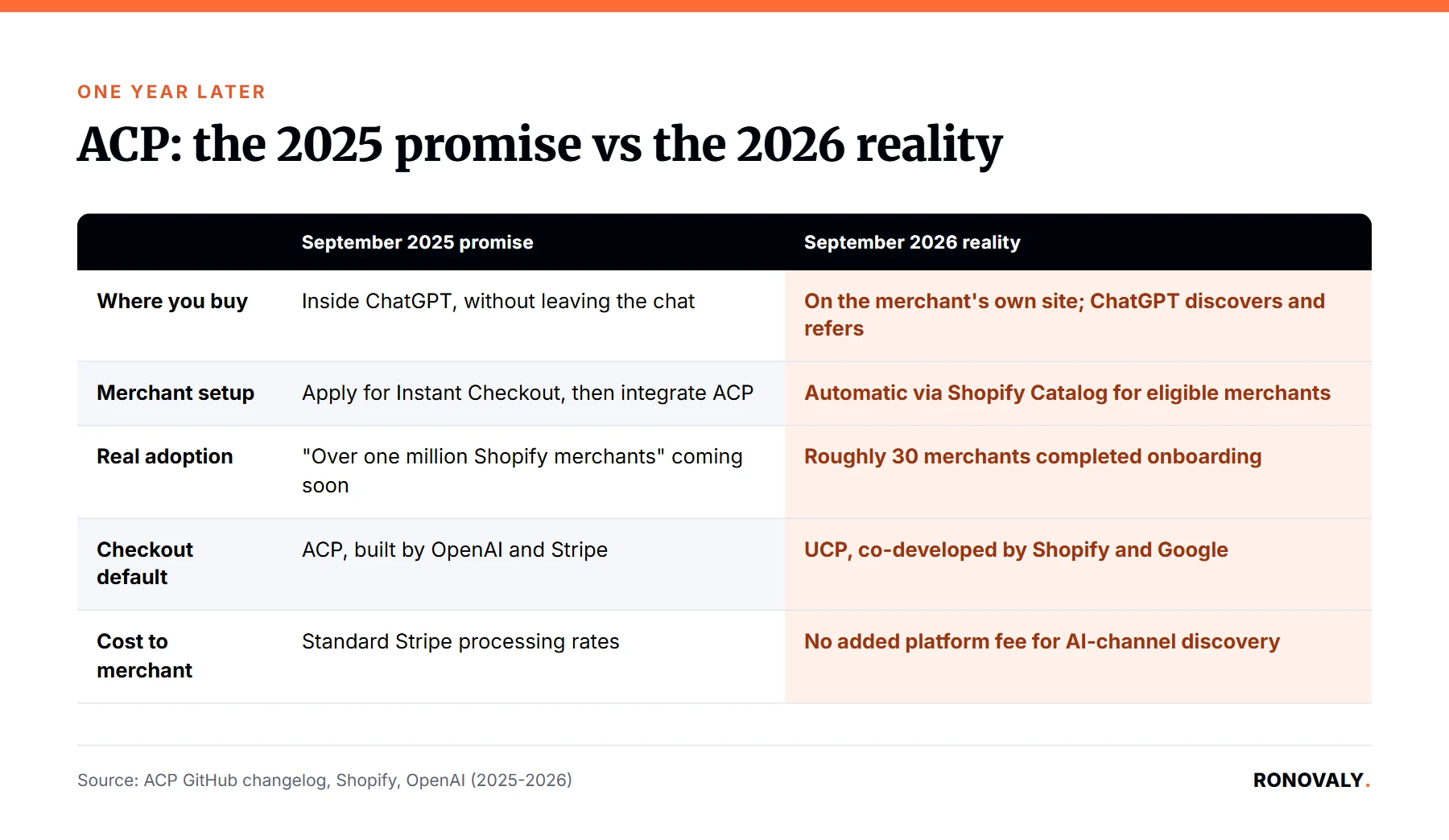
What actually changed, in one table:
| September 2025 promise | September 2026 reality | |
|---|---|---|
| Where you buy | Inside ChatGPT, without leaving the chat. | On the merchant’s own site; ChatGPT only discovers and refers. |
| Who built it | OpenAI plus Stripe (ACP), with Shopify and Etsy as launch partners. | ACP is still active infrastructure; Shopify’s checkout default is UCP, co-built with Google. |
| Merchant setup | Apply for Instant Checkout access, then integrate against ACP. | Automatic, via Shopify Catalog; no manual setup for eligible merchants. |
| Real adoption | “Over one million Shopify merchants” announced as coming soon. | Roughly 30 merchants ever completed Instant Checkout onboarding. |
| Cost to merchant | Standard Stripe processing rates. | No added platform fee for AI-channel discovery. |
What This Means for Agentic Commerce Protocol Shopify Merchants
For agentic commerce protocol shopify merchants specifically, the immediate impact is simple: you were never the bottleneck. Shopify Catalog already feeds ChatGPT, Copilot, and Google’s AI surfaces. It works whether or not ACP-powered in-chat checkout ever existed.
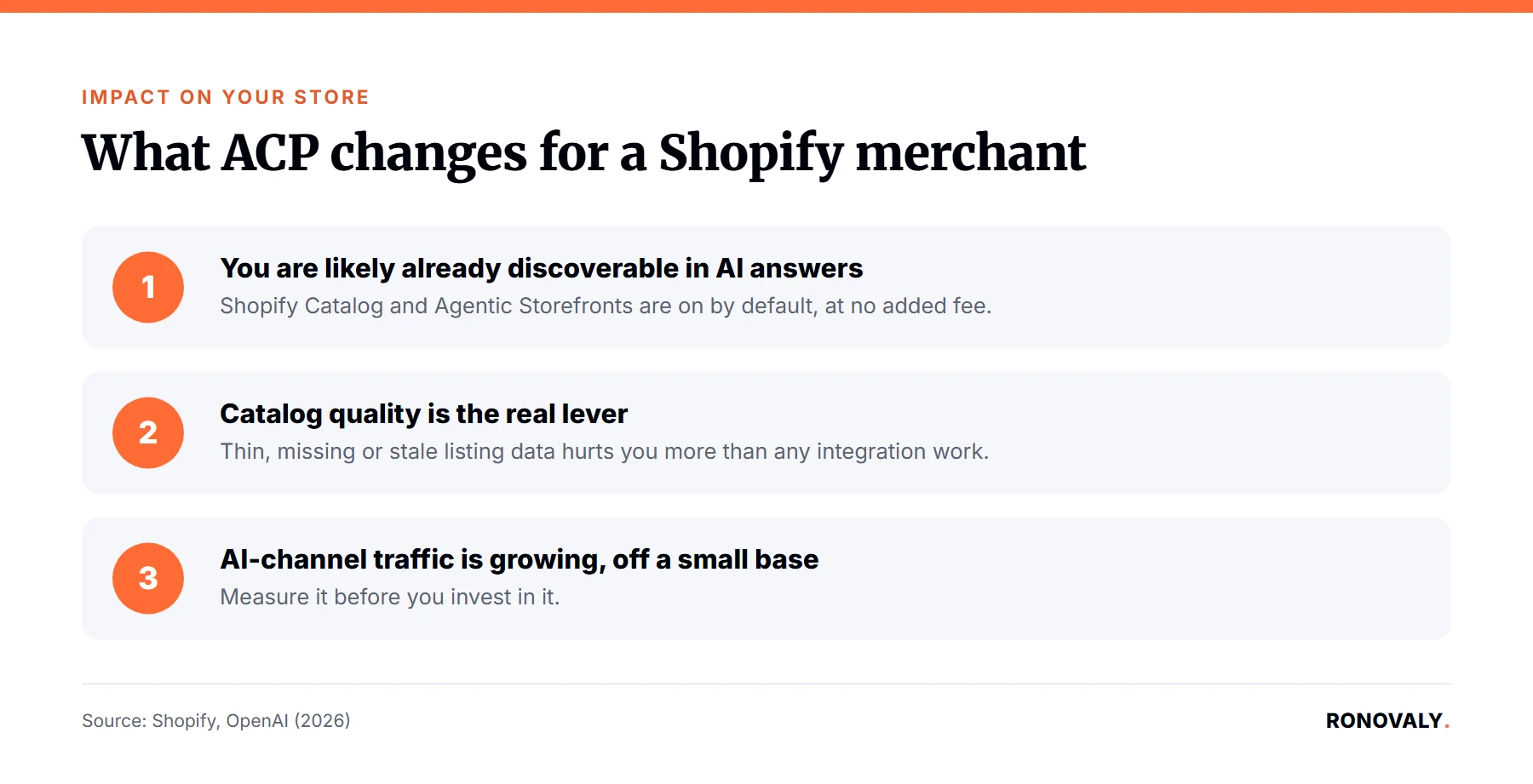
Impact 1: Your store is likely already discoverable in AI answers
If you sell on Shopify and your products are eligible, Shopify Catalog syndicates your listings automatically. No app install is required (Shopify, 2026). However, do not just assume you are opted in. Check the Agentic Storefronts dashboard in Shopify Admin to confirm it yourself.
Impact 2: Catalog quality is now your real lever, not integration work
Here is a stat worth sitting with: Shopify reports that AI searches powered by structured Catalog data convert at roughly twice the rate of AI answers pulling from scraped, unstructured data. In other words, the fastest win available to you is not code. It is cleaning up titles, images, and availability data, the same inputs that already feed your regular SEO. For example, a stale “out of stock” flag or a thin product title can silently cost you an AI-sourced sale. My AI SEO guide for Shopify covers that overlap between classic SEO and AI-citation readiness in more detail.
Impact 3: Traffic from AI channels is growing, but off a small base
Shopify measured AI-driven traffic to its stores growing 8x year over year in Q1 2026. AI-search orders were up nearly 13x, and new buyers arriving through AI channels ordered at almost twice the rate of other channels (Shopify, 2026). Two named merchants illustrate the range. Omnilux saw AI channels reach 3.2 percent of March 2026 revenue. In contrast, Cozy Earth reported 20x year-over-year revenue growth from AI channels specifically (Shopify Newsroom, June 17, 2026). In fact, both numbers are real, but neither is a majority channel yet. As a result, treat this as a growing input, not a strategy replacement.
What to Do Now
Here are three tiers of action, ordered by what actually deserves your time this quarter. I built this directly from the dated facts above, not from a vendor’s roadmap.
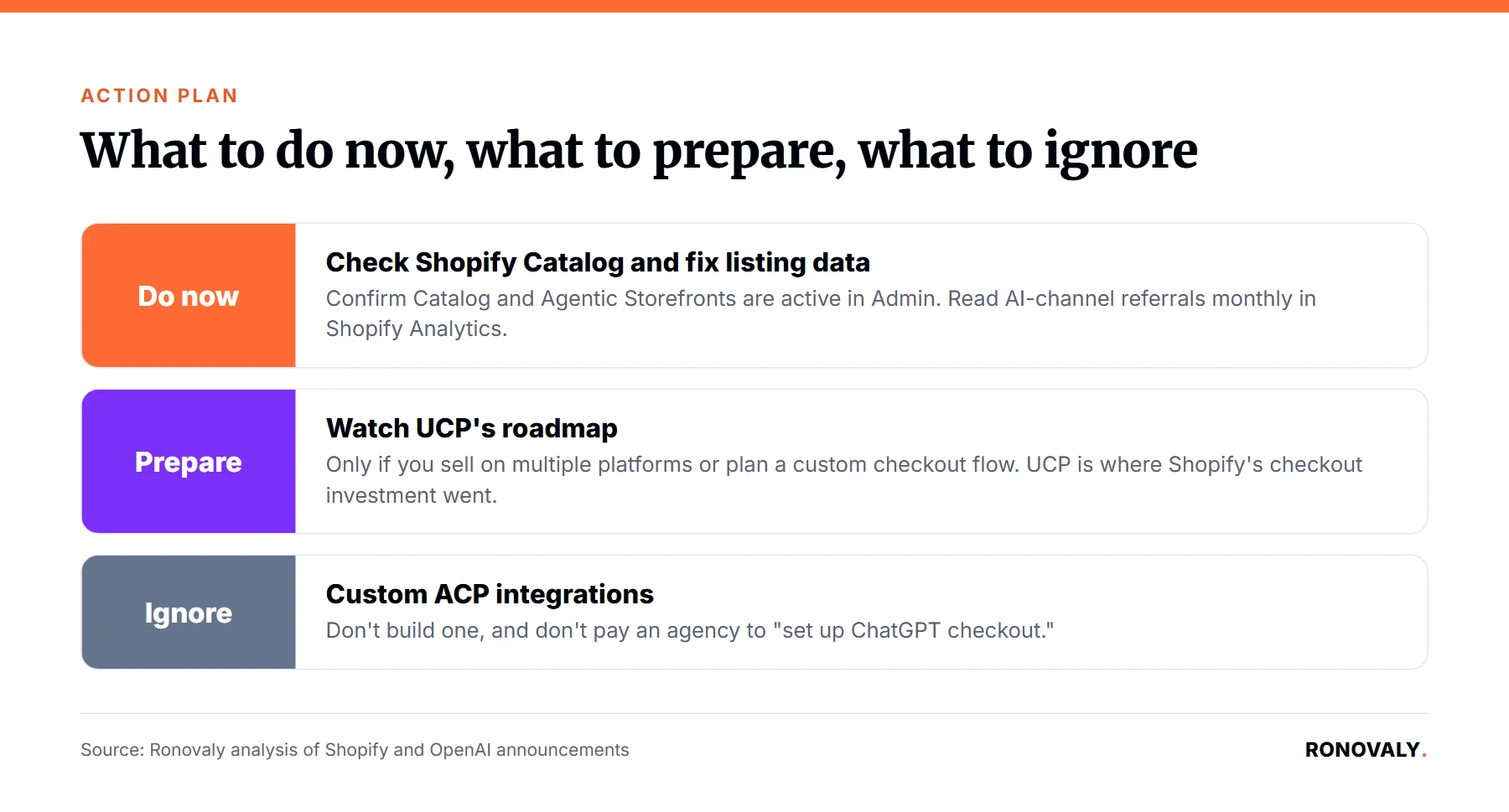
| Priority | Action | Why |
|---|---|---|
| Do now | Confirm Shopify Catalog and Agentic Storefronts are active in Admin; fix thin, missing, or stale listing data. | This is free and already live. Bad data is the only thing stopping it from working for you. |
| Do now | Read your AI-channel referral data monthly, in Shopify Analytics. | You cannot judge a new channel you are not measuring. |
| Prepare, do not build yet | Watch UCP’s roadmap if you sell on multiple platforms or plan a custom checkout flow. | UCP, not ACP, is where Shopify’s checkout investment is actually going. |
| Ignore for now | Building a custom ACP integration, or paying an agency to “set up ChatGPT checkout.” | The in-chat checkout product that used ACP for Shopify sellers no longer exists to integrate with. |
Do NOT:
– Hire an agency to build agentic checkout infrastructure Shopify already gives you for free.
– Assume “agentic commerce” is dead just because Instant Checkout was retired. In fact, AI-channel traffic and orders are still growing.
The Bigger Picture
So where does this actually settle? 2026 fell into the same pattern AI search has followed elsewhere: AI handles discovery, and the merchant keeps checkout. Consider OpenAI’s eight named retail partners under the new model: Walmart, Target, Sephora, Nordstrom, Lowe’s, Best Buy, Home Depot, and Wayfair. Notably, every one of them keeps its own checkout. Walmart’s “Sparky” assistant, for instance, supports account linking and loyalty points without ever completing the sale inside ChatGPT (Enterprise DNA, March 2026).
In fact, that pattern is the real signal worth watching, more than any single protocol’s name. Want a fuller framework for weighing AI-driven changes? I laid one out in my guide to AI-driven decision making for Shopify founders.
Related guides: for next steps, see how to get your products into Perplexity Shopping.
Frequently Asked Questions
What is the Agentic Commerce Protocol (ACP)?
ACP is an open standard released by OpenAI and Stripe under Apache 2.0 on September 29, 2025. It lets an AI agent collect a buyer’s payment choice and hand a scoped token to a merchant to charge. It is infrastructure, not a single feature. In fact, it has kept shipping updates through at least April 2026.
Is ChatGPT’s Instant Checkout still available for Shopify merchants?
No. OpenAI retired Instant Checkout on March 24, 2026, about six months after launch, after in-chat checkout converted roughly three times worse than a click-through to a merchant’s own site. As a result, ChatGPT now serves as a discovery layer that routes buyers to the merchant’s own checkout instead.
What is the difference between ACP and Shopify’s Universal Commerce Protocol (UCP)?
ACP was built by OpenAI and Stripe; UCP was co-developed by Shopify and Google, announced January 11, 2026. As of Shopify’s Spring ’26 Edition, UCP, not ACP, is the protocol Shopify actually runs by default for discovery-to-checkout across its AI-channel integrations.
Do I need to set anything up to appear in ChatGPT, Copilot, or Gemini?
Usually not. Shopify Catalog and Agentic Storefronts are enabled by default for eligible merchants, with no app, integration, or added fee. Check the Agentic Storefronts dashboard in Shopify Admin to confirm your store is opted in and your listing data is complete.
Should a small Shopify brand build a custom ACP integration right now?
No. The Instant Checkout product that used ACP for Shopify sellers was retired in March 2026 after fewer than 30 merchants ever completed onboarding. There is currently no live in-chat checkout surface for a small Shopify brand to integrate against. As a result, that engineering time is better spent on catalog quality.
Sources
- Stripe, “Developing an open standard for agentic commerce”, Stripe, September 29, 2025.
- Marketing Dive, “ChatGPT lets shoppers buy products within the platform”, Dani James, September 30, 2025.
- GitHub, agentic-commerce-protocol README and changelog, accessed September 8, 2026.
- CNBC, “OpenAI revamps shopping experience in ChatGPT after Instant Checkout,” March 24, 2026. Corroborated via TechInformed and The Keyword, both March 2026.
- Enterprise DNA, “OpenAI Kills Instant Checkout. Here’s What Won.”, citing CNBC reporting, March 31, 2026.
- Search Engine Land, “Walmart: ChatGPT checkout converted 3x worse than website”, Danny Goodwin, March 19, 2026. It cites Walmart EVP Daniel Danker’s statement to Wired. The new-customer-rate figure is corroborated via Digital Applied.
- Shopify Newsroom, “Agentic commerce momentum”, March 24, 2026.
- Shopify, “Universal Commerce Protocol”, accessed September 8, 2026.
- Shopify Newsroom, “Selling everything, everywhere, all at once: The Spring ’26 Edition”, June 17, 2026.
- Shopify, “Agentic Commerce on Shopify: How It Works”, 2026.
This article’s schema.org structured data lives in a separate sidecar file, not inline, per this site’s publishing setup.
Next Steps
Check the Agentic Storefronts dashboard in Shopify Admin today. Confirm your listing data is clean, and read your AI-channel referrals monthly. Skip any pitch to build custom ACP checkout infrastructure until a live in-chat checkout surface for Shopify sellers actually exists again. One agentic checkout surface is already live on Meta’s apps: here’s how Shopify’s Meta direct checkout works and when to turn it off. Another is live in Google AI Mode and Gemini: see what stops working in Shopify Google AI Mode checkout. Want to go deeper on measuring whether your store even shows up in AI answers at all? I compared the tools for that directly in AI visibility monitoring tools for Shopify DTC brands.
I’m Alex Carter, and I cover AI tools, automation, and platform strategy for Shopify and DTC brands at Ronovaly. In fact, I track protocol changes like this one against primary sources before I write about them, not just the trade-press summary. Notably, every statistic in this piece is fact-checked against its named source before publish. You can read more about how I verify what I cover on my About page.
This post contains affiliate links. If you make a purchase through these links, we may earn a commission at no extra cost to you.