Triple Whale Review 2026: Is It Worth $149/Month for DTC Brands?
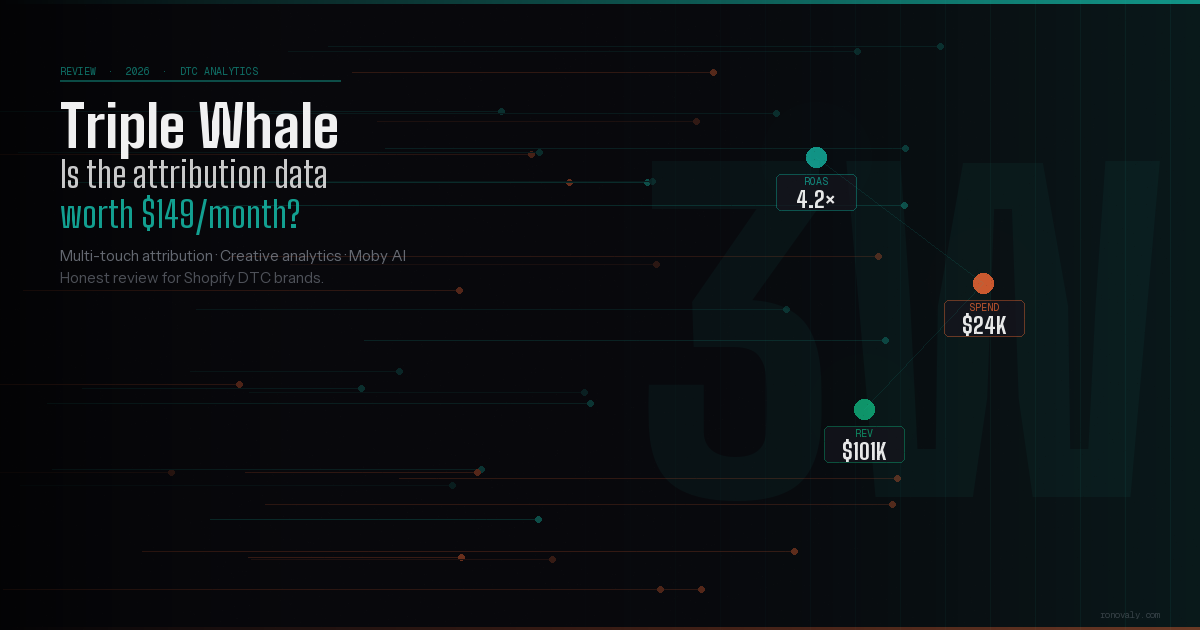
Triple Whale promises to fix your attribution problem and surface the insights buried in your ad data. Here’s what it actually delivers — and where it falls short.
Analytics tools only pay off when they feed a clear decision process. The AI decision-making guide for Shopify DTC founders covers how to turn data into action.
If you run paid ads for a Shopify store in 2026, you know the problem. Meta’s attribution says one thing, Google says another, and your real revenue matches neither. You end up making budget calls on data you don’t fully trust.
Triple Whale was built to solve exactly that. It’s an analytics and attribution platform designed for DTC brands on Shopify, and one of the most talked-about tools in the space. For a wider view of the analytics landscape, see how DTC brands use AI analytics to cut CAC and grow LTV.
But at $149/month for the entry paid plan, it’s a real investment. This review covers what you get, who it’s worth it for, and where it falls short.
Review Score
-8.8 Attribution Accuracy
-8.5 Creative Analytics
-7.8 Ease of Use
-7.2 Value for Money
-9.0 Shopify Integration
Bottom line: Triple Whale is a strong attribution tool for DTC brands spending $15K+/month on ads. Below that, the price is harder to justify. Above it, better budget decisions can cover the cost.
Table of Contents
What is Triple Whale?
Triple Whale is an analytics and attribution platform built only for Shopify brands. It was founded in 2021, just after iOS 14 had crippled Facebook’s pixel tracking and DTC founders were flying blind on ad performance.
Its core pitch: replace the scattered data from Meta, Google, TikTok, and Shopify with one dashboard that shows what’s really driving revenue.
It does this through its own first-party pixel (the Triple Pixel), which tracks customer journeys independently of platform-reported attribution. This is the foundational insight that makes Triple Whale different from just using Shopify’s built-in analytics or a spreadsheet.
The platform has since added creative analytics, cohort analysis, AI insights, and an AI assistant called Moby. Attribution is still the core of what it offers.
Triple Whale Features: What You Actually Get
Triple Pixel — First-Party Attribution
This is Triple Whale’s flagship feature. The Triple Pixel is a first-party tracking script that sits on your Shopify store and records customer journeys server-side. Unlike Meta’s pixel, it’s not subject to iOS tracking restrictions.
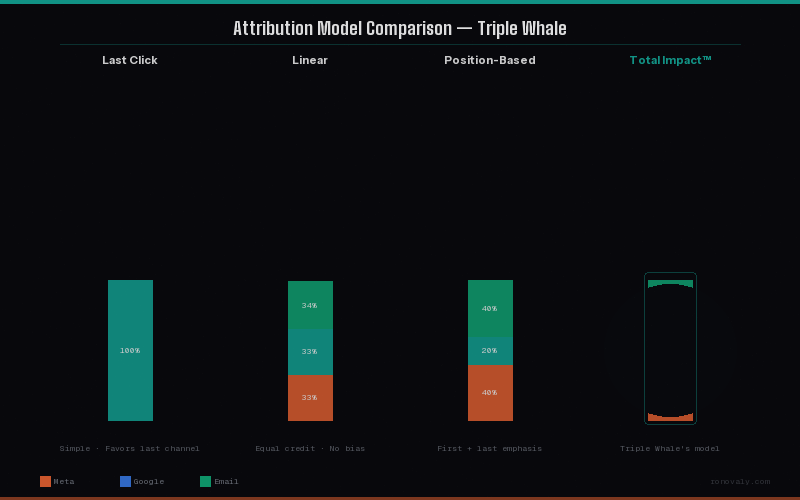
It offers several attribution models (Last Click, Linear, Position-Based, and its own Total Impact™ model), so you can compare how each one splits credit across your channels. A sensible approach is to use one model consistently for budget decisions and Last Click as a cross-check at channel level.
Summary Dashboard
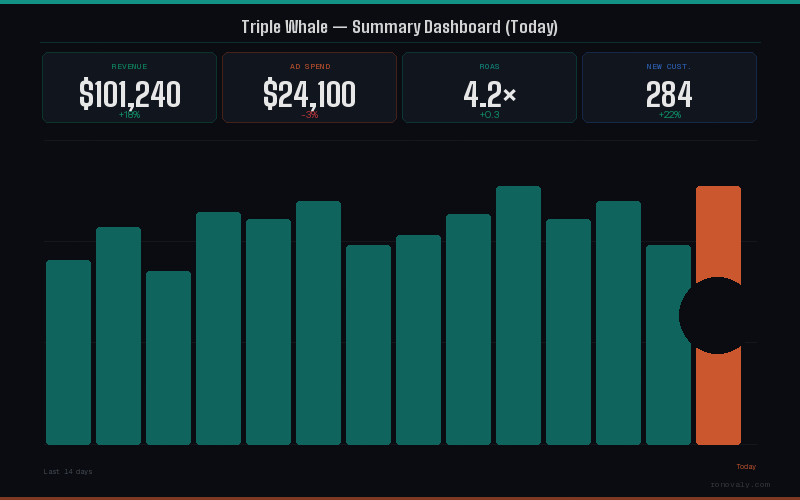
The Summary page is the first thing you see when you open Triple Whale. It shows your key metrics for the day: revenue, ad spend, ROAS, new vs. returning customers, and AOV — all in one view, pulling from Shopify and your ad platforms simultaneously.
For a founder who previously needed to open 4 tabs to get this picture, it’s genuinely useful. The data refreshes every hour, which is fast enough for most use cases (real-time is available on higher plans).
Creative Cockpit
The Creative Cockpit shows you ad-level performance — which images, videos, and copy combinations are actually driving results. It pulls directly from Meta and TikTok, letting you sort by ROAS, CPA, spend, and revenue at the individual creative level.
If you’re running 20+ active ad variations, this feature alone can save significant time. Instead of digging through Meta Ads Manager, you get a clean ranked view of what’s working.
Cohort Analysis
Triple Whale’s cohort analysis tracks groups of customers acquired in a given period and shows how their LTV grows over time. You can split by channel, product, or campaign. That’s the right way to judge whether your acquisition cost is really justified.
This is especially useful for brands with repeat purchase products (supplements, skincare, consumables). It answers the question: “Customers acquired from this Meta campaign — do they come back?”
Moby AI
Moby is Triple Whale’s AI assistant. You can ask it things like “Which ad set had the best ROAS last week?” or “Show me my top 5 products by new customer revenue this month,” and it answers from your store’s data.
In practice, Moby is useful for quick lookups and reducing time-to-insight, but it’s not a replacement for understanding the underlying data. Think of it as a shortcut, not a strategist. It has improved significantly since launch but still occasionally surfaces answers that require verification.
💡 Already using Rebuy for upsells? Pairing Rebuy’s AOV lift with Triple Whale’s attribution shows which channels bring your highest-LTV customers, not just first-order revenue.
Triple Whale Pricing (2026)
Triple Whale’s pricing is tiered and scales with your store’s annual revenue, so your price may differ from the figures below. Confirm your tier on Triple Whale’s pricing page before you commit. Here’s how the tiers were listed:
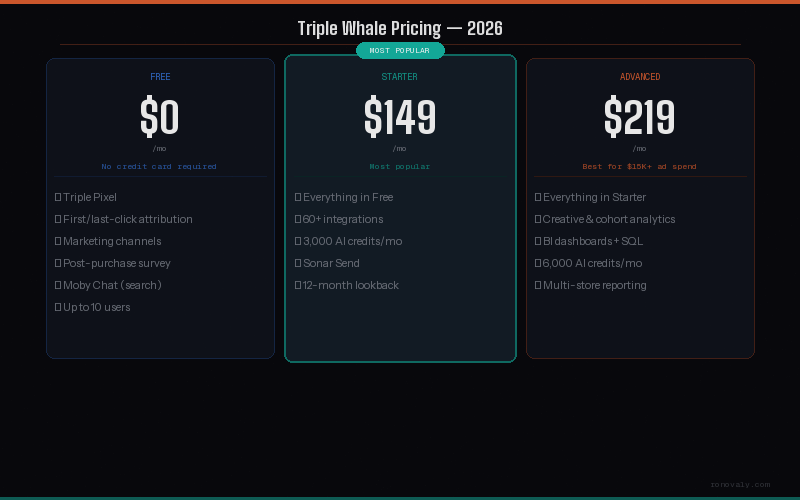
Free
$0 / mo
Test the core product — no credit card needed
- Triple Pixel (first-party tracking)
- First/last-click attribution
- Marketing channel performance
- Post-purchase survey (standard)
- Moby Chat (search only)
- Up to 10 users
MOST POPULAR
Starter
$149 / mo
For growing DTC brands scaling ad spend
- Everything in Free
- Attribution across 60+ integrations
- 3,000 monthly AI credits
- Sonar Send
- 12-month lookback
Advanced
$219 / mo
For data-driven brands needing deep analytics
- Everything in Starter
- Creative & cohort analytics
- BI dashboards + SQL access
- 6,000 monthly AI credits
- Sonar Optimize
- Multi-store reporting
Triple Whale now has a free plan that includes the Triple Pixel and basic attribution, so you can check the data before paying. Creative and cohort analytics sit on a higher tier.
Who Should Use Triple Whale
✓ Good fit
- Spending $15K+/month on paid ads
- Running Meta + Google + TikTok simultaneously
- Repeat purchase product (LTV matters)
- Team making daily budget decisions
- Post-iOS 14 attribution is broken for you
✗ Poor fit
- Under $5K/month in ad spend
- Single ad channel (Meta only)
- One-time purchase product, no repeat
- Early-stage store (not enough data volume)
- Budget is the main constraint
The clearest sign Triple Whale is right for you: you make budget decisions across several channels and don’t fully trust any of your native dashboards. In that case, a paid tier is a fair price for clarity.
If you spend under $10K/month on ads, start with Shopify’s built-in analytics and Google Analytics 4. They won’t match Triple Whale’s attribution, but they’re free. At that spend level, Triple Whale’s signal won’t be reliable anyway.
Triple Whale: Pros & Cons
✓ Pros
- First-party pixel works post-iOS 14
- Unified view across all ad channels
- Creative Cockpit saves hours weekly
- Cohort analysis is genuinely best-in-class
- Shopify-native — setup is straightforward
- Moby AI useful for quick data lookups
- Active product development — frequent updates
✗ Cons
- $149/month entry is steep for small stores
- Creative Cockpit is on a higher tier than the entry plan
- Learning curve: expect a few weeks before you trust the data
- Moby AI still makes occasional errors
- Limited B2B or non-Shopify support
- Data can lag on lower tiers
Triple Whale vs. Alternatives
| Tool | Starting price | Attribution | Creative analytics | Best for |
|---|---|---|---|---|
| Triple Whale | $149/mo | ✓ First-party pixel | ✓ (higher tier) | $15K+ ad spend DTC |
| Northbeam | ~$500/mo | ✓ Multi-touch | Partial | Enterprise DTC ($50K+ spend) |
| Elevar | $150/mo | ✓ Server-side | ✗ | Tracking accuracy focus |
| Shopify Analytics | Free | Basic | ✗ | Stores under $10K/mo spend |
| Google Analytics 4 | Free | Last-click only | ✗ | SEO + basic reporting |
Northbeam is often seen as more powerful than Triple Whale at the enterprise level. It’s priced higher and aimed at brands with much larger ad budgets. For the $15K to $50K spend range, Triple Whale is usually the better value.
Elevar is worth considering if your primary goal is fixing tracking accuracy (server-side tagging) rather than analytics. It’s a different category of tool.
The Verdict: Is Triple Whale Worth It in 2026?
For DTC brands spending $15,000/month or more on paid ads, yes, Triple Whale is worth it. Better attribution can change budget decisions enough to outweigh the subscription.
Here’s a simple illustration. A brand spending $20K/month on ads that gains even 5% in ROAS from better decisions gets back $1,000/month in ad efficiency. That alone would cover the entry plan.
Below $10K/month in ad spend, it’s harder to justify. There won’t be enough data for the attribution models to be reliable, and Shopify’s analytics plus GA4 will tell you most of what you need.
If you’re in the $10K to $15K range, start with the free plan, connect your ad accounts, and see whether the attribution data really challenges your current assumptions. If it does, the tool is earning its place. If everything matches your native dashboards, you may not need it yet.
For more analytics and AI tools worth adding to your Shopify stack, see our guide to the best AI tools for Shopify stores in 2026.
Try Triple Whale free for 14 days
No credit card required. Connect your Shopify store and ad accounts, and see if your attribution data changes how you read your results. See Triple Whale’s plans →
See how Triple Whale fits into your stack → best AI tools for Shopify
Triple Whale feeds into a bigger strategy: AI-driven decision making for Shopify DTC founders.
Related guides: for next steps, see which AI visibility monitoring tool is worth paying for, including Triple Whale’s free ChatGPT tracking; whether a small store should test ChatGPT Ads, with break-even math; how accurate AI demand forecasting really is by catalog type.
Frequently Asked Questions
Does Triple Whale work with Shopify’s native analytics?
Yes. Triple Whale pulls data from Shopify and sits alongside it. It doesn’t replace your Shopify dashboard. It adds multi-touch attribution and ad platform data that Shopify doesn’t have. Most founders use both: Shopify for revenue and orders, Triple Whale for channel attribution and ad decisions.
How accurate is Triple Whale’s attribution compared to Meta’s?
Since iOS 14, Meta’s own attribution tends to give its platform generous credit. Triple Whale’s first-party pixel and Total Impact™ model spread credit across touchpoints, so Meta’s ROAS often looks lower in Triple Whale. The number is less flattering, but it’s a more useful basis for budget decisions.
Is Triple Whale worth it for a brand just starting to run ads?
Not yet. Triple Whale needs enough data to produce useful attribution signals. If you spend under $5K/month on ads, the insights won’t be actionable. Start with GA4 and Shopify Analytics, grow your ad spend to $10K+/month, then test Triple Whale on its free plan.
Can Triple Whale track TikTok and Pinterest ads?
Yes. Triple Whale integrates with Meta, Google, TikTok, Pinterest, Snapchat, and other platforms. Which features you get depends on your plan, so check the tier details on Triple Whale’s pricing page. Multi-touch attribution becomes most valuable once all your ad channels are connected.
What’s the difference between Triple Whale and Northbeam?
Both are DTC analytics platforms with first-party attribution. Northbeam is often seen as more granular, but it’s priced higher and aimed at brands with much bigger ad budgets. Triple Whale is usually the better fit for the $15K to $50K monthly ad spend range. At enterprise scale, Northbeam is worth a look.
This post contains affiliate links. If you make a purchase through these links, we may earn a commission at no extra cost to you.