AI Visibility Monitoring Tools Shopify DTC Brands Compared
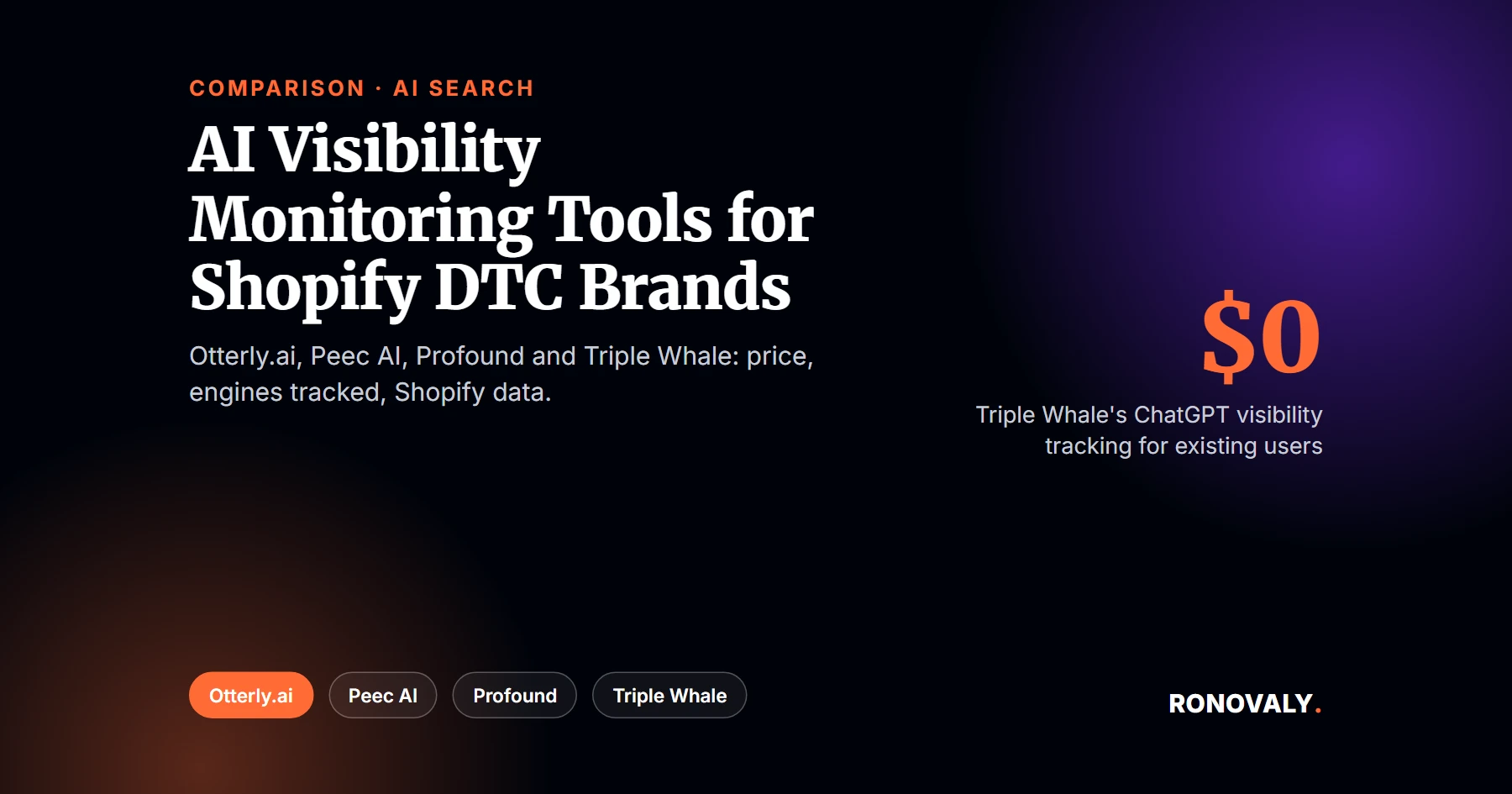
AI visibility monitoring tools shopify brands can pay for range from free to $1,000 a month. The right pick depends on how many AI engines you need tracked, and whether your existing Shopify analytics already covers the basics for free. Shopify changed how it connects to ChatGPT twice in the past year. First, OpenAI announced Instant Checkout for over a million Shopify merchants on September 29, 2025. Then, on March 17, 2026, Shopify shifted the model. Products now surface inside ChatGPT through its Global Catalog, while checkout stays on your own storefront, according to Digital Commerce 360. In other words, your catalog is already showing up inside ChatGPT, whether you’re watching it or not.
AI visibility monitoring is the practice of tracking whether AI answer engines mention or cite your brand inside a generated answer, specifically engines like ChatGPT, Perplexity, and Google AI Overviews. That’s different from tracking where your page ranks in a list of blue links. This shift matters for a practical reason too. Specifically, AI-referred traffic to U.S. retail sites grew 138 percent year over year in May 2026. That traffic also converted 54 percent better than non-AI traffic, per Adobe Analytics data reported by Digital Commerce 360 (2026). For a lean team, the tension is simple. Dedicated AI visibility tools cost real money every month. However, the Shopify analytics platform you might already run may cover the basics for free.
I spent this week pulling every tool’s own pricing page. For the two that blocked automated access, I cross-checked their numbers against independent 2026 reviews instead of guessing. I also mapped what each tool actually gives a Shopify DTC brand, not just what it promises a generic B2B marketing team. This comparison covers four tools: Otterly.ai, Peec AI, Profound, and Triple Whale’s built-in AI Visibility module. For the broader strategy, my colleague’s AI SEO guide for ranking on Google and getting cited by ChatGPT covers why AI citations matter to a Shopify store first. Then, come back here to pick a tool.
Key Takeaways
- Otterly.ai’s Lite plan starts at $29 a month for 15 daily-tracked prompts across ChatGPT, Google AI Overviews, Perplexity, and Microsoft Copilot. Notably, that’s the cheapest real entry point among the four.
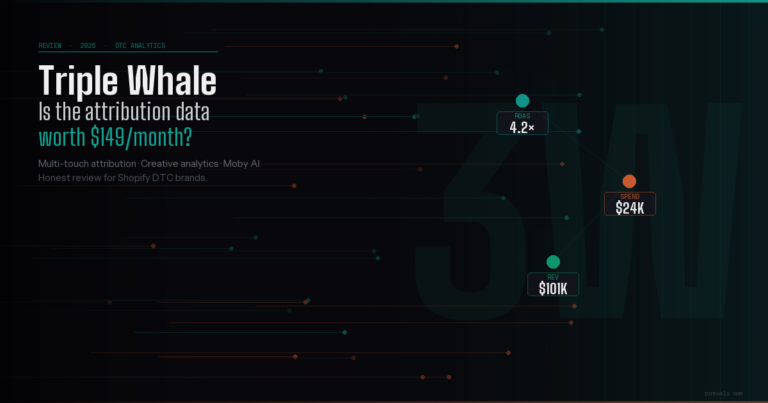
- Triple Whale’s ChatGPT AI Visibility tracking is free if you already run its Shopify analytics platform. Multi-LLM tracking, however, requires its paid Foundation tier starting at $219 a month.
- Profound’s Starter plan tracks ChatGPT only, for $99 a month. In contrast, its Growth plan jumps to $399 a month for 3 engines, positioned for teams running active answer-engine campaigns, not casual monitoring.
- Peec AI includes 3 engines (ChatGPT, Perplexity, Google AI Overviews) starting around €85 to €89 a month. Notably, extra models like Claude and Gemini are billed as separate add-ons.
- 73 percent of marketers say they’ve already invested in AI visibility tools. Yet 71 percent still aren’t tracking share of voice against competitors, per a Scrunch AI and Scribewise 2026 survey reported by Digiday. In short, buying the tool isn’t the same as using it.
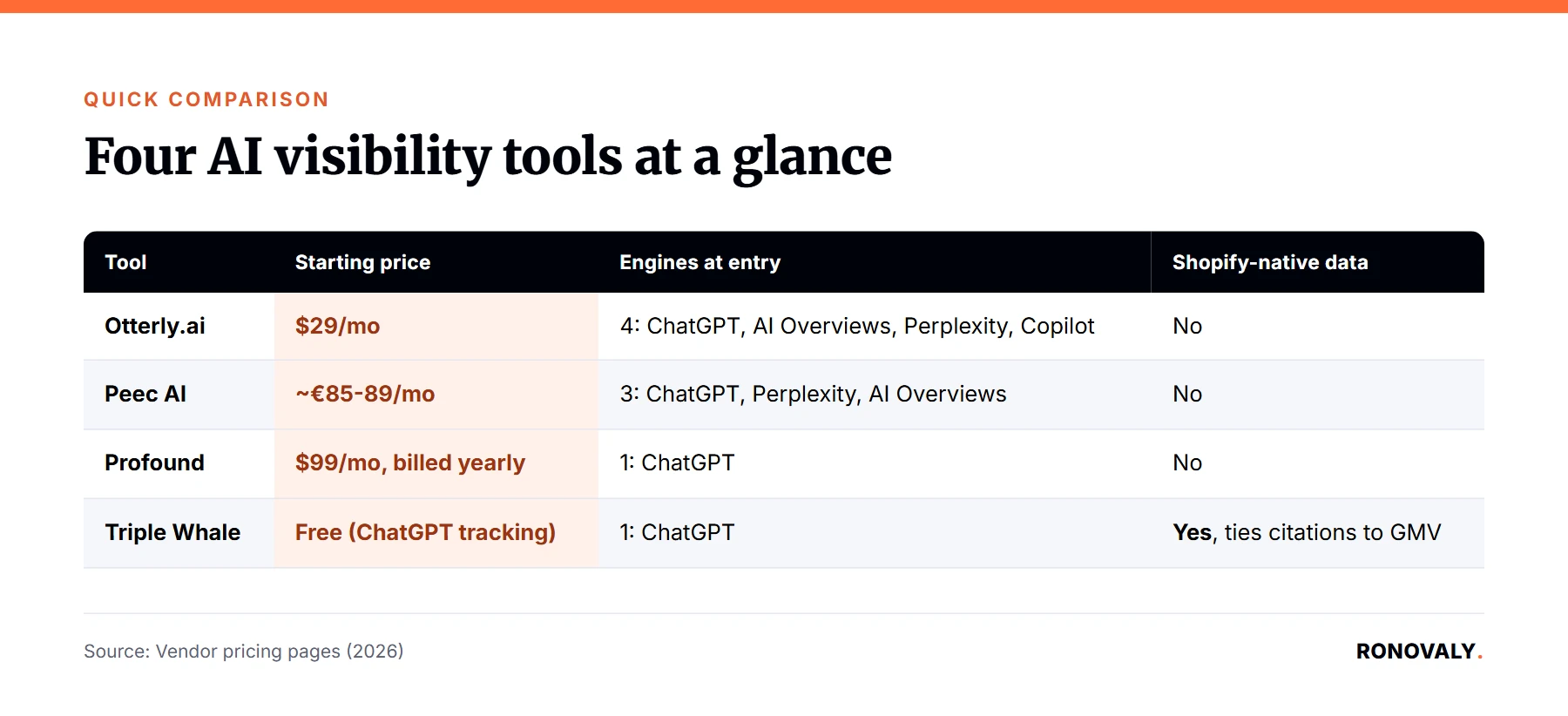
Quick Comparison Table
| Category | Otterly.ai | Peec AI | Profound | Triple Whale AI Visibility |
|---|---|---|---|---|
| Best For | Solo founders testing the waters | Teams wanting 3+ engines out of the gate | Brands running active AEO campaigns | Shopify stores already on Triple Whale |
| Starting Price | $29/month (Lite) | ~€85-89/month (Starter) | $99/month (Starter, billed yearly) | Free (ChatGPT tracking) |
| Mid Tier | $189/month (Standard) | ~€199-205/month (Pro) | $399/month (Growth) | $219/month (Foundation, GMV-scaled) |
| Top Self-Serve Tier | $489/month (Premium) | ~€425-499+/month (Advanced) | Enterprise (custom) | $749/month (Automate, GMV-scaled) |
| Engines at Entry Tier | 4 (ChatGPT, AI Overviews, Perplexity, Copilot) | 3 (ChatGPT, Perplexity, AI Overviews) | 1 (ChatGPT only) | 1 (ChatGPT, free) |
| Max Engines Available | Up to 7 with add-ons | 6-7 with paid per-model add-ons (~€30-140 each) | Up to 9 (Enterprise: Claude, Gemini, Grok, DeepSeek, Copilot, and more) | Multi-LLM (Gemini, Claude, more) on paid tiers |
| Shopify-Native Data | No | No | No | Yes, ties citations to attribution/GMV |
| Our Verdict | Winner: cheapest real start | Strong runner-up for breadth | Best for dedicated AEO teams | Winner: best free floor |
I checked pricing directly on each vendor’s page on September 1, 2026, except Peec AI and Triple Whale. Their pricing pages blocked automated fetch. So instead, I corroborated the figures against multiple independent 2026 reviews (sources listed at the end).
Which Tool Tracks the Most AI Engines?
Profound wins on raw engine coverage. At its Enterprise tier, it tracks up to 9 answer engines: ChatGPT, Perplexity, Claude, Gemini, Grok, Microsoft Copilot, DeepSeek, Google AI Overviews, and Google AI Mode. However, its self-serve Starter tier only covers ChatGPT for $99 a month. As a result, you pay extra to unlock the breadth that makes Profound worth choosing in the first place.
In my research, Otterly.ai covers 4 engines at its cheapest $29 tier: ChatGPT, Google AI Overviews, Perplexity, and Microsoft Copilot. It extends to 7 with add-ons. Similarly, Peec AI ships 3 engines standard, and treats every additional model, including Claude and Gemini, as a paid line item. Meanwhile, Triple Whale’s free tier is ChatGPT-only; multi-LLM tracking sits behind its $219-a-month Foundation plan.
Verdict: Profound wins on maximum breadth, but Otterly wins on breadth-per-dollar at the entry tier. If you only need to know whether ChatGPT and Google AI Overviews are citing you, you don’t need Profound’s full 9-engine stack yet.
Which Is Cheapest to Actually Start With?
Triple Whale wins on price, if you already run it. ChatGPT AI Visibility tracking ships free alongside its Shopify Pixel and basic attribution. That’s a real $0 option, not a trial.
If you’re not already on Triple Whale, Otterly.ai’s $29-a-month Lite plan is the cheapest dedicated tool. It covers 15 daily-tracked prompts across 4 engines. In contrast, Peec AI starts closer to €85 to €89 a month for similar 3-engine coverage. Profound’s $99 Starter plan looks competitive on paper, but it only tracks ChatGPT. Consequently, you’re paying more for less coverage than Otterly’s entry tier gives you.
Verdict: use Triple Whale’s free tier first if you have it, otherwise start with Otterly.ai. Neither Peec AI nor Profound make sense as a first purchase for a store under $1M ARR that just wants a baseline read.
Which Gives You Shopify-Specific Data, Not Just Generic Citations?
Triple Whale wins here by a wide margin. It’s built directly on top of your actual Shopify order and attribution data. So instead of just telling you that ChatGPT mentioned your brand, it connects that mention to the order it likely influenced. In short, that matters more to a founder than a raw citation count.
In contrast, Otterly.ai, Peec AI, and Profound are all platform-agnostic tools, built for any website, not Shopify specifically. They’ll tell you when and how often an engine cites your domain. None of the three, however, connects that citation to a specific SKU, order, or revenue figure. Instead, you’d need to build that link yourself in a spreadsheet.
Verdict: if revenue attribution matters more than raw citation counts, Triple Whale wins. If you need engine breadth Triple Whale doesn’t offer at its free tier, you’ll still need one of the other three.
Which Scales Best for a Growing Content or SEO Team?
Peec AI and Profound both win here, for different team shapes. Peec AI’s Pro and Advanced tiers are built for SEO and content teams managing multiple projects. Notably, per-project country tracking fits an operator already running structured content sprints. Profound’s Growth and Enterprise tiers, in contrast, lean toward answer engine optimization (AEO). That’s the practice of shaping content so AI engines are more likely to cite it. Its agent credits and dedicated support are built for teams actively producing AI-optimized content, not just watching a dashboard.
Otterly.ai scales too. Its Standard and Premium tiers add API and MCP access plus higher prompt volume. Still, it reads more like a monitoring tool that grew up than a full campaign platform. In contrast, Triple Whale doesn’t compete in this category at all. Its AI Visibility module is only a feature inside a broader analytics suite, not a standalone AEO tool.
Verdict: pick Peec AI if you’re SEO-led. Pick Profound if you’re actively running AEO campaigns and need agent-driven content output alongside the tracking.
Which Has the Most Honest Free or Low-Cost Tier?
Triple Whale’s free ChatGPT tracking wins outright. It’s genuinely free, with no disclosed prompt cap on the basic tier, not a time-limited trial. Otterly.ai, on the other hand, offers a 14-day free trial with no credit card required, which is generous, but still time-boxed. In contrast, Peec AI and Profound both gate their real functionality behind paid tiers from the start. Neither offers a meaningful free option beyond a demo or sales call.
Verdict: Triple Whale for a genuinely free start, Otterly for the best free-trial-to-paid on-ramp among the dedicated tools.
AI Visibility Monitoring Tools Shopify Brands Pay For: Pricing Compared
For a typical $500K to $5M ARR Shopify store, real cost ranges from $0 to roughly $200 to $400 a month. The $0 option is Triple Whale’s free ChatGPT tracking. The higher range is a mid-tier plan on Otterly, Peec, or Profound. You’ll need that higher tier once more than one or two engines matter to your reporting.
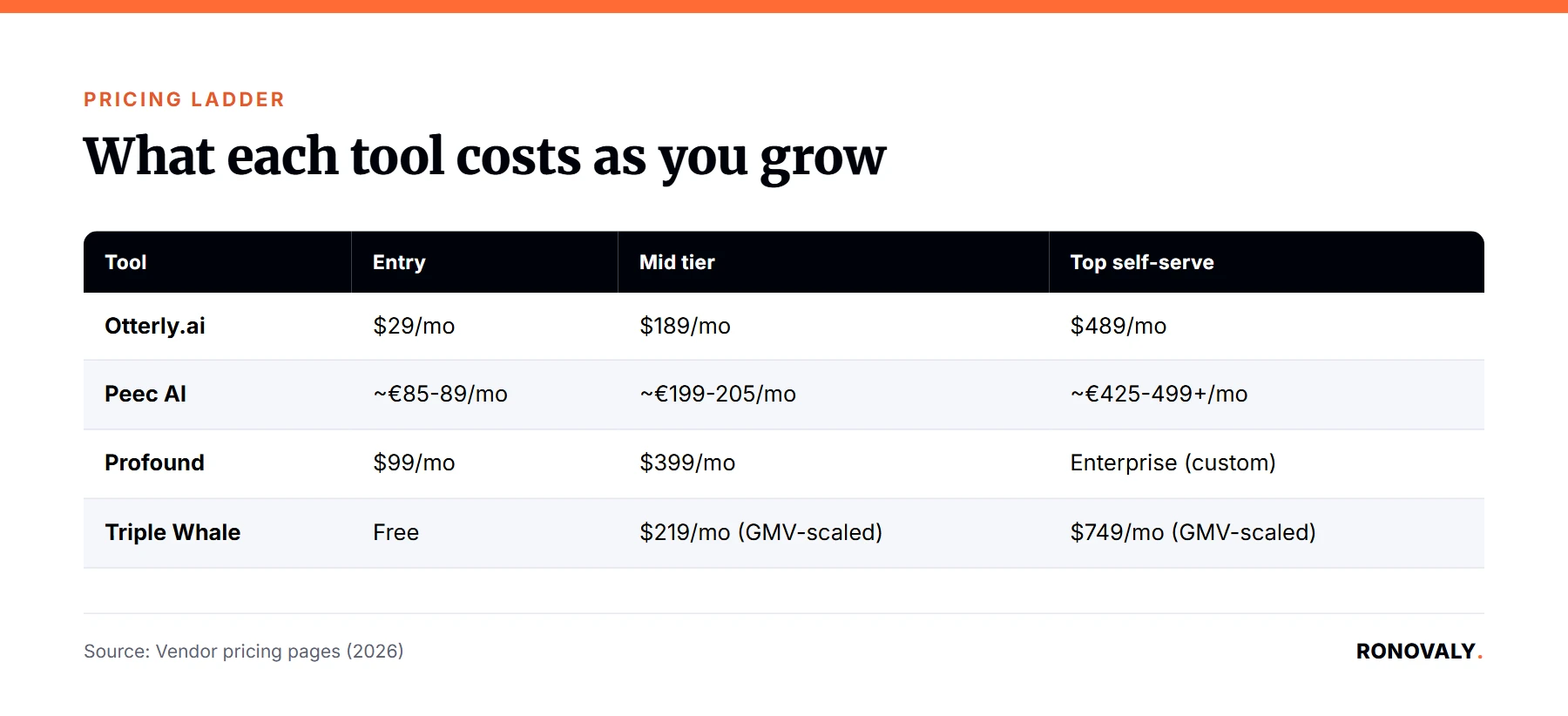
Having checked each vendor’s own numbers, the free tiers look more useful than they first appear. Triple Whale’s free ChatGPT module and Otterly’s 14-day trial both let you confirm one thing first: whether you’re being cited at all, before you commit a monthly line item. However, that’s exactly where costs sneak up too, specifically in the add-on model. For example, Peec AI’s extra engines run roughly €30 to €140 per model per month on top of the base plan. Similarly, Triple Whale’s Foundation and Automate tiers scale by your store’s GMV, not a flat number. As a result, the $219 and $749 figures are floors for the smallest qualifying stores, not fixed prices.
Value verdict: for a founder who just wants a baseline read, Triple Whale’s free tier or Otterly’s $29 plan wins on value. Peec AI and Profound only earn their higher price once you’re managing AEO across enough engines and campaigns to justify a dedicated seat. If subscription creep across your AI tool stack already worries you, check my audit of hidden Shopify AI app costs. It covers exactly the kind of add-on and usage-tier pricing that shows up here too.
Who Should Choose What
A founder who just wants to know if ChatGPT mentions their brand at all: start with Triple Whale’s free module, if you already run Triple Whale. Otherwise, try Otterly.ai’s $29 Lite plan instead. Either option answers the basic question, with no real budget commitment.
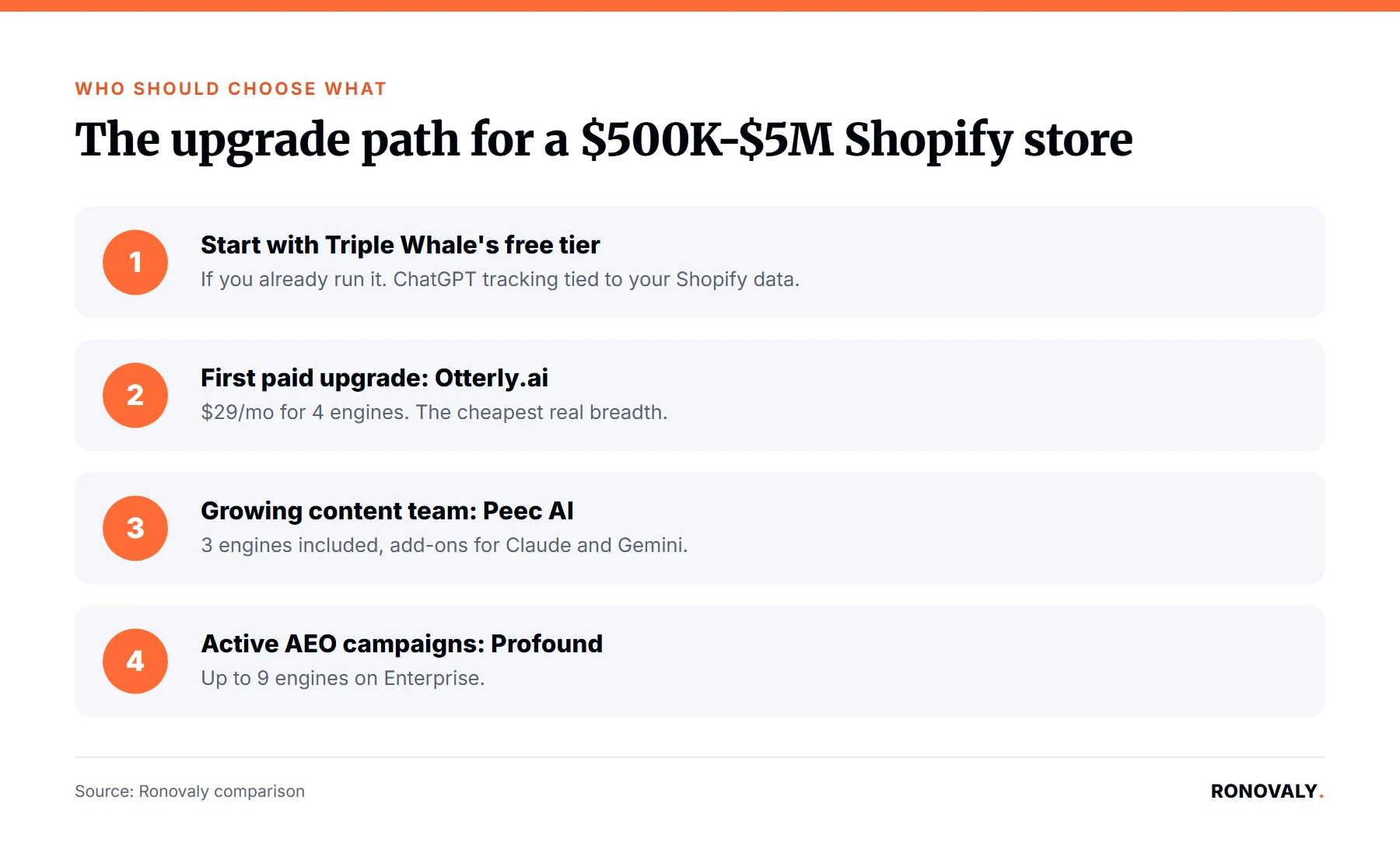
A store that already treats AI citations as a growth channel: move to Otterly’s Standard tier or Peec AI’s Pro tier once 4 or more engines matter to you. Alternatively, upgrade if you want API access to feed the data into your own reporting.
A brand actively producing AI-optimized content at scale, not just watching a dashboard: Profound’s Growth or Enterprise tier fits. Specifically, its agent credits are built for teams running ongoing AEO campaigns, not casual monitoring.
Edge case: if you’re a multi-brand portfolio or agency managing AI visibility across several Shopify stores, every vendor here offers a custom enterprise tier. Get a quote from at least two before committing, since none of them publish enterprise pricing. For the bigger picture, see my colleague’s AI-driven decision making guide for DTC founders. It covers where AI visibility fits into a founder’s overall strategy.
Related guides: for next steps, see how to optimize your Shopify store for Perplexity Shopping.
Frequently Asked Questions
What’s the difference between AI visibility monitoring and regular SEO rank tracking?
SEO rank tracking measures where your page lands in a list of blue links on Google. AI visibility monitoring, in contrast, measures something different: whether ChatGPT or Google AI Overviews mentions or cites your brand inside a generated answer. That kind of mention has no ranking position to track in the traditional sense.
Do I need a dedicated AI visibility tool if I already use Triple Whale for Shopify analytics?
Not necessarily. Triple Whale’s free tier already tracks ChatGPT AI Visibility, so check that first. A dedicated tool like Otterly, Peec AI, or Profound only makes sense once you need more engines than Triple Whale’s free tier includes. The same goes for deeper competitor share-of-voice reporting.
Which AI visibility tool tracks the most AI engines for the lowest price?
Otterly.ai’s $29-a-month Lite plan covers 4 engines: ChatGPT, Google AI Overviews, Perplexity, and Microsoft Copilot. That’s the best engine-to-dollar ratio among the four tools compared here, as of September 2026.
Can I monitor my brand’s ChatGPT visibility for free?
Yes. Triple Whale includes ChatGPT AI Visibility tracking free, as part of its base Shopify analytics platform. Otterly.ai also offers a 14-day free trial with no credit card required, if you want to test a dedicated tool first.
How often should a small Shopify DTC brand check its AI visibility?
Monthly is a reasonable starting cadence for a store under $5M ARR. That’s because AI engines refresh their training and retrieval data on their own schedule, not yours. Increase to weekly only once you’re actively testing content changes meant to influence citations.
Is Profound worth it for a store under $5M ARR?
Usually not, at the Starter tier. $99 a month only buys ChatGPT tracking, which Otterly covers more cheaply alongside 3 other engines. Profound becomes worth it once you’re running dedicated AEO content campaigns and need its Growth or Enterprise-tier agent tooling, not just a monitoring dashboard.
What counts as a “citation” versus a “mention” in these tools?
A mention is any time an AI engine’s answer references your brand name or product by name. A citation, in most of these tools, specifically means the engine linked to or named your domain as a source. In other words, a mention with no citation still shows brand awareness, but a citation sends a clickable link to your site.
Verdict with Category Winners
| Category | Winner |
|---|---|
| Engine breadth | Profound (raw coverage), Otterly (breadth per dollar) |
| Cheapest to start | Triple Whale (free), then Otterly.ai |
| Shopify-specific data | Triple Whale |
| Scales for content/SEO teams | Peec AI |
| Scales for AEO campaigns | Profound |
| Most honest free tier | Triple Whale |
| Overall (for a $500K-$5M ARR Shopify store) | Triple Whale’s free tier first, Otterly.ai as the first paid upgrade |
Overall verdict: here’s the short version, if you’re a lean Shopify DTC team choosing among these ai visibility monitoring tools shopify stores can pay for. Don’t start with the $200 to $500-a-month tools. Instead, start with what’s free (Triple Whale, if you run it) or cheapest ($29 Otterly). First, confirm you’re actually being cited somewhere. Then, upgrade to Peec AI or Profound only once engine breadth or campaign volume genuinely outgrows the entry tier.
Disagree with the ranking, or found a pricing change since September 2026? I’d want to know, since these vendors update tiers often.
I’m Alex Carter, and I write about AI tools and automation for Ronovaly. For the full context on why AI citations matter for Shopify stores right now, read my colleague’s AI SEO guide. If you’re deciding what else belongs in your AI tool stack, start with my AI productivity stack guide. You can read more about how we test and source these comparisons on our About page, or reach our editorial team through Contact. Every price in this comparison is checked against its named source before publish.
This post contains affiliate links. If you make a purchase through these links, we may earn a commission at no extra cost to you.