Shopify Meta Direct Checkout: Should You Turn It Off?
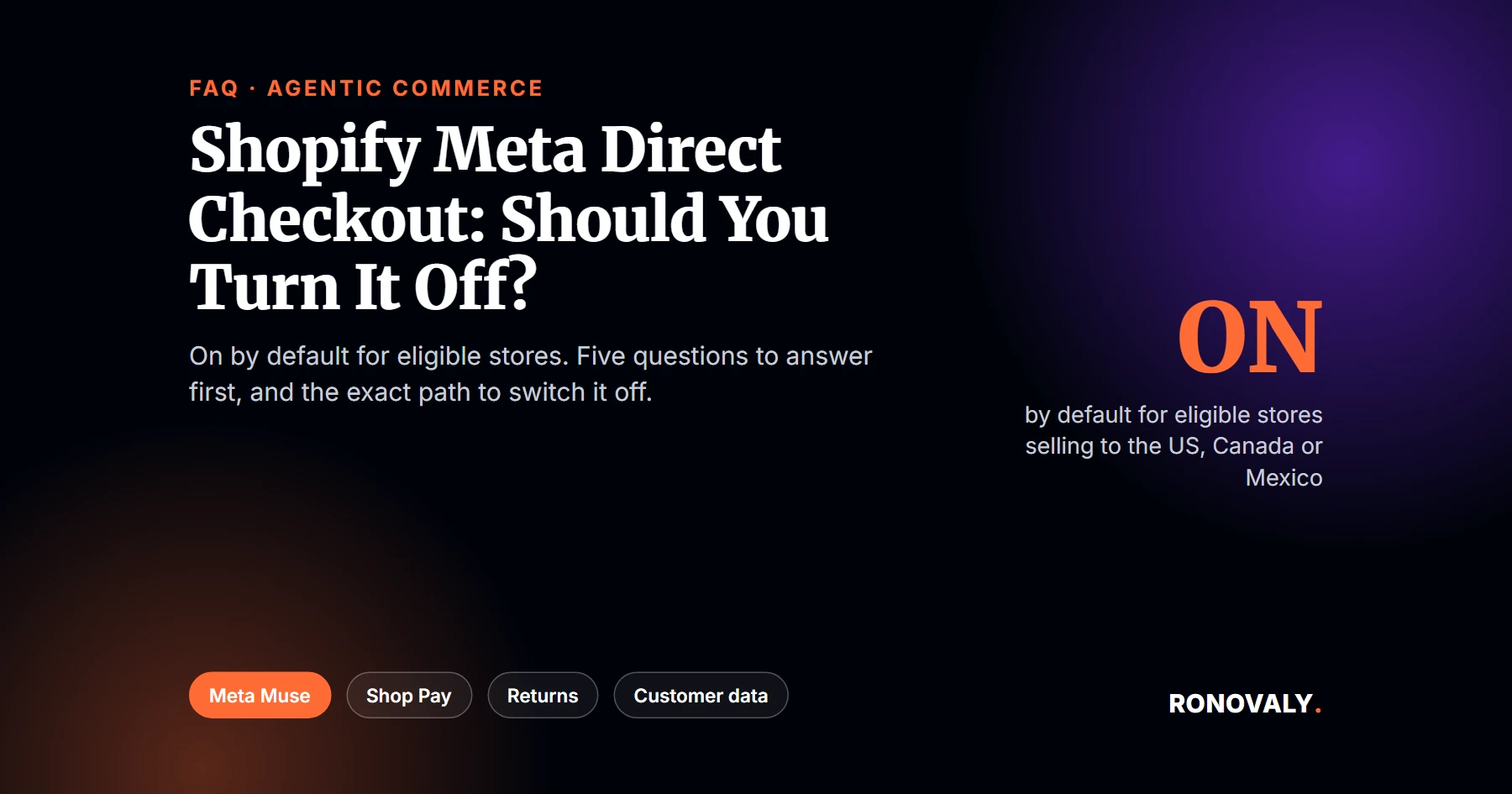
Shopify Meta direct checkout lets shoppers buy your products inside Meta’s apps, including its new Muse AI agent, without visiting your store. It’s switched on by default for eligible stores, according to Shopify’s Help Center. Should you leave it on? For most stores, yes, but only after checking five things. And if you decide against it, turning it off takes five clicks.
Meta direct checkout is a Shopify-powered checkout that runs on Meta surfaces, so a customer completes the purchase where they’re shopping. Muse is Meta’s personal AI agent, launched in the US on September 8, 2026, which can shop and pay on a user’s behalf, per TechCrunch.
I read Shopify’s help page and its full Agentic Storefronts terms, then the launch coverage. I haven’t watched Muse buy from a live store, so this is a decision guide, not a test. Here’s what the documents actually say.
Key Takeaways
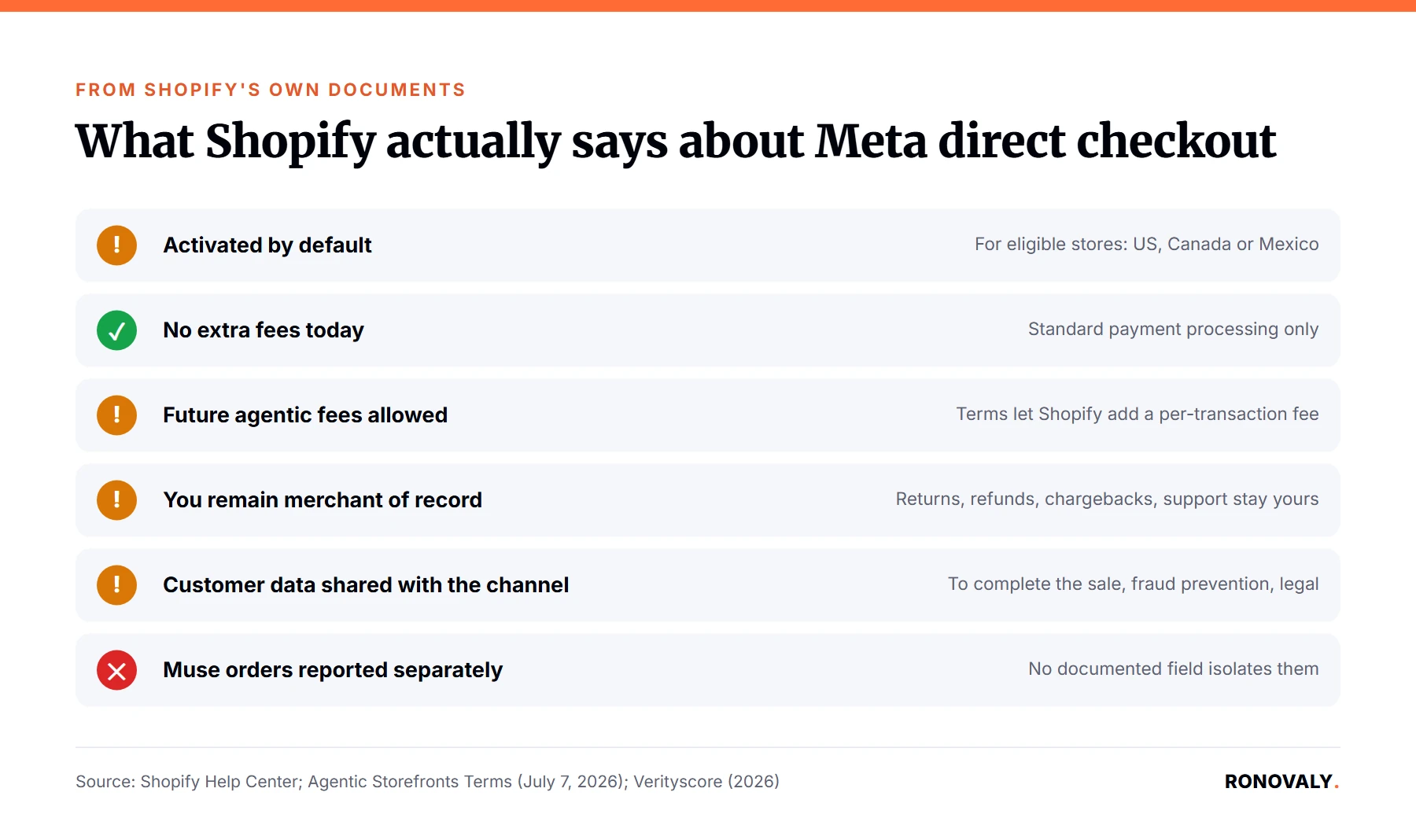
- Direct checkout is “activated by default for eligible stores” that sell to the US, Canada, or Mexico, per Shopify’s Help Center.
- Shopify says there are no fees today beyond standard payment processing. However, its terms let it add a fee on agentic transactions later.
- You stay the merchant of record, so returns, refunds, chargebacks, and customer service remain your job.
- Shopify can share customer and order data with the channel to complete the sale and prevent fraud.
- To opt out: Sales channels, then Agentic, then turn off “Allow Shopify to manage for me,” then Meta, then turn off “Direct checkout,” then Save.
Getting Started with Shopify Meta Direct Checkout
What is Shopify Meta direct checkout?
It’s a checkout that lets customers buy your products on Meta surfaces without leaving them. The Help Center says it covers Meta’s apps, “including Muse when available.” Orders still land in your Shopify admin, attributed to Meta, just like any other sales channel. In other words, Meta becomes another storefront that Shopify runs for you.
Is it really on by default?
Yes. Shopify’s Help Center states that “purchasing in direct checkouts is activated by default for eligible stores.” Eligible means you sell to customers in the US, Canada, or Mexico, your products qualify for Shopify Catalog, your store policies are complete, and you’ve accepted the Agentic Storefronts terms. So if you meet those conditions, it’s likely already live.
How much does it cost?
Nothing extra today. The Help Center says, “There are no fees associated with selling in Meta’s direct checkout. You pay only your standard payment processing fees.” However, I found one clause worth knowing. Shopify’s Agentic Storefronts Supplemental Terms, last updated July 7, 2026, allow it to “assess a fee on transactions” from agentic channels, listed in your admin. Check that page in your admin every quarter.
How Meta Direct Checkout Works
Who handles returns and customer service?
You do. Shopify says you “remain the merchant of record” and keep managing fulfillment, returns, and customer service. The terms add that you’re responsible for refunds and chargebacks too. As a result, an order an AI agent placed carries the same return risk as any other order. If your returns process is already stretched, read our guide to automating returns and exchanges first.
What customer data does Meta get?
Enough to complete the sale, plus fraud and legal uses. Shopify’s terms say it may share customer and transaction data with the channel to “initiate, process, or complete” the transaction, to send order updates, for fraud and abuse prevention, and for legal compliance. From my research, neither page says how Meta may use that data beyond those purposes. That gap matters if your brand promises customers strict privacy.
How do I see which sales came from Meta?
Orders placed on Meta surfaces are attributed to Meta in your admin. However, a September 2026 review by Verityscore found no documented field that separates Muse orders from other Meta orders. So you’ll see Meta sales, but not necessarily which ones the AI agent placed.
Common Problems and Decisions
Should I leave Meta direct checkout on?
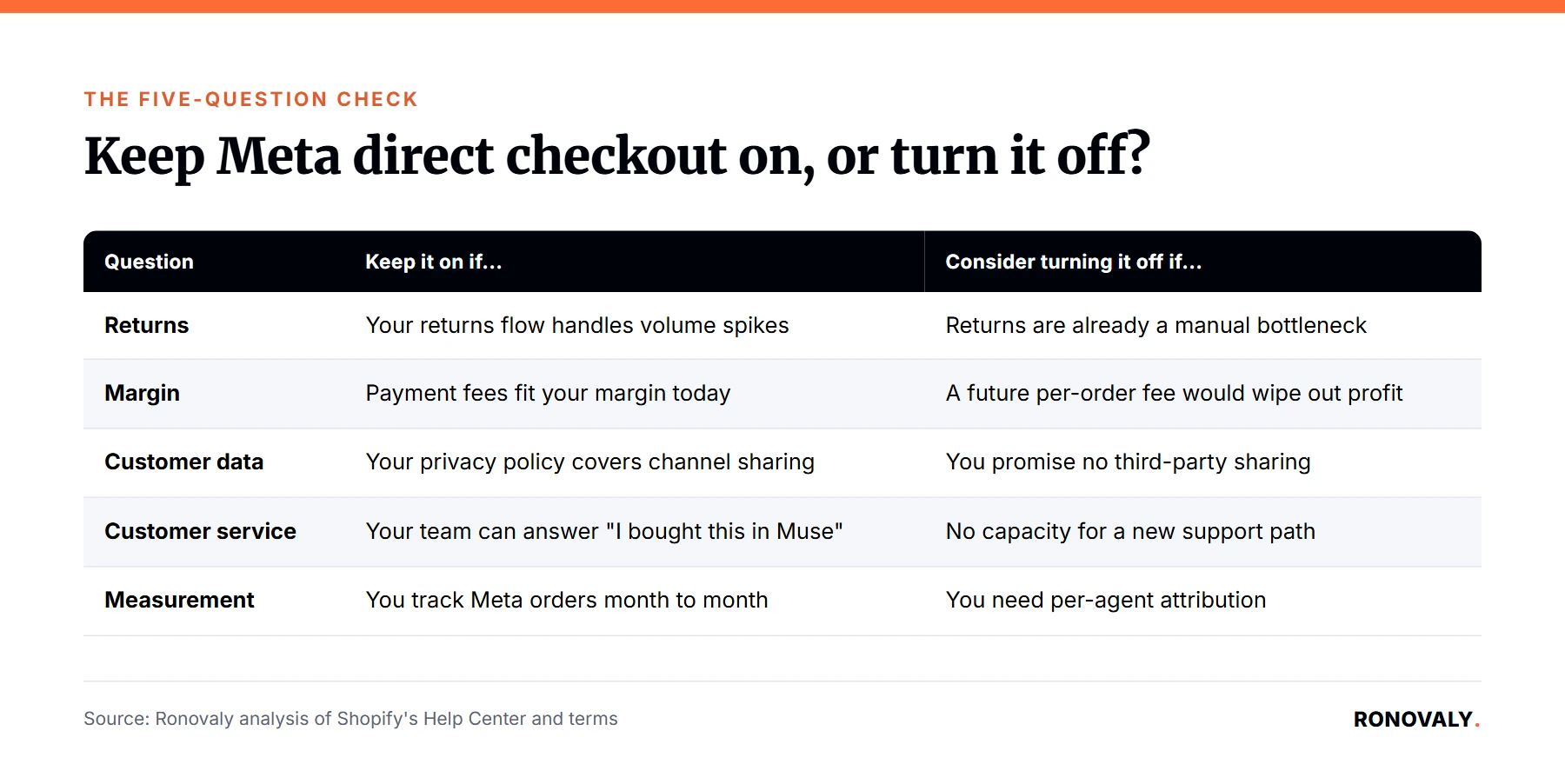
Leave it on if the five checks below pass. It’s a free extra storefront, and turning it off also removes your products from direct purchase on Meta surfaces. Turn it off if any check fails badly. Here’s how I’d decide:
| Question | Keep it on if… | Consider turning it off if… |
|---|---|---|
| Returns | Your returns flow handles volume spikes | Returns are already a manual bottleneck |
| Margin | Payment fees fit your margin today | A future per-order fee would wipe out profit |
| Customer data | Your privacy policy covers channel sharing | You promise customers no third-party sharing |
| Customer service | Your team can answer “I bought this in Muse” | You have no capacity for a new support path |
| Measurement | You can track Meta orders month to month | You need per-agent attribution to judge channels |
How do I turn off Meta direct checkout?
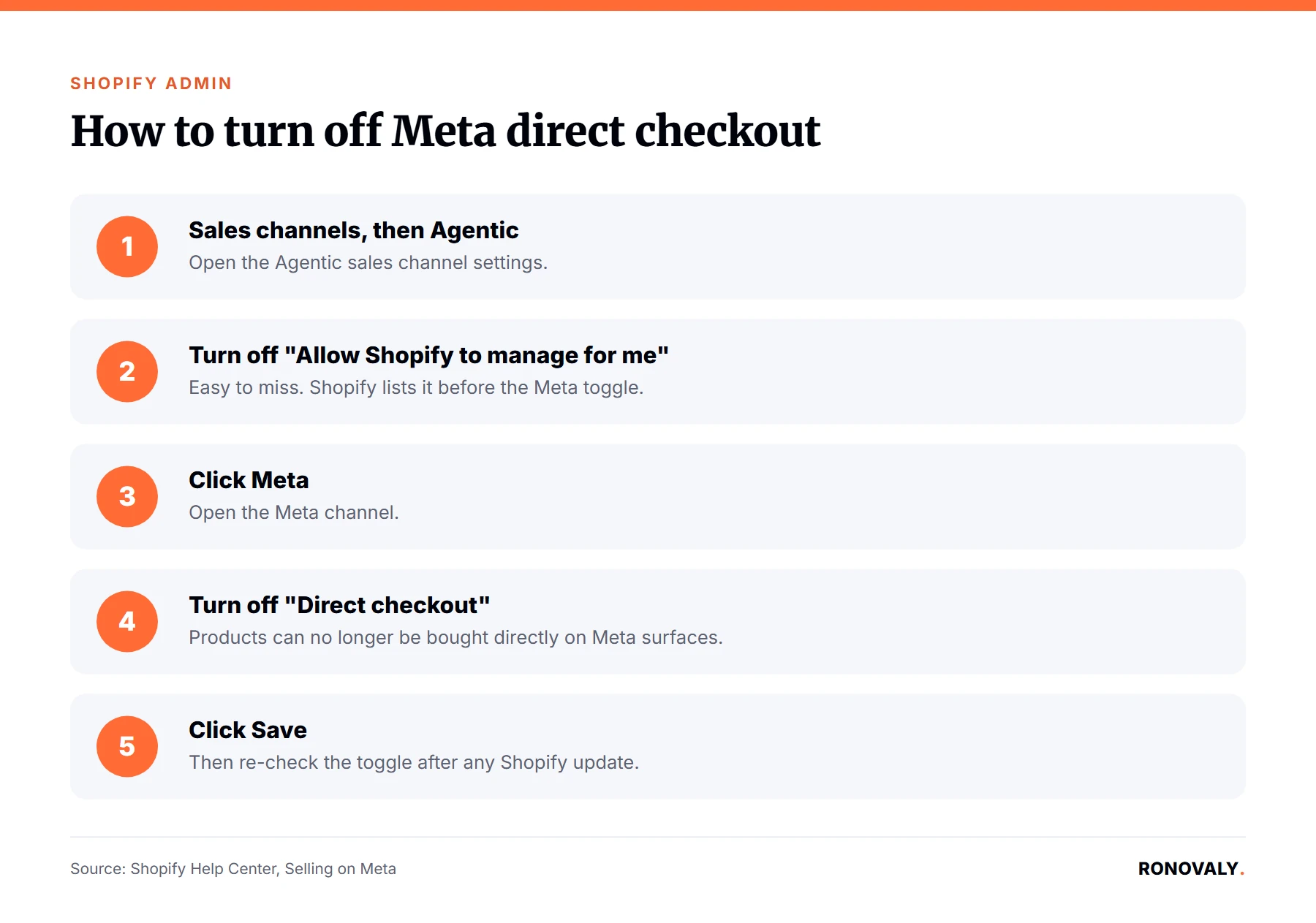
It takes five steps in Shopify admin: go to Sales channels, then Agentic; turn off Allow Shopify to manage for me; click Meta; turn off Direct checkout; then click Save. Turn off automatic management first, as Shopify lists it.
- Go to Sales channels, then Agentic.
- Turn off Allow Shopify to manage for me.
- Click Meta.
- Turn off Direct checkout.
- Click Save.
The second step is easy to miss. Shopify lists it before the Meta toggle, so switch off automatic management first, then turn off direct checkout.
Why would a store turn it off?
Mostly for control, not cost. For example, a brand with tight margins may not want a new channel whose fee terms can change. Similarly, a store that promises customers minimal data sharing may prefer to wait. Meanwhile, TechCrunch noted that consumer trust in Muse is still an open question, given Meta’s past privacy penalties.
Advanced Topics
How does this fit with ChatGPT and other AI channels?
It’s the same Shopify system, called Agentic Storefronts, with a different partner. Your products flow to AI channels through Shopify Catalog, and each channel has its own toggle. Google works the same way: see whether to keep Shopify Google AI Mode checkout on. For the protocols behind it, see our agentic commerce guide for Shopify merchants. And if you’re weighing paid placement in ChatGPT instead, read whether a small store should test ChatGPT Ads.
What should I watch over the next few months?
Watch three things monthly. First, your Meta order count and its return rate versus your store average. Second, the fee line for agentic channels in your admin. Third, Shopify’s Help Center page, since Muse checkout is still rolling out. If the return rate runs clearly above your average, revisit the toggle.
Related Resources
- Shopify Help Center, Selling on Meta: eligibility, opt-out path, fees.
- Shopify, Agentic Storefronts Supplemental Terms: data sharing, fees, responsibilities.
- PYMNTS on the Shopify and Meta partnership (September 22, 2026), including Shopify CEO Tobi Lütke’s announcement of “agentic checkout with Shop Pay on all Shopify stores.”
Still Have Questions?
Start with the five-question table above, and answer it with your own returns and margin numbers. If every row lands in the “keep it on” column, leave the default alone and review it monthly. If one row doesn’t, follow the five-step path and switch it off until the terms and tooling mature.
About the Author
Alex Carter covers AI, automation, and agentic commerce for Ronovaly, focusing on what these channels mean for Shopify stores in the $500K to $5M ARR range. Editorial note: every quote and figure in this post was fact-checked against its source on September 27, 2026.
Sources
- Shopify Help Center, “Selling on Meta” (checked 2026-09-27): https://help.shopify.com/en/manual/online-sales-channels/agentic-storefronts/meta
- Shopify, Agentic Storefronts Supplemental Terms of Service (last updated July 7, 2026): https://www.shopify.com/legal/terms-agentic-storefronts
- TechCrunch, “Meta debuts its Muse AI agent. Will consumers trust it?” (2026): https://techcrunch.com/2026/09/08/meta-debuts-its-muse-ai-agent-will-consumers-trust-it/
- PYMNTS, “Shopify brings Shop Pay checkout solution to Meta’s Muse AI agent” (2026): https://www.pymnts.com/commerce/ecommerce/2026/shopify-brings-shop-pay-checkout-solution-to-metas-muse-ai-agent/
- Verityscore, “Muse, Meta and Shopify” (2026): https://verityscore.io/en/blog/muse-meta-shopify/
This post contains affiliate links. If you make a purchase through these links, we may earn a commission at no extra cost to you.