AI Ad Creative Generation Shopify DTC Tools: Real Costs
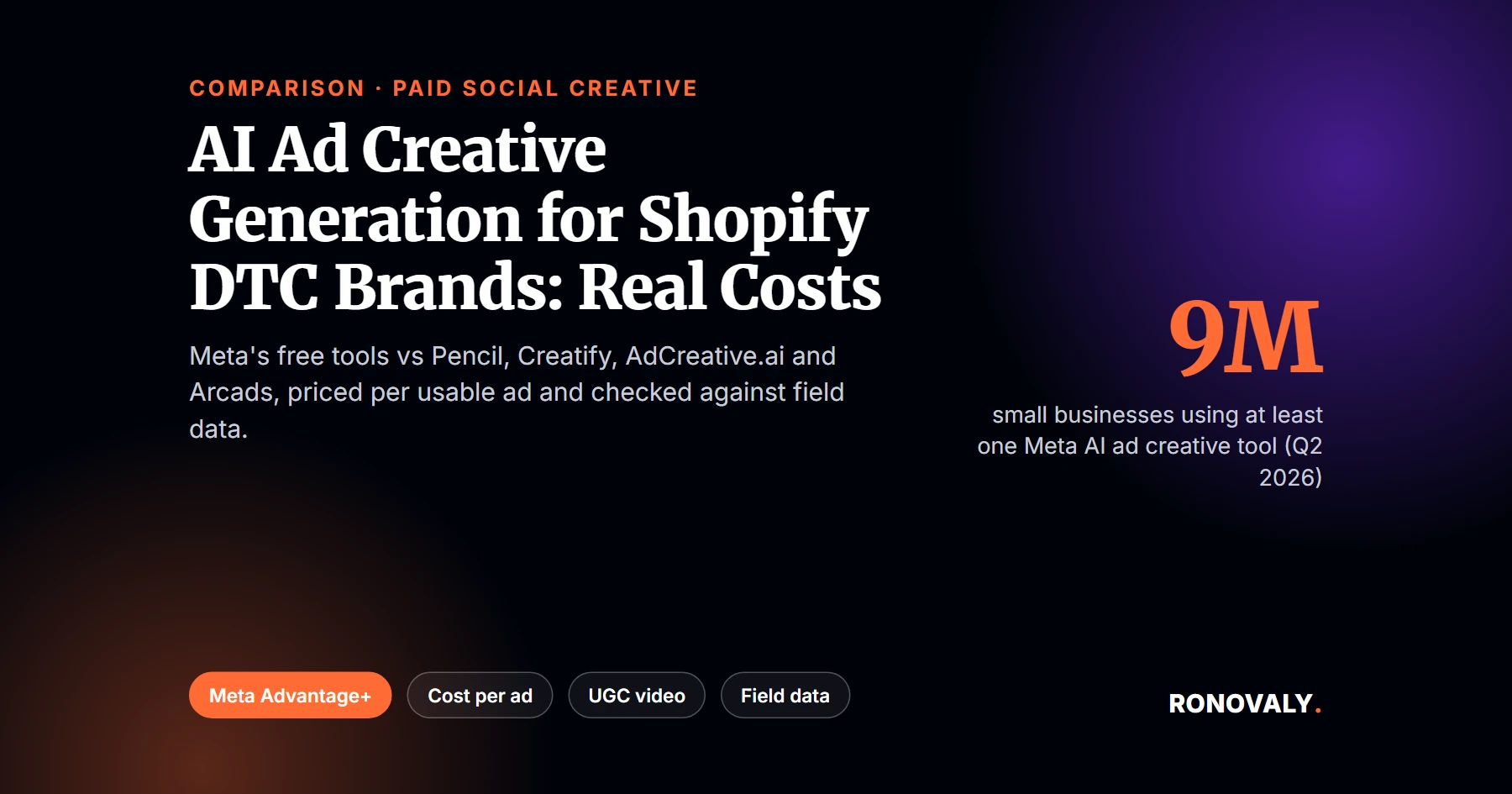
AI ad creative generation shopify dtc brands can use now starts at $0, because Meta’s own generative tools sit inside Ads Manager at no added cost. Paid tools only earn their subscription when they produce something Meta can’t: UGC-style video, brand-locked templates, or volume across several ad platforms. According to Meta’s Q2 2026 earnings call, 9 million small businesses already use at least one of its AI ad creative tools. In other words, the question for a lean store is no longer “should I use AI for ads?” It is “which layer do I actually need to pay for?”
AI ad creative generation is the use of generative models to produce ad images, video, and copy variations from a product photo, a URL, or a short brief. For a $500K to $5M ARR store, it matters for one practical reason: creative volume. Meta rebuilt its ad retrieval engine, Andromeda, to handle a fast-growing number of ad creatives, so a thin creative library gives it less to work with.
I spent this week pulling each tool’s own pricing page and working out what one usable ad actually costs. I also read two recent field studies on AI versus human ads, because vendor case studies alone can’t answer whether these ads convert. Here’s what I found, and who should skip each tool.
Key Takeaways
- Meta’s built-in generative ad tools are included in Ads Manager, and 9 million small businesses use at least one of them, per Meta’s Q2 2026 earnings call.
- On a 4,633-ad field dataset, AI images that looked human-made reached a 0.79% click-through rate versus 0.67% for human-made ads. However, AI images that looked AI-made fell to 0.62%.
- Labelling an ad as AI-generated cut clicks by about 31.5% in a separate Google Display Network field test.
- Paid entry tiers run from $14 a month (Pencil) to about $110 a month (Arcads, which publishes no pricing page).
- Cost per asset varies roughly 40x between tools, from about $0.28 per generation to about $11 per finished UGC video.
AI Ad Creative Generation Shopify DTC Tools: Quick Comparison Table
I checked every price below on the vendor’s own site on September 26, 2026. The one exception is Arcads, whose pricing page returns a 404, so its numbers come from a third-party review.
| Tool | Entry price | What you get at entry | Approx. cost per asset | Best for |
|---|---|---|---|---|
| Meta Advantage+ creative | Included with ad spend | Background generation, image expansion, text variations | $0 extra | Every Meta advertiser, first |
| Pencil | $14/mo (Core) | 50 generations a month | About $0.28 per generation | Cheap multi-platform variation testing |
| Creatify | $39/mo (Starter), free tier available | 100 credits a month | About $0.39 per credit | AI actor and product video ads |
| AdCreative.ai | $39/mo (Starter) | 10 credits a month | About $3.90 per credit | Static and banner ads in brand templates |
| Arcads | About $110/mo (third-party figure) | About 10 videos a month | About $11 per video | UGC-style talking-actor video |
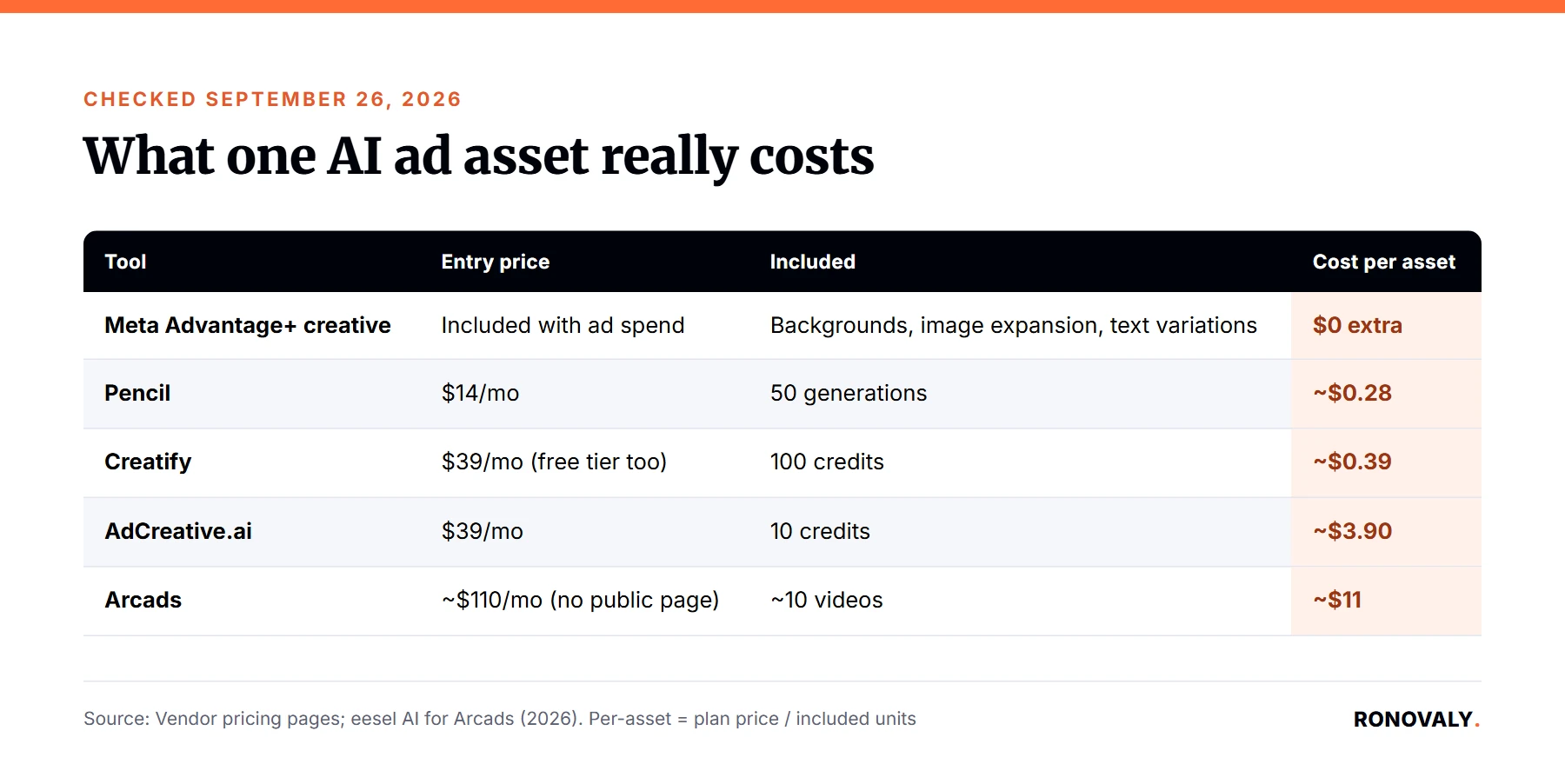
Sources: Pencil pricing, Creatify pricing, AdCreative.ai pricing, eesel AI on Arcads pricing (2026). Per-asset figures are my own division of plan price by included units.
Do AI-Generated Ads Actually Perform as Well as Human-Made Ones?
Yes, on clicks, but only when the ad does not look AI-made. The strongest evidence I found is a field dataset of 4,633 “sibling” ads from 202 brands on Taboola’s network. Each AI ad ran next to a human-made ad from the same brand, in the same campaign, at the same time. According to MediaCat’s report on the study (May 2026), AI images that viewers read as human-made earned a 0.79% click-through rate. In contrast, human-made ads earned 0.67%.
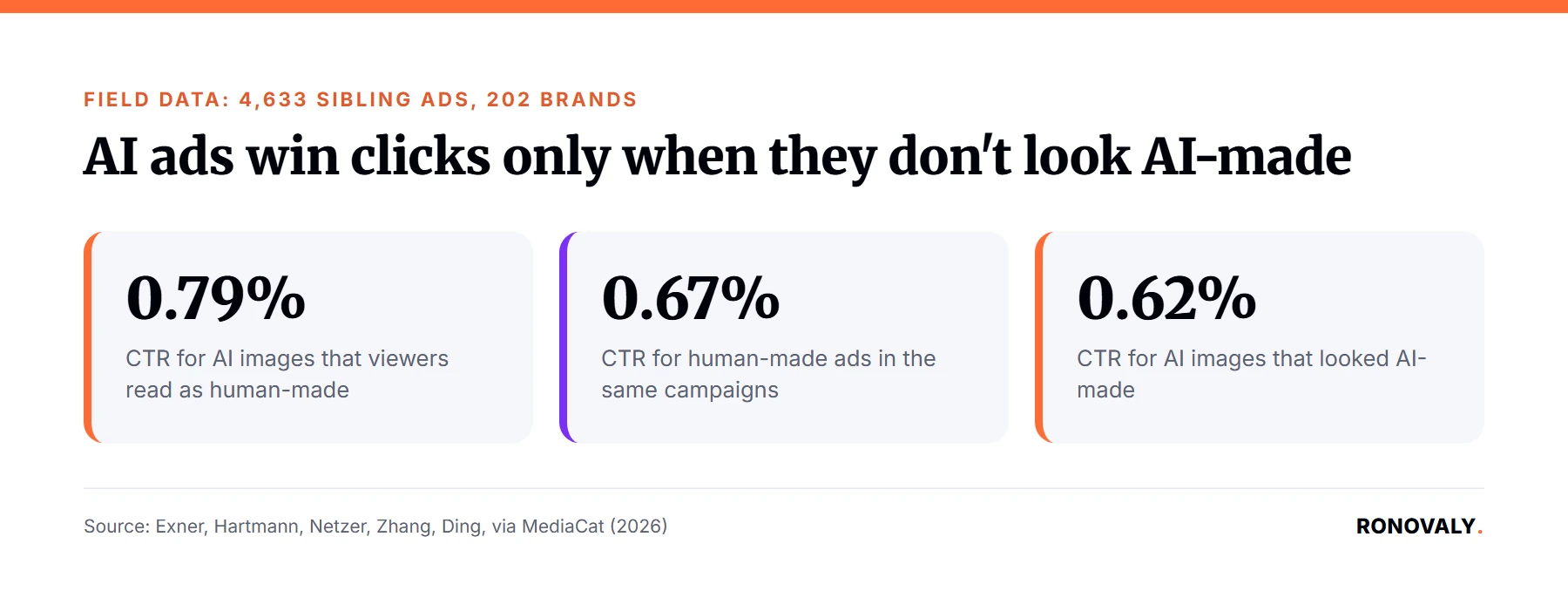
However, the catch sits in the same data. AI images that looked obviously synthetic dropped to 0.62%. Meanwhile, the researchers found AI images “performed no worse” than human work at converting clicks into sales. As a result, the practical rule is simple. The tool matters less than whether its output passes for a real photo.
Does Telling Shoppers an Ad Is AI-Made Hurt Performance?
Yes, and by a lot. In a Google Display Network field test by researchers at NYU and Emory, labelling ads as “AI-generated” or “AI-edited” cut click-through by about 31.5% compared with unlabelled human ads, per The Decoder (December 2025). That was true even when the images were identical.
This doesn’t mean you should hide AI use where a platform requires a label. Instead, it tells you where the risk is. Watermarked exports, glossy “AI look” renders, and robotic avatars all read as synthetic before any label appears. For example, Creatify’s free tier adds a watermark to exports, so treat it as a testing sandbox rather than a source of live ads.
Is Meta’s Built-In AI Enough for a Small Shopify Store?
For most stores advertising only on Meta, it’s the right place to start. Meta’s generative features include background generation, image expansion to fit each placement, and text variations for headlines and primary text. They run inside Ads Manager at no charge beyond ad spend, per Meta for Business.
Meta’s own numbers point the same way, although they’re vendor-reported. Its engineering team says businesses using image generation see a 7% increase in conversions (2024). In its Q2 2026 call, Meta added that image generation adoption more than doubled in a single quarter.
That said, where Meta’s tools stop is new concepts. They remix the assets you upload. They don’t script a UGC video, and they don’t help with TikTok or Google. That gap is exactly what the paid tools sell.
Which Paid Tool Is Cheapest Per Usable Ad?
Pencil is the cheapest per generation at about $0.28, since its $14 Core plan includes 50 generations a month. Its $55 Growth plan raises that to 250 generations. Therefore, it fits a founder who wants to test many copy and image variations across platforms without a big commitment.
AdCreative.ai costs far more per unit. Its $39 Starter plan includes 10 credits, about $3.90 each, and the $249 Professional plan includes 50. Yearly billing cuts those prices in half. In short, you’re paying for brand templates and static ad formats rather than raw volume.
Still, per-asset math only tells half the story. A cheap generation you discard costs more than a pricier one you ship. So track cost per ad you actually launch, not per credit.
Which Tool Is Best for UGC-Style Video Ads?
Creatify is the lower-cost entry, and Arcads is the specialist. Creatify’s Starter plan is $39 a month for 100 credits, and its Pro plan is $99 a month for 300 credits. It also offers a free tier with 10 monthly credits, enough for up to 2 video ads or 20 image ads.
By contrast, Arcads focuses on talking AI actors. It publishes no pricing page, which I confirmed on September 26, 2026. A June 2026 review by eesel AI puts its Starter plan at $110 a month for 10 videos, roughly $11 each. For context, that’s still cheap next to paying real creators. However, avatar video carries the highest “looks AI” risk from the field data above. As a result, test a few clips against your best real UGC before you commit to a monthly plan.
Who Should Choose What
The right tool depends on your monthly ad budget and which format your account is short on. For example, a Meta-only store and a three-platform store need very different stacks. Here’s how I’d decide:
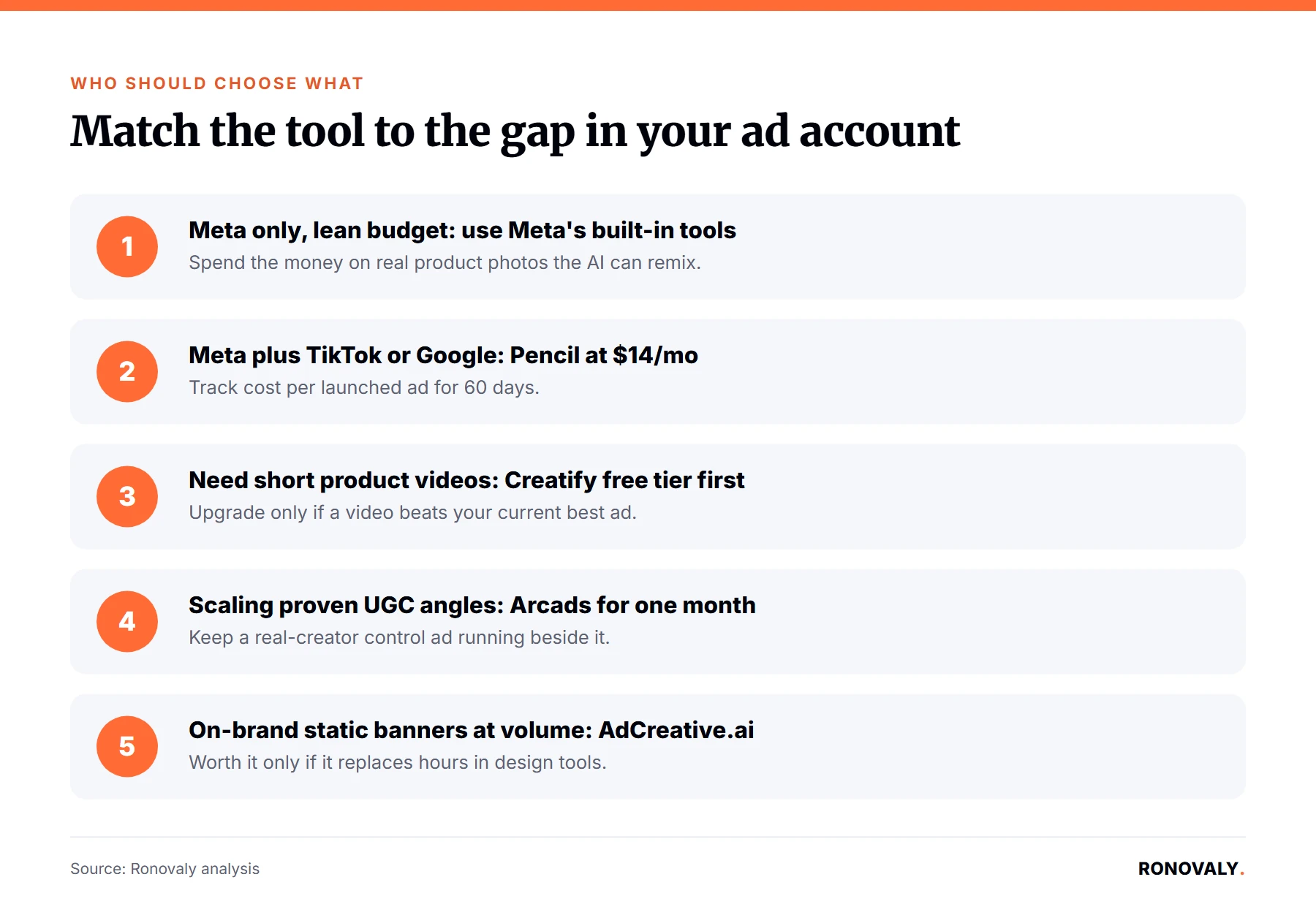
- Advertising on Meta only, on a lean budget: use Meta’s built-in tools and skip paid software. Put the money into real product photos the AI can remix instead.
- Running Meta plus TikTok or Google, with thin creative: start with Pencil’s $14 plan and track cost per launched ad for 60 days.
- Needing short product videos fast: trial Creatify’s free tier, then move to Starter only if a video beats your current best ad.
- Scaling proven UGC angles: test Arcads for one month, and keep a real-creator control ad running beside it.
- Needing on-brand static banners at volume: AdCreative.ai earns its price only if your team would otherwise spend hours in design tools.
Whatever you add, log it in your app stack. In addition, keep your ad copy on-voice; my colleague’s ChatGPT DTC content system shows how to stop AI copy from sounding generic. Subscription creep is exactly how these tools stop paying for themselves, a problem I cover in how to audit your Shopify AI app stack for hidden costs. For product imagery specifically, see our AI product image tools compared on quality and cost.
Frequently Asked Questions
Do AI-generated ads perform as well as human-made ads?
On clicks, they can perform better, but only if they don’t look AI-made. In a 4,633-ad field dataset, AI images that looked human-made earned a 0.79% click-through rate versus 0.67% for human ads. AI images that looked synthetic fell to 0.62%. Conversion from click to sale was no worse for AI images.
Is Meta’s built-in AI creative tool enough for a small Shopify store?
For most stores advertising only on Meta, yes, at least to start. Meta’s background generation, image expansion, and text variations run inside Ads Manager at no added cost. Paid tools make sense once you need UGC-style video, other ad platforms, or brand-locked templates that Meta’s remixing can’t produce.
How much does AI ad creative software cost per ad?
It ranges from about $0.28 to about $11 per asset, based on each plan’s price divided by its included units. Pencil’s $14 plan works out to about $0.28 per generation. Creatify’s Starter plan is about $0.39 per credit, AdCreative.ai’s is about $3.90 per credit, and Arcads is roughly $11 per video.
Should I disclose that an ad was made with AI?
Follow each platform’s labelling rules wherever they apply. Just know the cost: one field test found an “AI-generated” label cut click-through by about 31.5%. The better lever is output quality. Ads that look like real photos avoid the synthetic look that shoppers penalize, with or without a label.
How many new creatives should a DTC brand test each month?
There’s no universal number, so let your ad spend and your best ad’s fatigue rate set it. Meta’s retrieval engine is built to sort through many creatives, so genuinely different concepts matter more than near-duplicates. Start by adding a few genuinely different concepts each month, then scale what beats your control ad.
Next Steps
Start with what you already pay for. This week, turn on Meta’s generative features on one ad set, and keep your current best ad running as the control. If that leaves a clear gap, such as no video or no TikTok assets, trial one paid tool from the table above for 30 days. Judge it on cost per launched ad and on whether its best ad beats your control. If you advertise on Meta, also check whether shoppers can now buy inside Meta’s apps without reaching your store: see whether to keep Shopify’s Meta direct checkout switched on.
About the Author
Sarah Blake covers growth and conversion for Ronovaly, focusing on paid social, email, and retention for Shopify brands in the $500K to $5M ARR range. Editorial note: every figure in this post was fact-checked against its source on September 26, 2026, and vendor-reported numbers are labelled as such.
Sources
- Meta Platforms, Q2 2026 Earnings Call Transcript (2026): https://s21.q4cdn.com/399680738/files/doc_financials/2026/q2/META-Q2-2026-Earnings-Call-Transcript.pdf
- Engineering at Meta, “Meta Andromeda: Supercharging Advantage+ automation with the next-gen personalized ads retrieval engine” (2024): https://engineering.fb.com/2024/12/02/production-engineering/meta-andromeda-advantage-automation-next-gen-personalized-ads-retrieval-engine/
- MediaCat UK, “Disguised AI ads outperform human ones” (2026), reporting Exner, Hartmann, Netzer, Zhang and Ding: https://mediacat.uk/disguised-ai-ads-outperform-human-ones/
- The Decoder, “Telling consumers an ad is AI-generated cuts clicks by 31 percent, study finds” (2025): https://the-decoder.com/telling-consumers-an-ad-is-ai-generated-cuts-clicks-by-31-percent-study-finds/
- Meta for Business, Meta Advantage+ creative: https://www.facebook.com/business/ads/meta-advantage-plus/creative
- Pencil pricing (checked 2026-09-26): https://www.trypencil.com/pricing
- Creatify pricing (checked 2026-09-26): https://creatify.ai/pricing
- AdCreative.ai pricing (checked 2026-09-26): https://www.adcreative.ai/
- eesel AI, “Arcads AI pricing in 2026” (2026): https://www.eesel.ai/blog/arcads-ai-pricing
This post contains affiliate links. If you make a purchase through these links, we may earn a commission at no extra cost to you.