SparkToro for Shopify: Find Where Your Customers Actually Hang Out (2026)
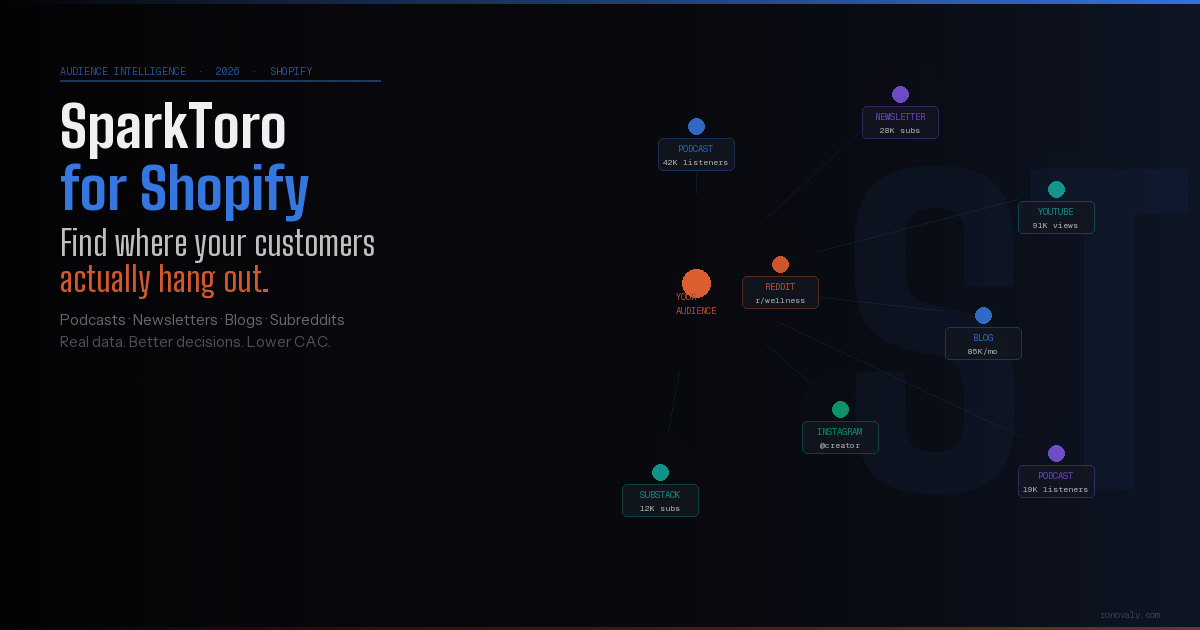
You know who your customers are. SparkToro tells you where they spend their time online. That changes where you advertise, what content you create, and who you partner with.
Audience research only adds value when it shapes better decisions. The AI-driven decision-making guide for Shopify founders shows how to close that loop.
Most Shopify founders know their customer avatar — “women 28–42, interested in wellness, US-based.” That’s a start. But knowing who your customer is tells you almost nothing about where to reach them.
Which podcasts do they listen to on their commute? Which newsletters do they actually open? Which Instagram accounts do they follow — not the obvious brand accounts, but the niche creators they genuinely trust? Which blogs did they read before landing on your product page?
SparkToro answers these questions. It’s an audience research tool built by Rand Fishkin (founder of Moz). It analyzes public profiles at scale to map where an audience spends its attention online. For Shopify founders spending on ads and content, it’s one of the most underused tools in the stack.
Bottom line: SparkToro isn’t an AI tool in the usual sense. It’s an audience research tool. But what it shows makes other marketing decisions sharper: better ad targeting, better creator picks, better content topics. For stores spending $5K+/month on ads, it’s worth testing a paid plan. The free plan is enough to check whether it works for your niche.
Table of Contents
What SparkToro Actually Reveals About Your Audience
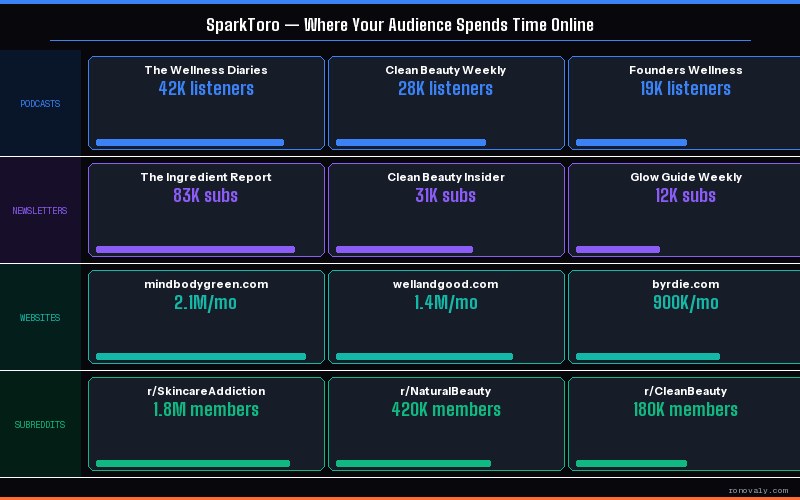
SparkToro works by analyzing public profiles at scale. You describe your audience with a keyword they use, a website they visit, or an account they follow. SparkToro returns a profile of that audience’s online behavior.
Specifically, it shows you:
- Websites they frequently visit — not just Google and Amazon, the niche sites
- Social accounts they follow — broken down by platform
- Podcasts they listen to — with download estimates
- YouTube channels they watch
- Hashtags and topics they engage with
- Subreddits they participate in
For a Shopify founder, that’s very useful. Instead of guessing where to run ads or which creator to sponsor, you see where your audience’s attention already lives.
💡 Pair SparkToro’s audience data with Klaviyo’s segmentation and you can write emails that connect to the content your audience already reads. That makes them more relevant.
4 Concrete Use Cases for Shopify Stores
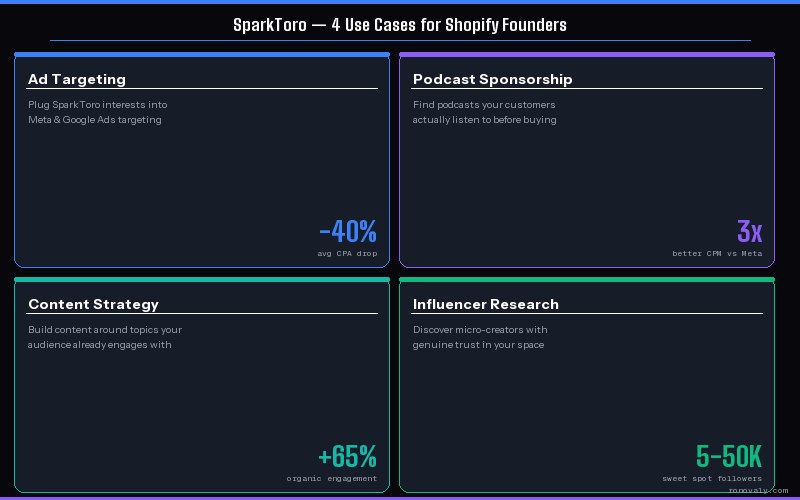
Better Ad Targeting
Find the websites, apps, and interests your audience uses, and test them in your Meta or Google Ads targeting. It beats guessing.
Podcast & Creator Sponsorships
SparkToro shows which podcasts your audience actually listens to — with audience size estimates. Find the right podcast to sponsor before your competitor does.
Content Strategy
See which topics, hashtags, and publications your audience engages with. Build content around what they already love — not what you assume they care about.
Influencer Discovery
Find niche creators your audience follows. Skip the mega-influencers everyone uses and look for micro-creators with 5-50K followers and real trust in your space.
Real Example: Austin DTC Skincare Brand
Illustrative example (hypothetical): picture a founder selling natural skincare who searches SparkToro for “interested in clean beauty.” The results might show her customers gather around a few podcasts she’s never heard of, some niche wellness newsletters, and one active subreddit.
She could then move a small slice of her Meta budget into a newsletter sponsorship and a podcast mid-roll, and compare cost per acquisition on those channels with her Meta average. Audiences that already trust a host or writer are often easier to convert, but only your own test will tell.
That kind of insight doesn’t come from an ad platform’s own targeting tools. It comes from knowing where attention actually lives.
SparkToro Pricing: What Each Plan Gets You
Free:$0 / mo
5 searches/month — enough to validate
- 5 audience searches
- Limited results per search
- All data categories
- No export
BEST VALUE
Basic:$50 / mo
For growing stores running active campaigns
- 50 searches/month
- Full results per search
- CSV export
- All data categories
Standard:$150 / mo
For agencies or multi-brand operators
- 150 searches/month
- Full results + deep data
- CSV export
- Priority support
For most Shopify founders, the free plan is the right place to start. Run a few searches on your core audience and see whether the data changes how you think about your marketing. If it does, upgrade. If your niche is too narrow to return useful results, SparkToro isn’t the right fit, and you’ve lost nothing.
How to Run Your First SparkToro Search (Step by Step)
Step 1 — Define Your Audience Input
SparkToro gives you three ways to define your audience: a keyword they use in their bio, a website they often visit, or a social account they follow. Start with the keyword approach. Enter 2-3 words that describe your customer’s identity or interest (“sustainable fashion,” “home gym,” “clean eating”).
Step 2 — Filter the Results
SparkToro returns results across all data categories. Focus first on podcasts and websites — these give you the clearest action items. Sort by audience size and note the top 5–10 in each category. Look for options your competitors are unlikely to be using yet.
Step 3 — Build Your Outreach List
For each podcast or newsletter in your list, find the contact or sponsorship info directly. Most indie podcasts and newsletters actively look for sponsors and have rates far below what you’d pay for equivalent Meta reach. Document everything in a simple spreadsheet: name, audience size, estimated CPM, contact info.
Step 4 — Cross-Reference with Your Ad Data
Take the interests SparkToro surfaces and test them in your Meta or Google Ads targeting. If SparkToro says your audience reads a certain publication or follows a certain creator, check whether Meta offers it as an interest or Google as a placement. Many findings turn straight into targeting tests. To track results across those channels, our Triple Whale review covers cross-channel attribution.
Who Should Use SparkToro for Their Shopify Store
✓ Good fit
- Spending $5K+/month on ads
- Looking for new acquisition channels
- Building a content or SEO strategy
- Exploring podcast or newsletter sponsorships
- Niche product with a defined audience
- Wanting to find micro-influencers
✗ Less relevant
- Very broad audience (everyone uses it)
- Early-stage store, no ad budget yet
- Purely local business (SparkToro is US-heavy)
- B2B with a very niche ICP
SparkToro works best with a clearly defined niche. The broader your audience, the less useful the results. A store selling “outdoor gear” gets generic data. A store selling “gear for ultralight backpackers” gets sharp insights. This fits into a wider AI tools stack for Shopify: SparkToro handles research, while automation tools handle execution.
SparkToro: Pros & Cons
✓ Pros
- Free plan — zero risk to test
- Data no other tool surfaces easily
- Podcast and newsletter discovery is unique
- Directly actionable for ad targeting
- Saves weeks of manual research
- Regularly updated dataset
✗ Cons
- Limited searches on free plan (5/month)
- Results thin for very niche audiences
- US-centric data (less useful for non-US brands)
- No direct Shopify integration
- $50/month is hard to justify under $5K ad spend
One thing worth noting: SparkToro is not an automation tool — it won’t do anything for you automatically. It’s a research tool. You still need to act on the data: reach out to podcasters, test the ad interests, contact newsletter owners. The tool gives you the intelligence; the execution is still on you.
Start your first SparkToro search — it’s free
The free plan needs no credit card. Run one search on your audience and see if the data changes how you think about your marketing channels. Try SparkToro Free →
Frequently Asked Questions
Is SparkToro worth it for a small Shopify store?
Start with the free plan. It’s enough to judge. If your audience is well defined and the results show podcasts or publications you didn’t know about, a paid plan is worth it. If your audience is too broad or the data too generic, it’s not the right fit. The free tier removes the risk from testing.
How is SparkToro different from Meta’s audience tools?
Meta’s tools only show data inside Meta’s own apps: pages, demographics, and ad behavior. SparkToro looks across the web: podcasts, newsletters, YouTube channels, subreddits, and independent blogs. It’s a wider view of where attention lives. The two work well together: use SparkToro to find channels, and Meta’s tools to refine targeting inside Meta.
Can I use SparkToro to research my competitors’ audiences?
Yes, and it’s one of its best uses. Search by a competitor’s website (people who visit competitor.com) and you’ll see where that audience spends time online. That shows you where your competitor’s customers can be reached.
Does SparkToro work for non-US brands?
SparkToro’s data is strongest for US audiences. For US stores selling to US customers, the data is solid. For brands mainly targeting the UK, Australia, or other markets, expect thinner results, so test with the free plan first.
How often should I run SparkToro searches?
For most stores, once a quarter is enough. Run a batch of searches when you plan a new campaign, launch into a new category, or review your channel mix. Audience behavior changes slowly, so you don’t need to check every month. The free plan’s monthly searches reset each month, so you can run a quarterly review without paying.
This post contains affiliate links. If you make a purchase through these links, we may earn a commission at no extra cost to you.