ChatGPT Ads Shopify App: Should a Small Store Test It?
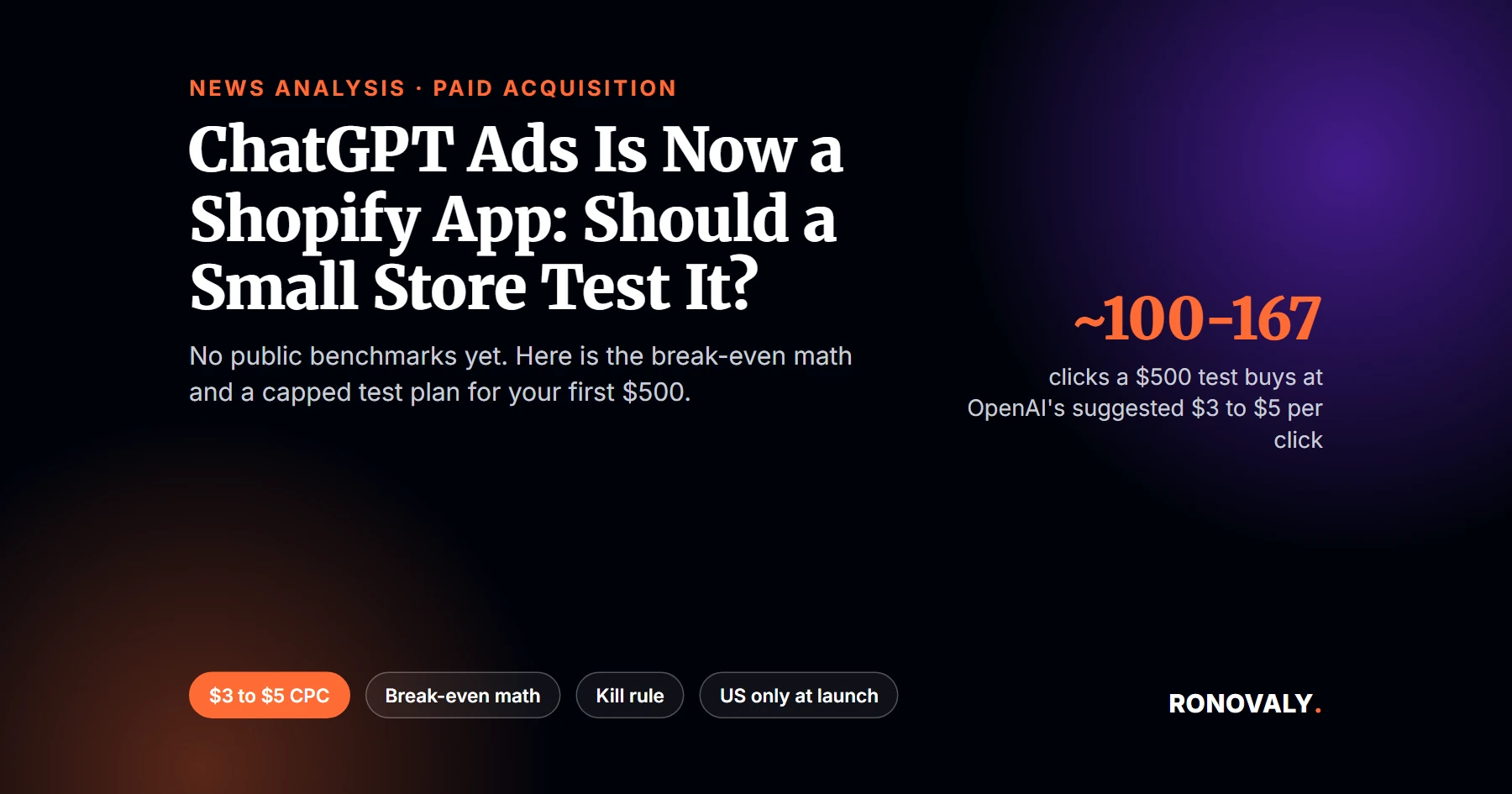
The ChatGPT Ads Shopify app lets US merchants run ads inside ChatGPT straight from Shopify admin, and it’s free to install. Should a small store spend its first $500 there? Only as a tightly capped test. OpenAI hasn’t published performance benchmarks, and at its suggested $3 to $5 per click, $500 buys roughly 100 to 167 clicks. That’s enough to spot an obvious winner or loser, not enough to prove anything in between.
ChatGPT Ads is OpenAI’s advertising platform, which places labelled ads inside ChatGPT conversations and bills by impressions, clicks, or conversion-optimized bidding. On September 16, 2026, OpenAI named Shopify its first ecommerce partner. As a result, your product catalog can now flow into a brand-new paid channel with a few clicks.
I read the app listing, every review posted so far, and OpenAI’s own campaign guidance, as far as it’s public. I haven’t spent ad money on the channel yet, so this post gives you a test plan and the math, not results. Here’s what’s known, what isn’t, and who should wait.
Key Takeaways
- The ChatGPT Ads app is free to install, US-only at launch, and rated 2.5 out of 5 from its first 16 reviews, several citing product-sync errors.
- OpenAI recommends starting bids of $3 to $5 per click. As a result, a $500 test buys roughly 100 to 167 clicks.
- OpenAI hasn’t disclosed performance benchmarks, even though the ads business passed a $1 billion annualized run rate in under 200 days.
- Organic AI referrals convert 60% better than non-AI traffic, per Adobe. However, that’s unpaid traffic, not proof that paid ChatGPT clicks will convert.
- Work out your break-even cost per order before launching, and stop the test once spend passes twice that figure with no sales.
What Happened
OpenAI plugged its ad platform into Shopify in September 2026. According to PPC Land (September 16, 2026), the app syncs your inventory to ChatGPT automatically. It also runs campaigns using a Shopify pixel and conversion events. In addition, OpenAI is testing Sponsored Agents, a labelled side conversation with a brand’s own AI agent, with select US advertisers.
The app listing shows a September 3, 2026 launch, free installation, and US-only availability. Rollout to other ChatGPT Ads markets followed on September 23. Meanwhile, ad setup in Ads Manager can suggest copy and images drawn from your landing page, per Shopifreaks.
Why This Matters for a Small Store
It’s the first time a lean team can buy placement inside ChatGPT without an agency or a big commitment. However, early on the channel was closed to small budgets. According to WebFX (June 2026), early partners reportedly needed a $200,000 commitment. That fell to $50,000 in April, and the requirement was removed on May 5, 2026, when self-serve Ads Manager launched. Meanwhile, the demand signal is real, too. Adobe data reported by Digital Commerce 360 (August 2026) shows AI-referral visits to US retail sites converting 60% better than non-AI traffic, with 53% more revenue per visit. That said, those are organic visits from AI tools. Paid clicks may behave differently, and nobody has published data on that yet.
What Nobody Knows Yet
The honest answer on performance is that there’s no public benchmark. In fact, I found no performance data from OpenAI at all. PPC Land also notes that OpenAI hasn’t disclosed performance benchmarks, even as the ads business reached a $1 billion annualized run rate in under 200 days. So any “average ChatGPT ads ROAS” you see online is an estimate, not OpenAI data.
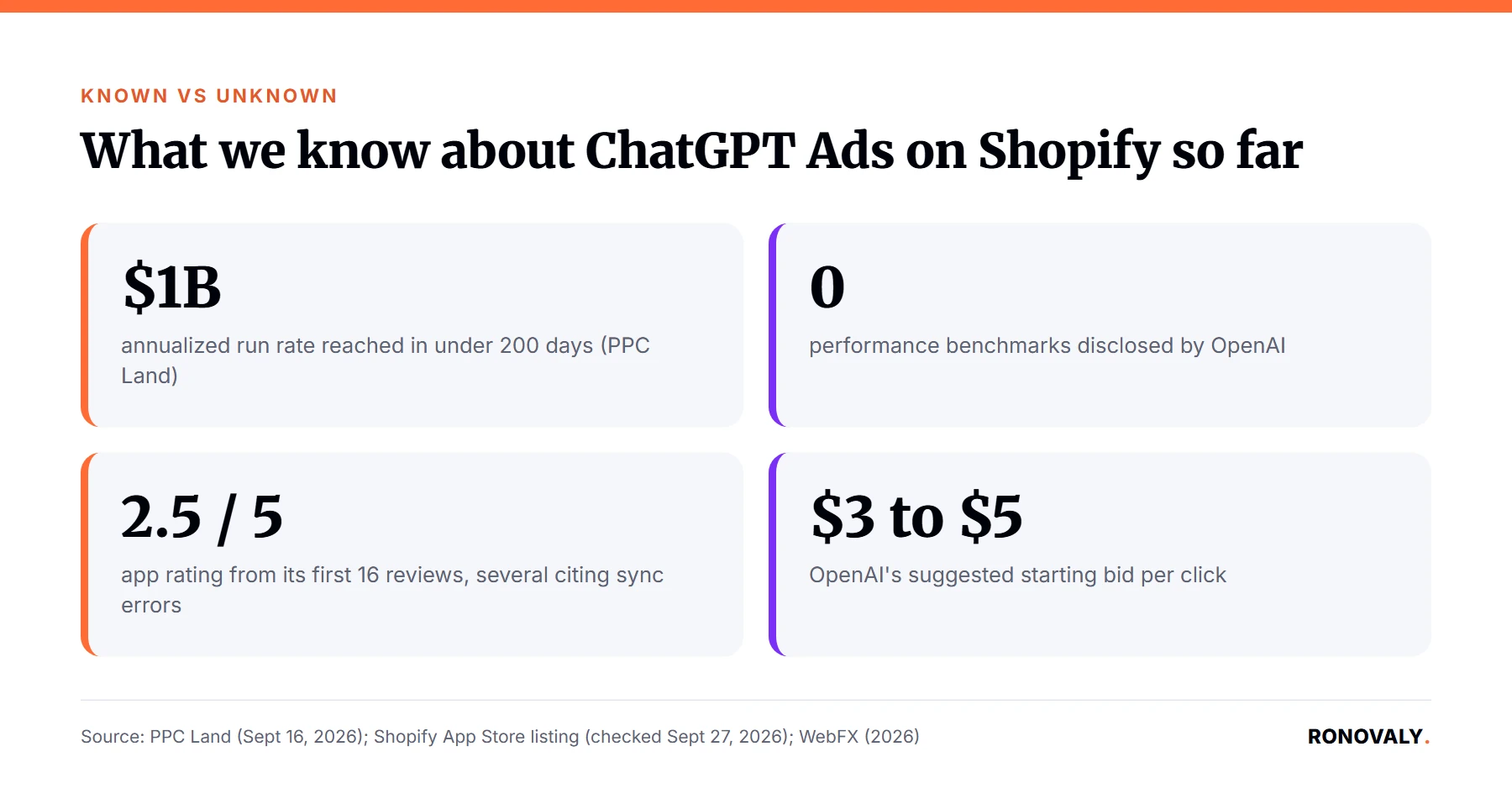
From my research into the app listing, the early reviews add a practical warning. Of the first 16 reviews, 69% are one-star. For example, one merchant wrote on September 21 that products were “not syncing, manual sync keeps rejecting.” Another asked why ads can target “the whole usa only.” Still, a five-star review called setup “a snap” across two stores. In short, check that your catalog actually syncs before you judge the channel.
Can a $500 Test Tell You Anything?
Yes, but only a limited amount. First, count the clicks. At OpenAI’s suggested $3 to $5 per click, $500 buys about 100 to 167 clicks. Next, find your break-even cost per order, which is your average order value multiplied by your gross margin. It’s the most you can pay for one sale without losing money on it.
After that, divide your cost per click by that break-even figure. The result is the share of clicks that must turn into orders just to break even. Here’s an illustrative example for a store with an $80 average order and a 50% margin. These are sample numbers, not results:
| Cost per click | Clicks from $500 | Break-even cost per order | Clicks that must buy to break even |
|---|---|---|---|
| $3 | About 167 | $40 | 7.5% |
| $4 | 125 | $40 | 10% |
| $5 | 100 | $40 | 12.5% |
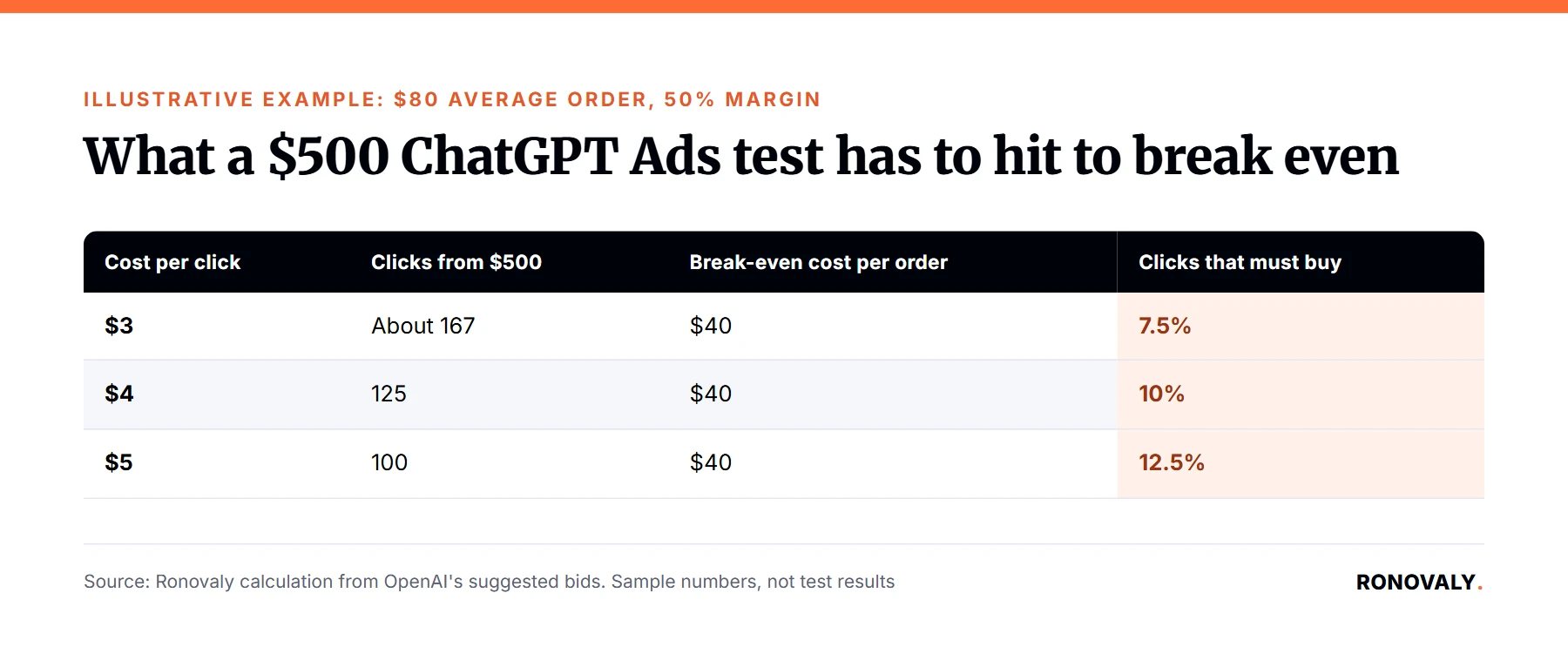
When I ran these numbers, I found the required rate climbs fast as bids rise. So compare that last column with your store’s current conversion rate in Shopify Analytics. Use a rate from after September 21, 2026, when Shopify changed how it counts sessions: see the Shopify session measurement update. If you need 10% and your store converts a fraction of that, the test is very likely to lose money on first orders. In that case, it only makes sense if repeat purchases carry the economics.
What to Do Now
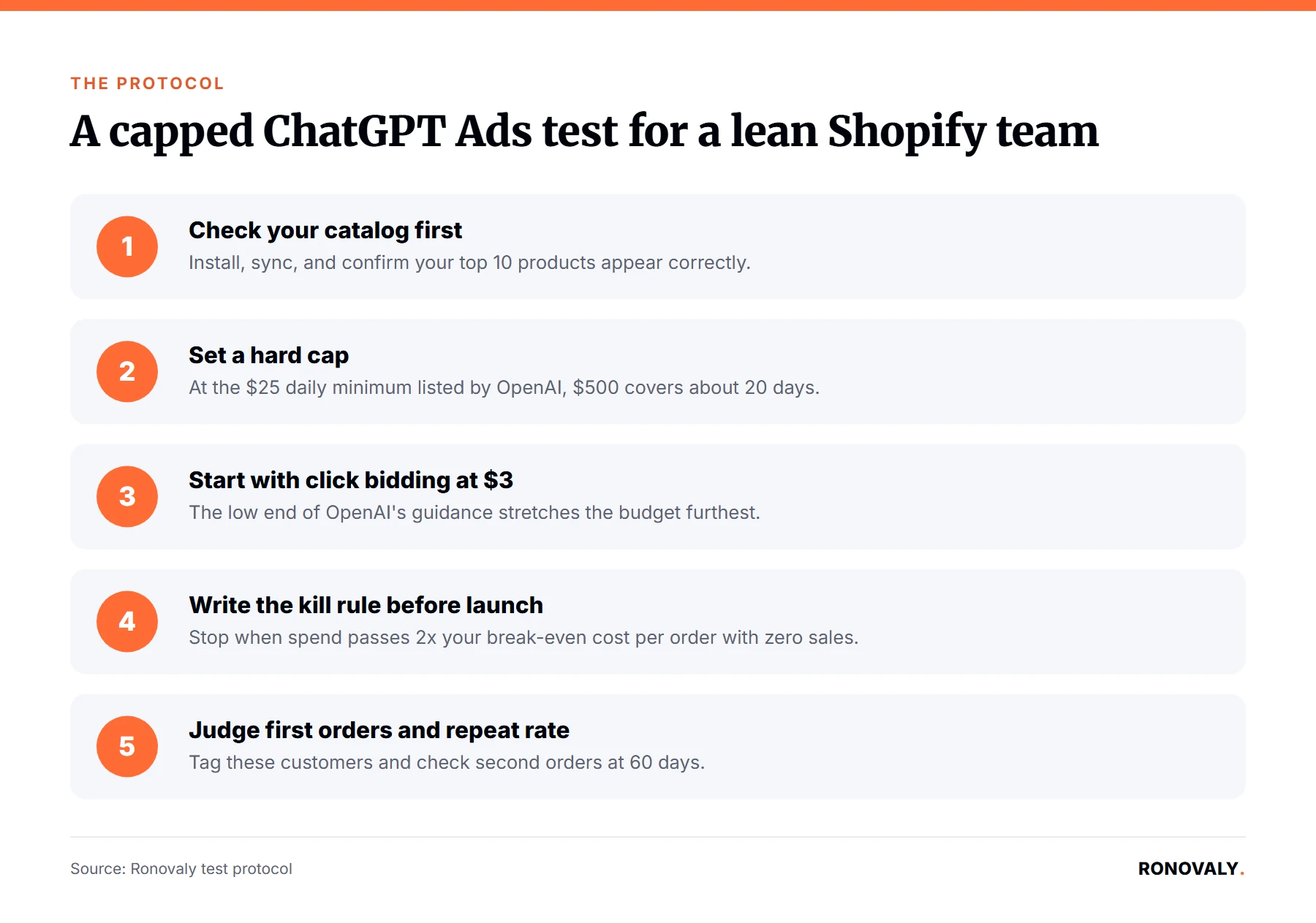
Run a capped, pre-committed test rather than an open-ended experiment. Here’s the protocol I’d use:
- Check your catalog first. Install the app, sync, and confirm your top 10 products appear correctly before you spend anything.
- Set a hard cap. OpenAI’s help center lists a $25 minimum daily budget. At that level, $500 covers about 20 days.
- Start with click bidding at $3. It’s the low end of OpenAI’s guidance, and it stretches the test budget furthest.
- Write your kill rule before launch. Stop the day spend passes your break-even cost per order two times over with zero sales.
- Judge first orders and repeat rate together. Tag these customers, and check their second-order rate at 60 days before deciding to scale.
Also, don’t treat the Shopify pixel as the final word. Compare against total store revenue for the test period, because platform-reported conversions can overlap with sales other channels would have made anyway. For organic visibility in ChatGPT, which costs nothing, start with our comparison of AI visibility monitoring tools.
Who Should Skip It for Now
In short, some stores should wait for benchmarks. Skip the test if any of these apply:
- Your break-even cost per order is below $20. At $3 per click, at least 15% of clicks would have to buy just to break even.
- You sell outside the US. Launch availability was US-only, and one review flags national-only targeting.
- Your catalog data is messy. Poor titles and missing attributes feed the ads directly. Our agentic commerce guide covers why catalog quality comes first.
- You’re already struggling with app sprawl. Another channel adds reporting overhead; see how to audit your AI app stack.
Related guides: for next steps, see how to optimize your store for Perplexity Shopping, which costs nothing.
Frequently Asked Questions
How much does it cost to advertise on ChatGPT from Shopify?
The Shopify app is free to install, and you pay only for ad spend. OpenAI recommends starting bids of $3 to $5 per click for click campaigns. According to WebFX, OpenAI’s default maximum bid for impression campaigns is a $60 CPM, and Digiday reported some advertisers seeing CPMs as low as $25.
Is there a minimum budget for ChatGPT Ads?
There’s no large commitment anymore. The early $200,000 partner minimum was cut to $50,000 in April 2026, then removed on May 5, 2026, when self-serve Ads Manager launched. OpenAI’s help center now lists a $25 minimum daily budget, so confirm the current figure inside Ads Manager before planning a test.
Are there performance benchmarks for ChatGPT Ads?
Not from OpenAI. The ads business passed a $1 billion annualized run rate in under 200 days, but OpenAI hasn’t disclosed performance benchmarks. Adobe’s data shows organic AI referrals convert 60% better than non-AI traffic. However, that covers unpaid visits, so treat any quoted ChatGPT ads ROAS as an estimate.
Is the ChatGPT Ads Shopify app available outside the US?
It launched for US merchants on September 3, 2026, and reached other ChatGPT Ads markets on September 23, 2026. Availability still depends on where ChatGPT Ads itself operates. Early reviews also flag that targeting was national rather than regional, which matters for stores that ship only to certain areas.
Should a small Shopify store test ChatGPT Ads now?
Only with a capped budget and a kill rule written in advance. Calculate your break-even cost per order, then check what share of clicks must convert at $3 to $5 per click. If that rate is far above your store’s normal conversion rate, wait for public benchmarks before spending.
Next Steps
Above all, do the math before the money. This week, pull your average order value and gross margin, work out your break-even cost per order, and compare it with the table above. If the numbers work, install the app, confirm your catalog syncs, and run a 20-day capped test with your kill rule written down first. ChatGPT isn’t the only AI surface where shoppers can now buy: Shopify’s Meta direct checkout is switched on by default for eligible stores, so check that setting too.
About the Author
Sarah Blake covers growth and conversion for Ronovaly, focusing on paid acquisition, email, and retention for Shopify brands in the $500K to $5M ARR range. Editorial note: every figure in this post was fact-checked against its source on September 27, 2026, and the worked example is illustrative, not a test result.
Sources
- Shopify App Store, ChatGPT Ads by OpenAI, listing and reviews (checked 2026-09-27): https://apps.shopify.com/chatgptads
- PPC Land, “OpenAI lets advertisers run ChatGPT ads from HubSpot and Shopify” (2026): https://ppc.land/openai-lets-advertisers-run-chatgpt-ads-from-hubspot-and-shopify/
- Shopifreaks, “OpenAI brings ChatGPT Ads into Shopify and HubSpot” (2026): https://www.shopifreaks.com/openai-brings-chatgpt-ads-into-shopify-and-hubspot-its-first-ecommerce-and-crm-partners-and-tests-sponsored-agents-in-the-us/
- WebFX, “How Much Do ChatGPT Ads Cost?” (2026): https://www.webfx.com/blog/ai/chatgpt-ads-cost/
- OpenAI Help Center, Create campaigns for ChatGPT Ads: https://help.openai.com/en/articles/20001210-create-campaigns-for-chatgpt-ads
- Digital Commerce 360, “Adobe: AI-referral traffic spending, converting more than counterparts” (2026): https://www.digitalcommerce360.com/2026/08/19/adobe-ai-referral-traffic-data-july-2026/
This post contains affiliate links. If you make a purchase through these links, we may earn a commission at no extra cost to you.