Shopify Hydrogen vs Liquid Speed: Real User Data for 2026
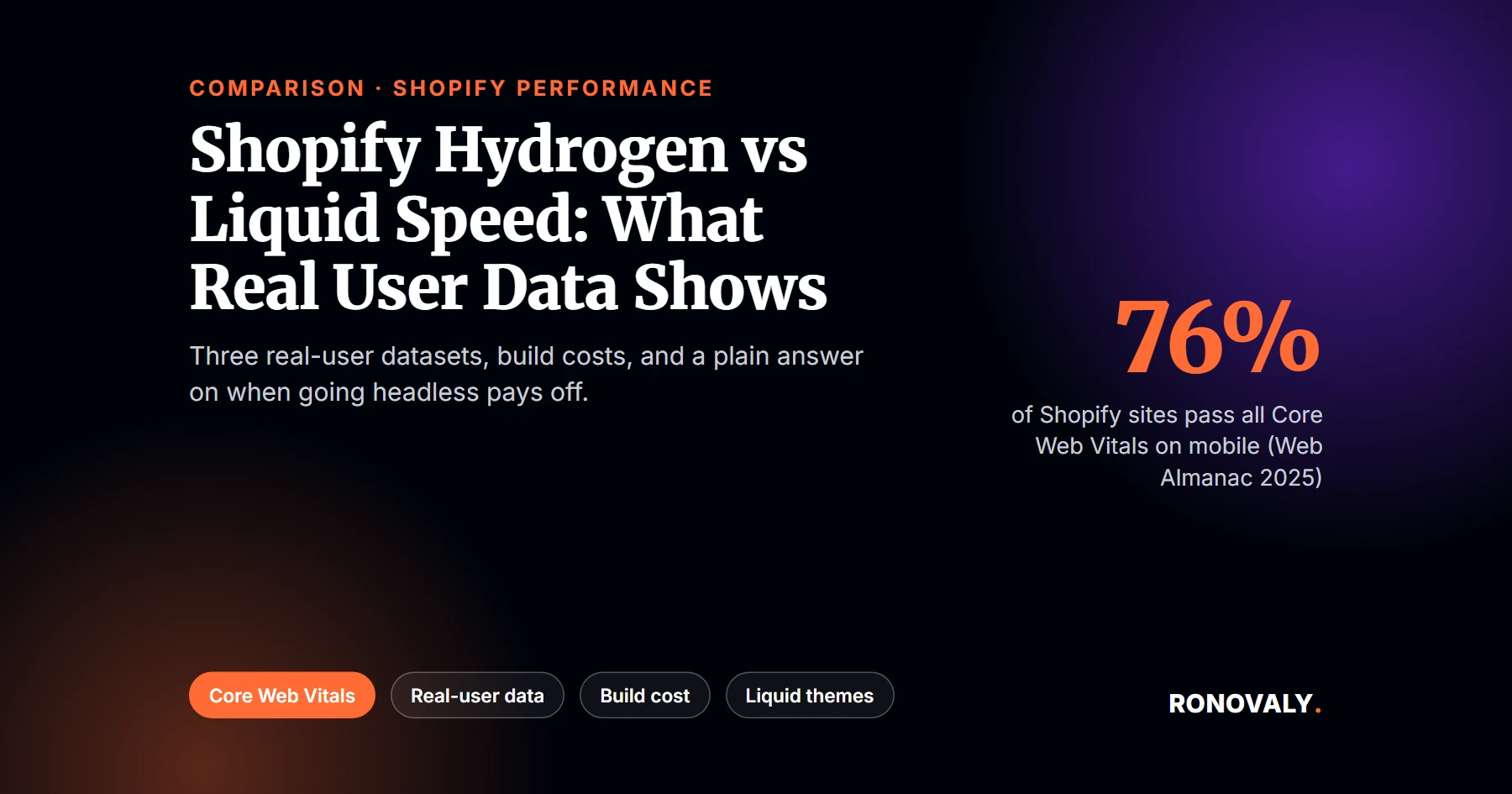
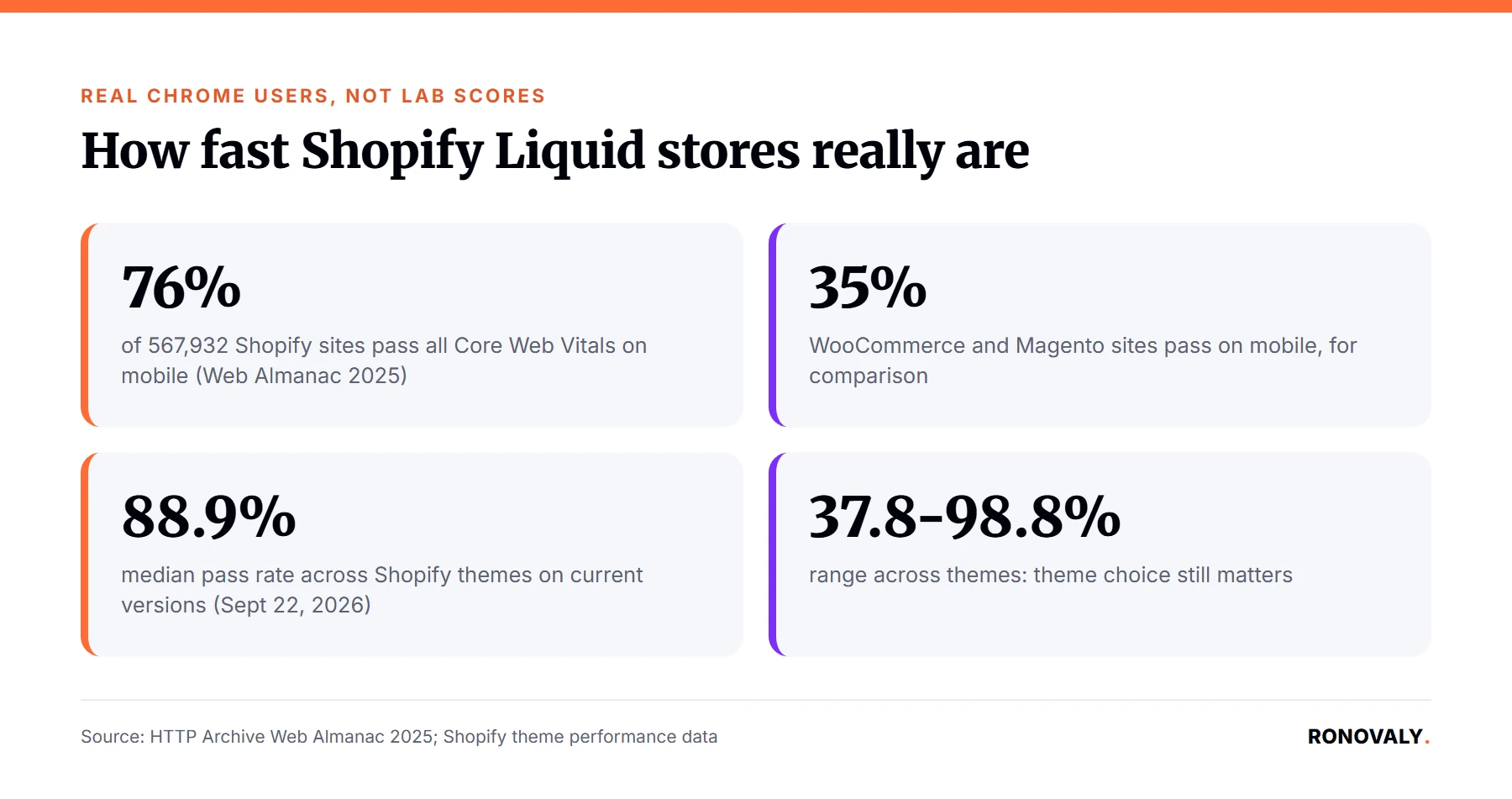
On Shopify Hydrogen vs Liquid speed, the real-user data favors Liquid for most stores. According to the HTTP Archive Web Almanac 2025, 76% of Shopify sites pass all three Core Web Vitals on mobile, the best rate among major ecommerce platforms. Meanwhile, the only public head-to-head I found, from Shopify’s own performance team, had Hydrogen at 35% against Liquid at 59.5%. A well-built Hydrogen store can be very fast. However, “headless” doesn’t make a store fast on its own.
Hydrogen is Shopify’s React framework for building a custom, headless storefront, hosted on Shopify’s Oxygen platform. Liquid is Shopify’s standard theme language, the one behind Dawn, Horizon, and nearly every theme in the Theme Store. The speed question matters because a Hydrogen rebuild is a large project, and speed is one of the main arguments made for it.
I spent this week pulling the three public real-user datasets that compare these setups, rather than relying on lab scores. I didn’t build a Hydrogen store for this post. Instead, here’s what the field data from real Chrome users shows, and who should still consider going headless.
Key Takeaways
- 76% of 567,932 Shopify sites passed all three Core Web Vitals on mobile in the Web Almanac 2025, ahead of WooCommerce and Magento at 35% each.
- Shopify’s own theme data, updated September 22, 2026, shows a median 88.9% Core Web Vitals pass rate for stores on current theme versions.
- The only public real-user head-to-head, from 2023, had Hydrogen at 35% of sites passing Core Web Vitals versus 59.5% for Shopify overall.
- Oxygen hosting for Hydrogen is included on paid Shopify plans. However, one 2026 agency estimate puts a Hydrogen build at about $10K to $150K+.
- For most $500K to $5M stores, an optimized Liquid theme is the faster and cheaper path.
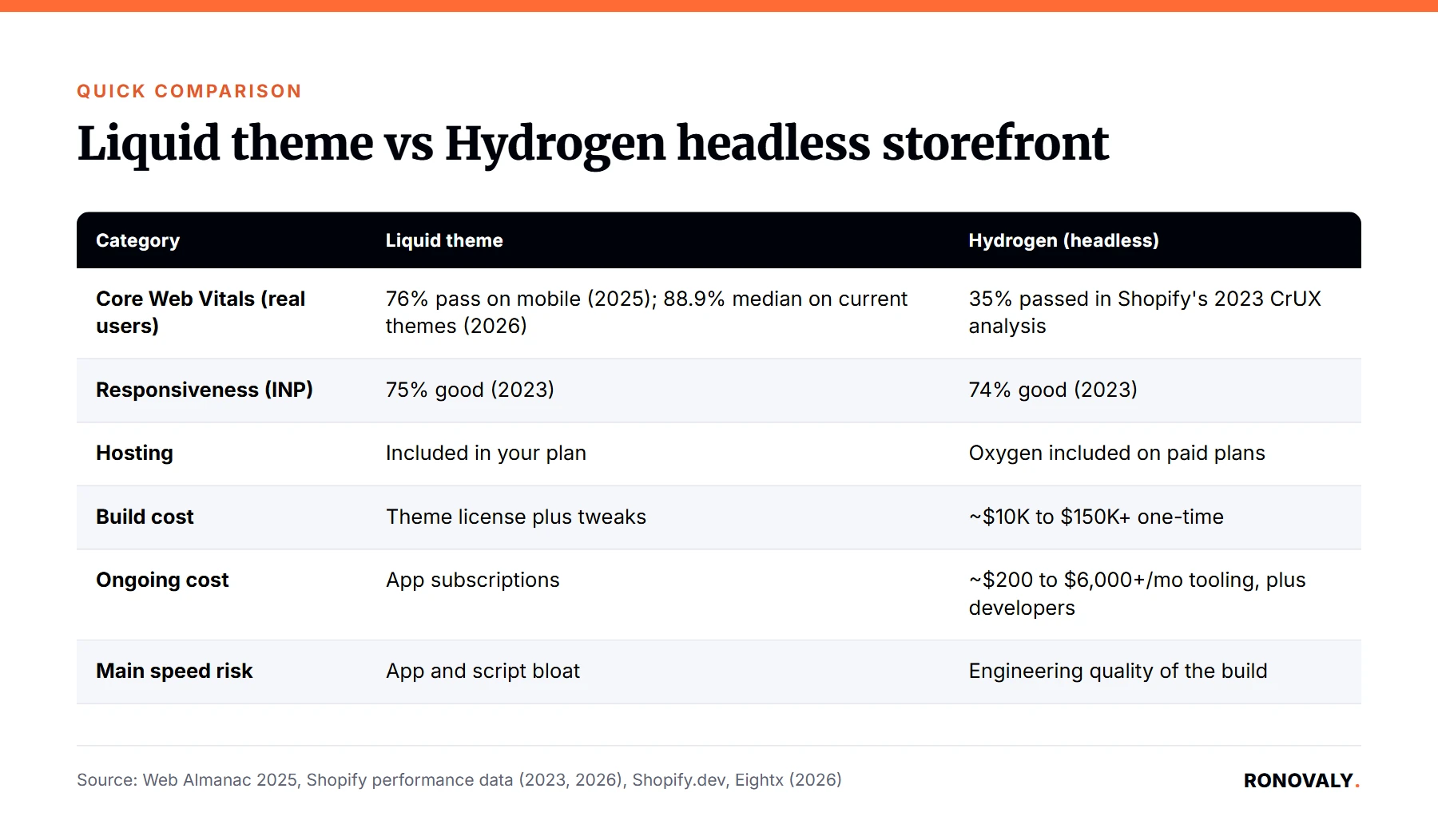
Shopify Hydrogen vs Liquid Speed: Quick Comparison
Here’s how the two setups compare on the numbers that matter to a lean team. For example, hosting is a non-issue for both, while build cost is where they split apart.
| Category | Liquid theme | Hydrogen (headless) |
|---|---|---|
| Real-user Core Web Vitals | 76% of Shopify sites pass on mobile (2025); 88.9% median on current themes (Sept 2026) | 35% of Hydrogen sites passed in Shopify’s 2023 CrUX analysis |
| Responsiveness (INP) | 75% good in Shopify’s 2023 analysis | 74% good in the same analysis |
| Hosting | Included in your Shopify plan | Oxygen included on paid plans at no extra charge |
| Build cost | Theme license plus tweaks | About $10K to $150K+ one-time (agency estimate, 2026) |
| Ongoing cost | App subscriptions | About $200 to $6,000+ a month in tooling, plus developers |
| Main speed risk | App and script bloat | Engineering quality of the custom build |
| Verdict | Faster for most stores, by default | Fast only when built and maintained well |
What Does Real-User Data Say About Liquid Speed?
Liquid stores are fast by default, according to two independent real-user datasets. The Web Almanac 2025 measured 567,932 Shopify sites on mobile. It found 86% with good Largest Contentful Paint, 90% with good Interaction to Next Paint, and 92% with good layout stability. Overall, 76% passed all three. By contrast, WooCommerce and Magento sites passed at 35% each.
Shopify’s own theme data goes further. Its theme performance table, updated September 22, 2026, covers stores on the three latest versions of each theme. The median theme passes all Core Web Vitals for 88.9% of visits. For example, Dawn sits at 89.1% and Horizon at 86.6%. However, the range runs from 37.8% to 98.8%, so theme choice still matters.
Is Hydrogen Actually Faster Than Liquid?
Not on average, based on the only public real-user comparison. In a 2023 analysis by Shopify’s performance team, 59.5% of Shopify sites passed all Core Web Vitals. In contrast, Hydrogen sites passed at 35%, while Next.js and Remix sites landed around 28% to 29%. Hydrogen did beat the other headless frameworks, though.
Two caveats matter here. First, this data is from 2023, and it comes from Shopify, which sells both options. Second, the study found responsiveness nearly tied: 75% of Shopify sites had good INP versus 74% for Hydrogen. In other words, Hydrogen’s gap was mostly about loading, not interaction.
I looked for a newer public head-to-head and didn’t find one with real-user data. As a result, treat any 2026 claim that “headless is 2x faster” with care, since it often rests on lab scores from a single, hand-tuned build.
Why Would a Hydrogen Store Be Slower?
Because the framework only sets the ceiling. The engineering sets the actual speed. A Liquid theme ships with years of platform tuning, image handling, and caching already done. A Hydrogen build starts from a custom codebase, so every data fetch, script, and image decision is yours to get right.
On the hosting side, Hydrogen is well supported. According to Shopify’s developer documentation, Oxygen is available at no extra charge on paid plans. Hydrogen is also built on React Router, which loads page data in parallel. Still, those are capabilities. Consequently, the speed you actually get depends on the team that builds and maintains the store.
What Does a Hydrogen Build Actually Cost?
More than most lean teams expect. A June 2026 breakdown by the agency Eightx puts a headless Hydrogen build at about $10K to $150K+ one-time. It adds roughly $200 to $6,000+ a month in tooling. It also calls ongoing engineering “the largest line over time.”
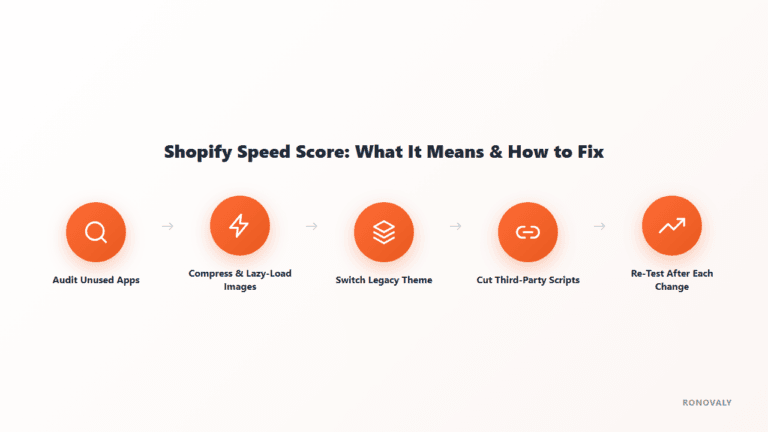
Compare that with the Liquid path. On Liquid, many speed wins come from removing apps and scripts rather than rebuilding. For example, our three-step guide to removing unused Shopify apps shows how to cut apps and the code they leave behind. Similarly, our seven proven Shopify speed fixes cost little beyond time.
Who Should Choose What
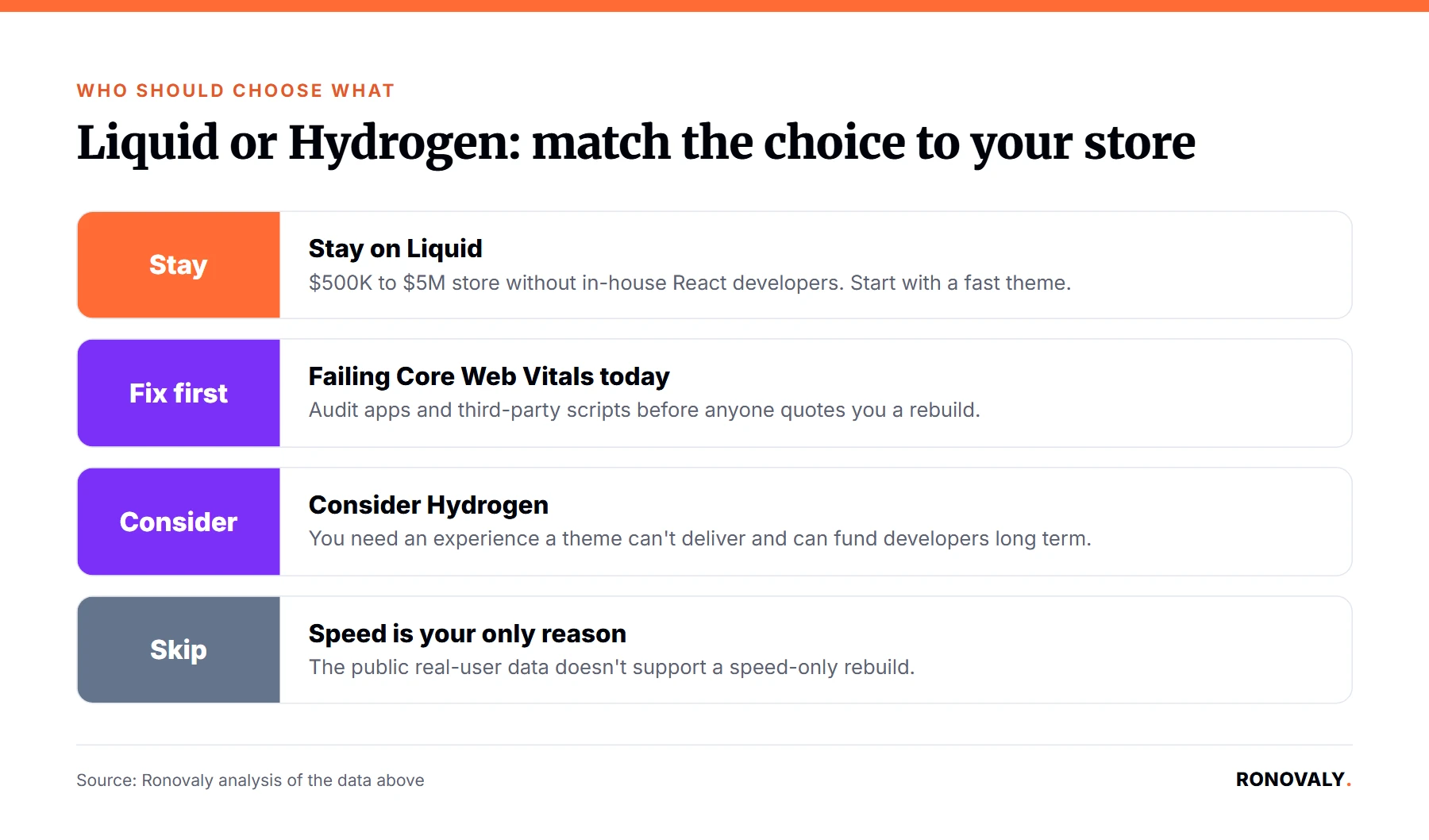
Liquid is the right call for most stores. Hydrogen fits a narrow profile. Here’s how I’d decide:
- Stay on Liquid if you’re a $500K to $5M store without in-house React developers. Start with a fast theme; our speed-tested theme roundup is a good shortlist.
- Fix Liquid first if you fail Core Web Vitals today. Check apps and third-party scripts before blaming the platform.
- Consider Hydrogen if you need experiences a theme can’t deliver, such as a fully custom product builder, and you can fund developers long term.
- Skip Hydrogen if speed is your only reason. The public data doesn’t support a speed-only rebuild.
Whichever path you pick, also watch checkout. Extensions there can add weight a theme audit misses, as covered in our checkout extensibility speed guide.
Frequently Asked Questions
Is Shopify Hydrogen faster than Liquid?
Not on average, according to the only public real-user comparison. Shopify’s 2023 analysis found 35% of Hydrogen sites passing all Core Web Vitals, versus 59.5% of Shopify sites overall. A well-engineered Hydrogen build can be very fast. However, the framework alone doesn’t guarantee it, and a poorly built one often trails a tuned Liquid theme.
Does Hydrogen hosting cost extra on Shopify?
No. Shopify’s developer documentation states that Oxygen, the hosting platform for Hydrogen, is available at no extra charge on paid Shopify plans. The real costs sit elsewhere: the custom build, third-party tooling such as a CMS or search, and the developers needed to maintain the storefront over time.
How much does a Shopify Hydrogen build cost?
One 2026 agency estimate puts a headless Hydrogen build at about $10K to $150K+ one-time. It adds roughly $200 to $6,000+ a month in tooling. Ongoing engineering is usually the largest cost over time. By comparison, most Liquid speed fixes cost little beyond a theme license and time.
Why do some Liquid stores still fail Core Web Vitals?
Mostly because of what gets added on top of the theme. Shopify’s theme data shows pass rates ranging from 37.8% to 98.8% across themes, so theme choice matters too. In practice, extra apps, third-party scripts, and oversized images are common causes of a slow Liquid store.
When is Hydrogen worth it for a mid-size Shopify brand?
When you need a storefront experience a theme can’t deliver, and you can fund React developers long term. For example, a fully custom product configurator may justify it. For a $500K to $5M store whose main goal is speed, an optimized Liquid theme is usually faster and far cheaper.
Next Steps
Start by checking where you stand today. Open your store’s Core Web Vitals in Google Search Console, then compare your theme against Shopify’s theme performance table. If you’re failing, audit apps and scripts before anyone quotes you a rebuild. Consider Hydrogen only once a feature, not a speed score, requires it.
About the Author
Alex Carter covers AI, automation, and Shopify performance for Ronovaly, focusing on what actually moves speed and cost for stores in the $500K to $5M ARR range. Editorial note: every figure in this post was fact-checked against its source on September 26, 2026, and vendor-reported numbers are labelled as such.
Sources
- HTTP Archive, Web Almanac 2025, Ecommerce chapter (2026): https://almanac.httparchive.org/en/2025/ecommerce
- Shopify, Theme performance data table (updated September 22, 2026): https://performance.shopify.com/pages/theme-performance-data-table
- Shopify Performance blog, “Liquid vs headless: A look at real user web performance” (2023): https://performance.shopify.com/blogs/blog/liquid-vs-headless-a-look-at-real-user-web-performance
- Shopify.dev, Hydrogen and Oxygen fundamentals: https://shopify.dev/docs/storefronts/headless/hydrogen/fundamentals
- Eightx, “Shopify Hydrogen now deploys to Vercel. The real cost of headless.” (2026): https://eightx.co/blog/shopify-hydrogen-vercel-headless-commerce-cost
This post contains affiliate links. If you make a purchase through these links, we may earn a commission at no extra cost to you.