Shopify Flow AI Automation: Complete Setup Guide (2026)
Shopify Flow AI Automation: Complete Setup Guide (2026)
Shopify Flow AI automation is included free on every Shopify plan, and its 2026 Sidekick AI update lets you describe a workflow in plain English instead of building it field by field. If you haven’t touched Flow yet, this is the automation to set up before you pay for anything external — usage grew 340% among merchants in 2025 for exactly that reason.
This guide is part of our complete guide to AI tools for Shopify stores. If you’ve already outgrown Flow’s internal scope, compare it against Zapier and Make for connecting to external apps.
What Is Shopify Flow (and Why It’s Free)
Shopify Flow is Shopify’s built-in, no-code automation builder — a visual editor where you define a trigger, optional conditions, and one or more actions, all without leaving your Shopify admin. It’s included on every plan at no extra cost, which sets it apart from Zapier and Make, both of which require a separate paid subscription.
The trade-off is scope. Flow’s actions are limited to Shopify’s own objects (orders, customers, products, inventory) plus a growing list of apps that have built Flow-specific triggers and actions. It can’t reach the other 6,000+ apps that Zapier connects to. For anything that needs to leave the Shopify ecosystem — Slack, Google Sheets, an external CRM — you’ll eventually need Zapier or Make. But for automations that live entirely inside your store, Flow is faster to set up and costs nothing.
What You’ll Need
- Any active Shopify plan (Flow is included, no upgrade required)
- Admin access to install the Shopify Flow app from the Shopify App Store
- 20-30 minutes to set up your first 2-3 workflows
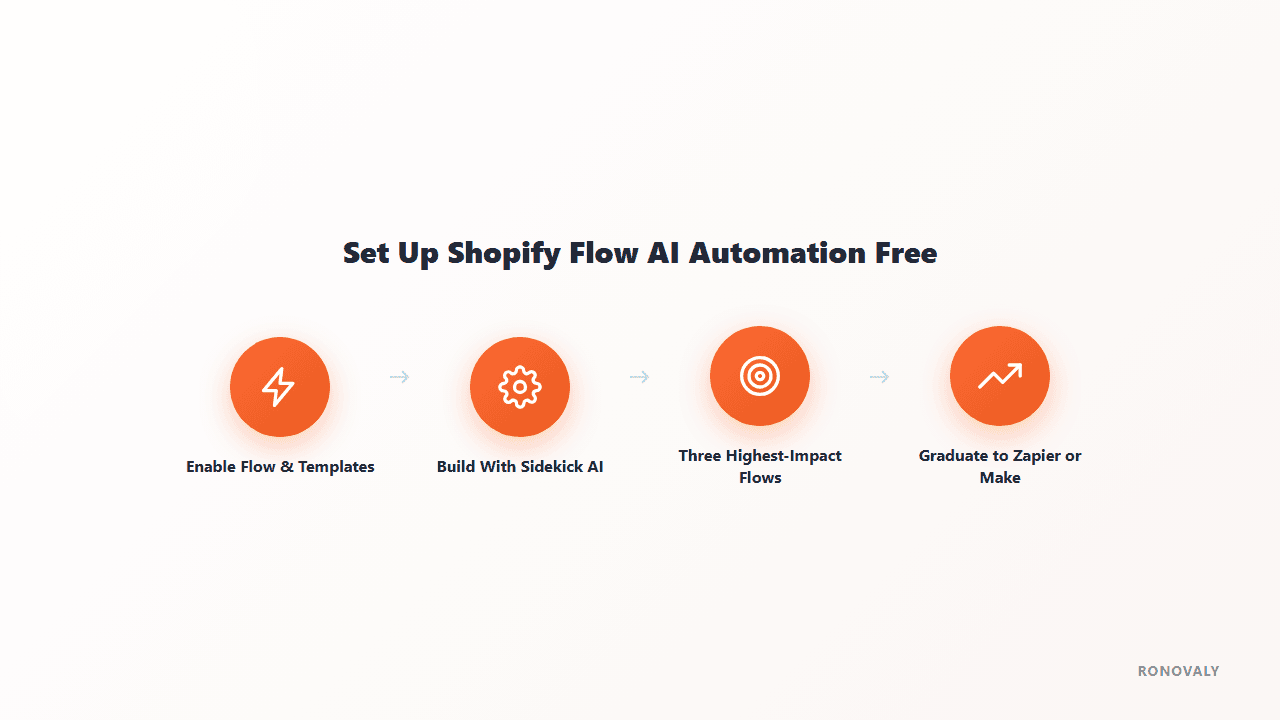
Step 1: Enable Shopify Flow and Explore the Template Library
Install Shopify Flow from the Shopify App Store — it’s a free Shopify-built app, not a third-party listing. Once installed, it appears under Apps in your admin. Open it and go straight to the official template library before building anything from scratch.
Shopify Flow’s template library contains more than 200 pre-built workflow examples, organized into categories including buyer experience, customer management, and fulfillment. A template is a ready-made workflow that store owners install with one click, then customize by changing the specific values — the inventory threshold, the notification recipient, the tag name — before turning it on. This template-first approach means most common automations don’t require building a workflow from an empty canvas at all. Categories in the library include workflows that add tags to orders based on customer behavior, send internal notifications about buyer experience issues, and manage fulfillment routing based on order location or contents, covering the majority of tasks a growing Shopify store needs to automate first. For a store owner setting up automation for the first time, working through the template library top to bottom before writing a single custom workflow is consistently the fastest path to a working setup.
Browse by category and install anything that matches a manual task you’re doing today — tagging VIP customers, flagging low stock, routing fulfillment by location are the most commonly installed templates.

Step 2: Build a Workflow with Sidekick AI
Flow’s 2026 update added Sidekick AI, Shopify’s AI assistant, directly into the workflow builder. Instead of manually selecting a trigger, adding condition blocks, and configuring actions, you describe what you want — “when an order is over $200, tag the customer as VIP and notify the fulfillment team” — and Sidekick builds the complete workflow (trigger, conditions, actions) for you to review before activating.
This mirrors what Zapier’s Copilot and Make’s AI builder do for external automations, but Sidekick has the advantage of native Shopify context — it already understands your store’s objects, so there’s less back-and-forth clarifying what data is available.
Practical example: a home goods store in Portland, Oregon, wanted to flag any order over $150 for a handwritten thank-you note before shipping. Describing that single sentence to Sidekick produced a working Flow — trigger on order creation, condition on order value, action to add an internal tag — reviewed and activated in under 3 minutes, with zero manual field configuration.

Step 3: Set Up Your 3 Highest-Impact Flows First
Don’t try to automate every process at once. These three cover the majority of what growing Shopify stores need from Flow:
- Low stock alerts — when inventory drops under a set threshold, automatically email your supplier or notify your team, instead of discovering a stockout after it’s already cost sales.
- VIP customer tagging — when an order value crosses a threshold (or a customer hits their 3rd purchase), automatically tag them for your loyalty program or a personalized follow-up.
- Fulfillment routing — when an order comes in, automatically route it to the correct location or flag it for special handling based on order details, instead of a team member manually checking every order.
These three alone account for a large share of the reported 340% growth in Flow usage during 2025 — they’re the automations with the clearest, most immediate payoff for a small team.
Step 4: When to Graduate to Zapier or Make
Flow hits its ceiling the moment a workflow needs to touch something outside Shopify — sending a Slack message, updating a Google Sheet, triggering an email in a marketing platform without native Flow support. That’s the exact handoff point covered in our guides to Zapier and Make.
The practical dividing line between Shopify Flow and external automation tools like Zapier or Make is whether every step of a workflow stays inside Shopify’s own data — orders, customers, products, inventory — or needs to reach an external application. Flow is free and faster to configure for internal-only automations because it requires no separate account or subscription and understands Shopify’s data natively through Sidekick AI. The moment a single step in a workflow needs to post to Slack, write to a Google Sheet, or trigger an action in a CRM or email platform without a dedicated Flow integration, the workflow needs an external connector. Most growing Shopify stores end up running Flow and an external tool simultaneously rather than choosing one exclusively, using Flow for internal store logic and Zapier or Make for everything that needs to leave Shopify.
A practical rule: build it in Flow first. If you hit a wall because the app or action you need isn’t available, that’s your signal to add Zapier or Make for that specific workflow — not to abandon Flow for everything.

Common Mistakes to Avoid
Skipping the template library. Building from scratch when a template already exists for your exact use case wastes time and increases the chance of a misconfigured condition. Search the library before building anything new.
Setting conditions too loosely. A “tag VIP customers” flow without a clear value threshold will tag everyone, making the tag meaningless. Define the exact condition before activating, not after you notice the tag applied to 90% of customers.
Forgetting Flow can’t reach outside Shopify without a connected app. If a workflow silently doesn’t work, the most common cause is expecting Flow to notify an app (like a non-integrated CRM) that doesn’t have a Flow action built for it. Check the action’s available app list before building around it.
Never reviewing running Flows after setup. Shopify Flow logs every run in its activity history. Review it monthly — thresholds that made sense at $50k/month in revenue often need adjusting as order volume grows.
FAQ
Is Shopify Flow really free?
Yes — Shopify Flow is included on every Shopify plan at no additional cost, unlike Zapier or Make, which both require separate paid subscriptions once you exceed their free tiers. This makes Flow the natural starting point for any Shopify store’s automation stack before adding an external tool.
What can’t Shopify Flow do?
Flow’s actions are limited to Shopify’s own objects and apps that have built specific Flow integrations. It cannot connect to the broader universe of external apps — Slack, Google Sheets, arbitrary CRMs or email platforms — unless that specific app has added Flow support. For anything outside that scope, Zapier or Make is the correct tool.
Do I need coding skills to use Shopify Flow?
No. Flow’s visual builder is designed for non-technical store owners, and the 2026 Sidekick AI update removes even the visual configuration step for most workflows — you describe the automation in plain English and review the generated workflow before turning it on.
How is Shopify Flow different from Zapier or Make?
Shopify Flow only automates actions that stay entirely inside Shopify’s ecosystem, and it’s free. Zapier and Make both connect Shopify to thousands of external apps but require a paid plan. Most well-automated stores use Flow for internal store logic (tagging, inventory alerts, fulfillment routing) and Zapier or Make for anything that needs to reach outside Shopify.
What are the most common Shopify Flow workflows?
The most frequently installed templates cover low stock alerts, VIP customer tagging based on order value or purchase count, and fulfillment routing based on order location or contents. These three cover the majority of automation needs for growing stores before more advanced, cross-app workflows become necessary.
Key Takeaways
- Shopify Flow AI automation is free on every plan — set it up before paying for Zapier or Make.
- Sidekick AI (2026) lets you describe a workflow in plain English instead of manually configuring triggers and actions.
- Start with the 3 highest-impact flows: low stock alerts, VIP tagging, and fulfillment routing.
- Flow’s ceiling is anything that needs to leave Shopify — that’s the signal to add an external tool, not replace Flow entirely.
- Most stores run Flow and an external automation tool side by side, not one instead of the other.
For the full stack comparison, see our guides to automating Shopify with Zapier and Make, or revisit the complete guide to AI tools for Shopify stores for the full picture.
This post contains affiliate links. If you make a purchase through these links, we may earn a commission at no extra cost to you.