AI Chatbot vs Human Support Shopify: When to Switch
AI chatbot vs human support Shopify is not a single verdict for every store. Instead, it is a per-ticket decision. The right split depends on your ticket volume, product complexity, order value, and how good your human support already is. Here is the pattern I see across the stores I evaluate: founders either automate everything at once and watch CSAT slip. Or, they automate nothing and burn hours on tickets a bot could close in seconds. In short, neither extreme survives contact with the data.
Key Takeaways
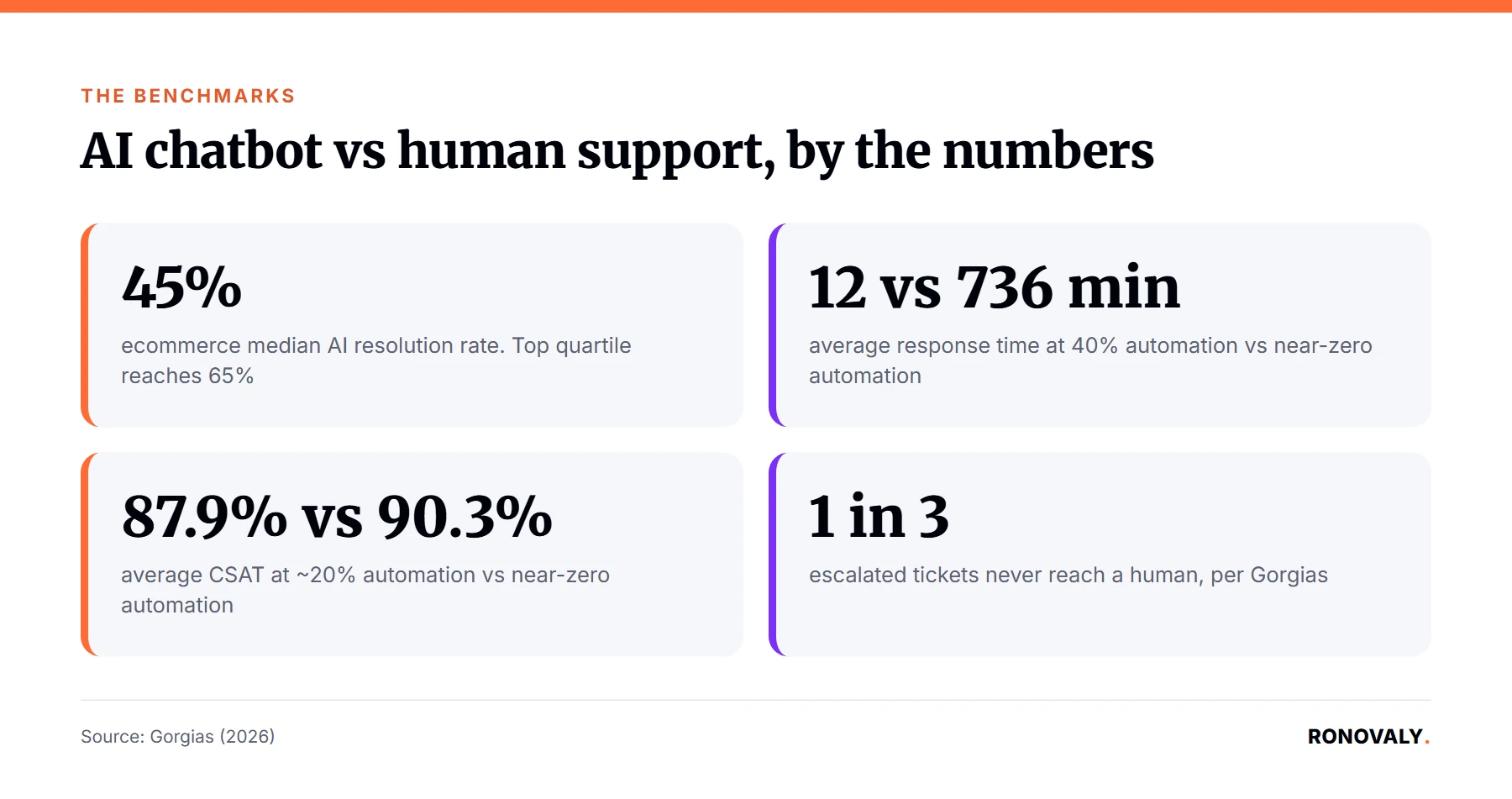
- Stores automating around 20% of tickets average 87.9% CSAT. Stores at near-zero automation average 90.3%. That is a real but narrow 2.4-point gap, not a cliff, per Gorgias’s 2026 Ecom Lab benchmark data.
- Median AI resolution rate across ecommerce brands sits at 45%, with the top quartile reaching 65%, according to the same dataset.
- Ticket volume per order varies sharply by product type. Electronics sellers see roughly 46 tickets per 100 orders. Food and beverage sellers see roughly 20. So “when to switch” depends on what you sell, not just how big you are.
- The biggest risk is not answer quality. It is the handoff. A third of tickets escalated from AI to a human never get a human response at all, per Gorgias.
- Use the scored decision matrix below, not a vendor’s resolution-rate claim, to decide how far to automate.
AI Chatbot vs Human Support Shopify: Why This Decision Is Harder Than It Looks
Ecommerce AI support adoption is still low. In fact, only about 1 in 5 ecommerce brands has deployed AI in customer-facing support today. That is per Gorgias’s 2026 Ecom Lab benchmark report (updated May 15, 2026). It is true even though the brands that have adopted it are seeing real headcount and revenue gains. As a result, a gap has opened up for a simple reason: most founders decide without a framework. Instead, they react to a vendor’s pitch deck rather than running their own numbers first.
The real tension is not “AI versus human” as a philosophy. Rather, it is that automating the wrong ticket type costs you customers. Refusing to automate the right one, meanwhile, costs you hours you do not have. Resolution rate is the share of support tickets an AI agent closes end to end, without a human stepping in. CSAT is the customer satisfaction score collected right after a support interaction, usually a 1-to-5 or percentage rating. Resolution rate is the metric every vendor leads with. However, it alone will not tell you whether automation is right for your store.
This comparison covers resolution rate, satisfaction, cost at scale, and how to handle complex or high-value tickets. Then, it gives you a scored matrix to apply to your own ticket data. If you have already decided to add AI support and need the installation steps, my colleague covers that separately in Shopify AI Customer Support: How to Set It Up. Notably, this post answers the question that comes before that guide: should you switch at all, and how far.
Quick Comparison Table
| Category | AI Chatbot | Human Support |
|---|---|---|
| Best For | Repetitive, rules-based tickets (order status, policy lookups) | Judgment calls, high-value disputes, emotionally charged tickets |
| Median resolution rate | 45% ecommerce median, 65% top quartile (Gorgias, 2026) | Not separately benchmarked; folds into the 70-75% blended target |
| Response time at scale | 12 minutes average at 40% automation (Gorgias, 2026) | 736 minutes average at near-zero automation (Gorgias, 2026) |
| CSAT | 87.9% average at ~20% automation (Gorgias, 2026) | 90.3% average at near-zero automation (Gorgias, 2026) |
| Availability | 24/7, no queue | Business hours or shift-dependent |
| Handoff risk | 1 in 3 escalated tickets never reach a human, per Gorgias | Not applicable; already human |
| Setup effort | Days to weeks: policy docs, FAQ import, testing | A hiring and training cycle |
| Cost pattern | Pay-per-resolution on Gorgias and Intercom Fin, scales with volume | Fixed headcount cost, semi-fixed with overtime or contractors |
| Our Verdict | Wins on routine tickets and speed | Wins on complex, high-value, and CSAT-sensitive tickets |
Benchmark sourcing note: every figure in this table traces to a named, dated source in the citations throughout this post. Gorgias‘s Ecom Lab figures come from platform-level behavioral data spanning thousands of ecommerce brands, updated May 15, 2026. Intercom’s Fin figures are self-reported vendor data across more than 12,000 customers, current as of June 2026.
The Chatbot-Readiness Decision Matrix
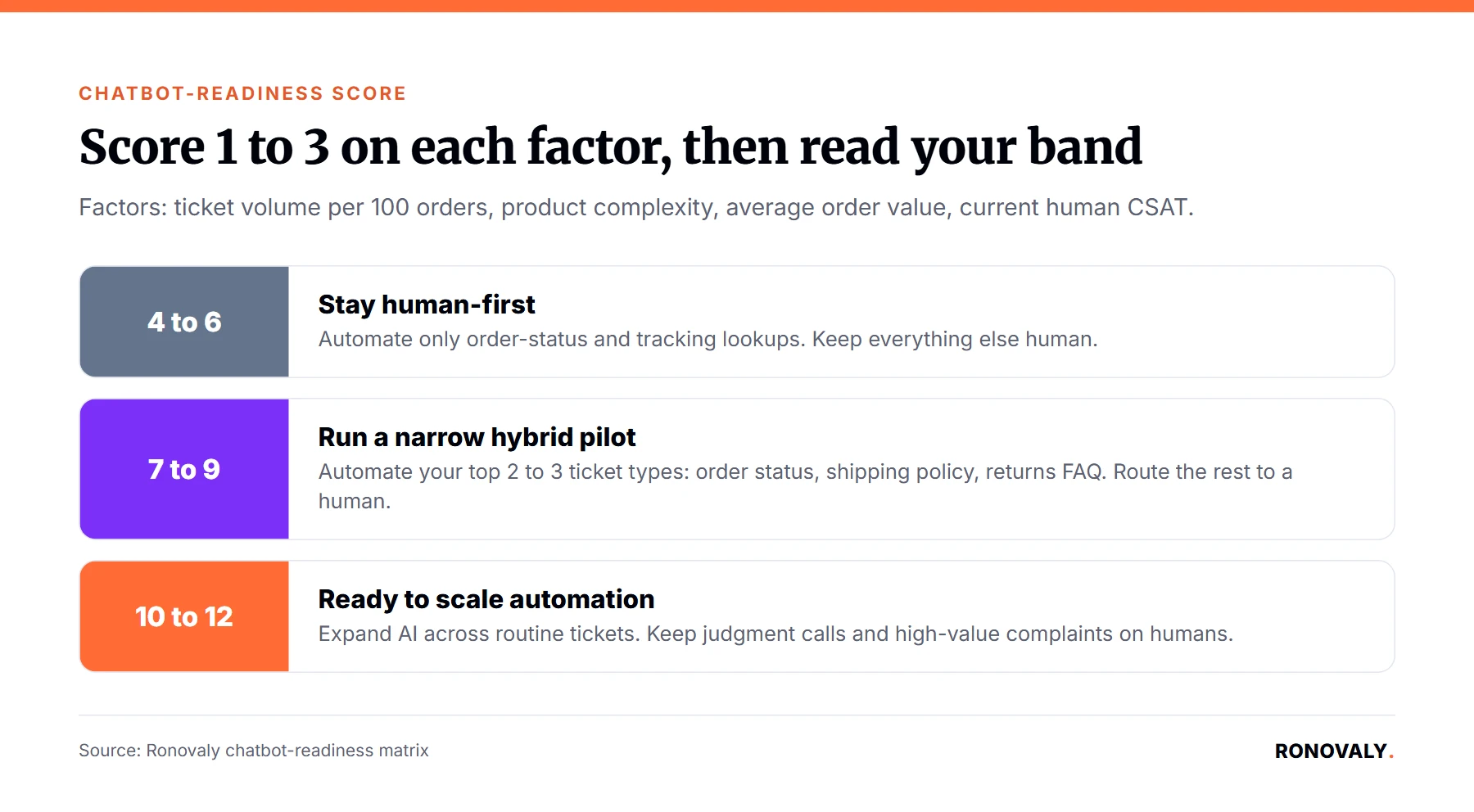
Score your store on four characteristics below. Then, add the points. The total tells you which of three action bands fits your store right now: stay human-first, run a narrow hybrid pilot, or scale automation further. This matrix is the original artifact this post exists to deliver. Specifically, I built it from the Gorgias Ecom Lab benchmarks above, not from a single vendor’s resolution-rate claim.
| Characteristic | 1 point | 2 points | 3 points |
|---|---|---|---|
| Ticket volume per 100 orders | Low, under 20 (matches food and beverage sellers) | Medium, 20 to 45 | High, 45 or more (matches electronics sellers) |
| Product complexity | High: technical specs, custom builds, sizing-critical apparel | Moderate: some variant or fit questions | Low: simple, few variants, minimal configuration |
| Average order value | High, over $150 (a wrong answer risks a costly return or chargeback) | Mid, $50 to $150 | Low, under $50 (automation errors are cheap to fix) |
| Current human-support CSAT | Above 92% (you have more to lose than gain right now) | 85 to 92% (matches the ecommerce benchmark band) | Below 85% (consistency from automation likely helps) |
Score bands and what to do:
| Total score | Band | Action |
|---|---|---|
| 4 to 6 | Stay human-first | Automate only order-status and tracking lookups. Keep everything else human. |
| 7 to 9 | Run a narrow hybrid pilot | Automate your top 2 to 3 ticket types: order status, shipping policy, and returns FAQ. Route everything else to a human, and watch CSAT for 30 days before expanding. |
| 10 to 12 | Ready to scale automation | Expand AI to a larger share of routine tickets. Keep judgment calls and high-value complaints on humans regardless of your score. |
For example, picture a technical hardware brand with a $220 average order, 92% current CSAT, and 46 tickets per 100 orders. It scores low on three of four dimensions: product complexity, order value, and CSAT. As a result, it lands at 5 to 7 points, squarely in the “stay human-first or narrow pilot” range, even though its ticket volume alone would suggest heavy automation. In short, volume is only one input, not the whole answer.
Which Wins on Speed and Availability?
AI chatbot wins on speed and availability, without a close second. Response time collapses as automation increases. For example, stores automating near 0% of tickets average a 736-minute first response. Stores at 40% automation average just 12 minutes, according to Gorgias’s 2026 benchmark data. A chatbot never clocks out. Additionally, it never builds a queue backlog after a product launch. It answers the same order-status question at 2am that it answers at 2pm.
Human support, in contrast, is bound by shift coverage and headcount. As a result, a lean team covering business hours only will always show slower averages. That gap comes purely from the overnight and weekend hours, regardless of how fast any individual agent is.
Verdict: AI wins on speed and availability for every store, with no exceptions in this category.
Which Wins on Resolution Rate for Routine Tickets?
AI chatbot wins on routine, rules-based tickets. Human support wins once a ticket needs judgment. The ecommerce-wide median AI resolution rate is 45%, with the top quartile reaching 65%, per Gorgias’s Ecom Lab data. Meanwhile, Intercom’s Fin reports an even higher self-reported average of 76% across more than 12,000 customers. Some customers, notably, exceed 85%, according to Intercom’s official Fin product page (accessed September 2026).
However, these figures blend easy and hard tickets together. “Where’s my order” and “what’s your return policy” resolve at much higher rates than a damaged-item dispute or a request that falls outside written policy. As a result, a store’s blended resolution rate says more about its ticket mix than about which vendor it picked.
Verdict: AI wins decisively on routine tickets. Neither vendor’s headline resolution rate tells you how it performs on your hardest tickets, though. So, test it on your own ticket log before trusting the number.
Which Wins on Customer Satisfaction?
Human support wins on CSAT, but the gap is smaller than most founders assume. Stores automating around 20% of tickets average 87.9% CSAT. Stores at near-zero automation average 90.3%. That is a 2.4-point difference, per Gorgias’s Ecom Lab data (updated May 15, 2026). Notably, CSAT varies only 0.2 points across 14 ecommerce verticals, despite a 5.5x swing in response time across those same verticals. In other words, speed does not automatically buy satisfaction, and a slower human team does not automatically lose it either.
Separately, Intercom reports a 90% satisfaction score for Fin on G2, 8 points ahead of its nearest named competitor. However, that figure measures satisfaction with the AI interaction specifically, not a blended store-wide CSAT.
Verdict: Human support wins on CSAT today, by a real but modest margin. The gap narrows further once automation is scoped to genuinely routine tickets instead of applied broadly.
Which Wins on Complex or High-Value Tickets?
Human support wins on complex and high-value tickets, and this is the category where getting it wrong costs the most. A damaged-item dispute, a custom order gone sideways, or a $300 order with a shipping problem all involve judgment. They involve empathy, too. Sometimes they involve a policy exception a bot is not authorized to make. Routing these to AI does not just risk a bad answer. It also risks losing a customer who was already frustrated before the ticket started.
The data backs the caution here. Handoff abandonment is what happens when an AI agent escalates a ticket but no human ever follows up, and it is far more common than founders expect. Specifically, a third of tickets handed off from AI to a human never receive a human response at all. Additionally, the median wait between handoff and human reply is 10 hours, with a 90th percentile of 71 hours, per Gorgias. In short, the handoff itself, not the AI’s initial answer, is where high-value tickets most often go wrong.
Verdict: Human support wins clearly. If you automate any part of a high-value ticket flow, test the handoff mechanism on its own first. Trust it with a customer who matters only after it passes.
Which Wins on Cost as Volume Grows?
AI chatbot wins on marginal cost as ticket volume grows. Human support wins on cost predictability at low volume. Both major AI support vendors, Gorgias and Intercom’s Fin, price their AI agents on a pay-per-resolution basis. That is true according to their own pricing and product pages, and it is not a flat seat fee (accessed September 2026). Therefore, cost scales directly with ticket volume. It does not jump in discrete hiring increments the way headcount does.
The outcome data supports this at the store level. Specifically, 23.5% of brands reduced their support team size after adopting AI. Meanwhile, 51% achieved fewer people, the same ticket volume, and flat or higher revenue, all at once, per Gorgias. Among brands that kept headcount steady, the remaining agents handled 29% more tickets per month while revenue grew 22%. Even so, the lowest-automation tier of brands still nets an estimated $73,000 per year after platform costs.
Verdict: AI wins on cost efficiency at meaningful scale. Below roughly 20 to 30 tickets a month, though, a per-resolution AI fee can cost more than the time it saves. Run the math against your own last month’s ticket count first.
Who Should Choose What
A founder with under 30 tickets a month and mostly simple products: stay human-first for now. Your volume does not justify the setup time, and as a result, a per-resolution AI fee may cost more than the hours it saves.
A founder selling technical or high-AOV products with strong current CSAT: run a narrow hybrid pilot on order-status and shipping-policy tickets only. Your matrix score likely lands in the 7 to 9 range. Here, protecting your CSAT matters more than chasing a resolution-rate headline.
A founder with high ticket volume, simple products, and CSAT already under 85%: you are the clearest case for scaling automation. Your matrix score likely lands at 10 or higher, so consistency from AI is more likely to help than hurt.
If your handoff process is not tested yet: pause before switching any ticket type. After all, a fast AI answer followed by 10 hours of silence after handoff is worse for the customer than a slower human reply from the start.
Frequently Asked Questions
How do I know if my Shopify store is ready for an AI support chatbot?
Score your store on the four-part matrix above: ticket volume per 100 orders, product complexity, average order value, and current CSAT. A total of 4 to 6 points means stay human-first, 7 to 9 means run a narrow pilot, and 10 to 12 means you are ready to scale automation on routine tickets.
What percentage of support tickets can AI chatbots actually resolve on Shopify?
The ecommerce-wide median is 45%, with top-quartile stores reaching 65%, according to Gorgias’s 2026 Ecom Lab benchmark data. However, vendor-reported figures like Intercom Fin’s 76% average blend easy and hard tickets together, so treat any single resolution-rate number as a starting estimate, not a guarantee for your own ticket mix.
Will switching to an AI chatbot hurt my customer satisfaction score?
It can, but the effect is smaller than most founders expect. Stores automating around 20% of tickets average 87.9% CSAT, versus 90.3% at near-zero automation, a 2.4-point gap, per Gorgias. Therefore, scoping automation to genuinely routine tickets, rather than applying it broadly, is what keeps that gap narrow.
Which support ticket types should always stay with a human agent?
Damaged-item disputes, custom or high-value order problems, policy exceptions, and anything already emotionally charged should stay human regardless of your readiness score. These are the tickets where a wrong or delayed answer costs the most, and where AI handoff failures do the most damage.
What happens when an AI chatbot hands off a ticket to a human, and what can go wrong?
The handoff itself is the weakest link, not the AI’s initial answer. In fact, a third of tickets handed off from AI to a human never get a human response at all, and the median wait is 10 hours, per Gorgias’s 2026 data. So, test your handoff flow before trusting it with any ticket that matters.
Is Gorgias or Intercom Fin better for a small Shopify store just starting with AI support?
Both price their AI agent on a pay-per-resolution basis rather than a flat fee. So, the better fit depends on your existing helpdesk and ticket volume more than a feature comparison. Run last month’s ticket count against each vendor’s published pricing model before committing. Per-resolution costs scale with volume in ways a flat monthly quote does not show.
Can I run AI chatbot support and human support at the same time without confusing customers?
Yes, and the hybrid model is what the benchmark data actually recommends over an all-or-nothing switch. Route ticket types by the matrix above, and keep the AI’s scope narrow and visible to the customer. Monitor your handoff response time specifically, since that is where hybrid setups most often break down.
The Verdict
| Category | Winner |
|---|---|
| Speed and availability | AI Chatbot |
| Resolution rate on routine tickets | AI Chatbot |
| Customer satisfaction | Human Support |
| Complex or high-value tickets | Human Support |
| Cost efficiency at scale | AI Chatbot |
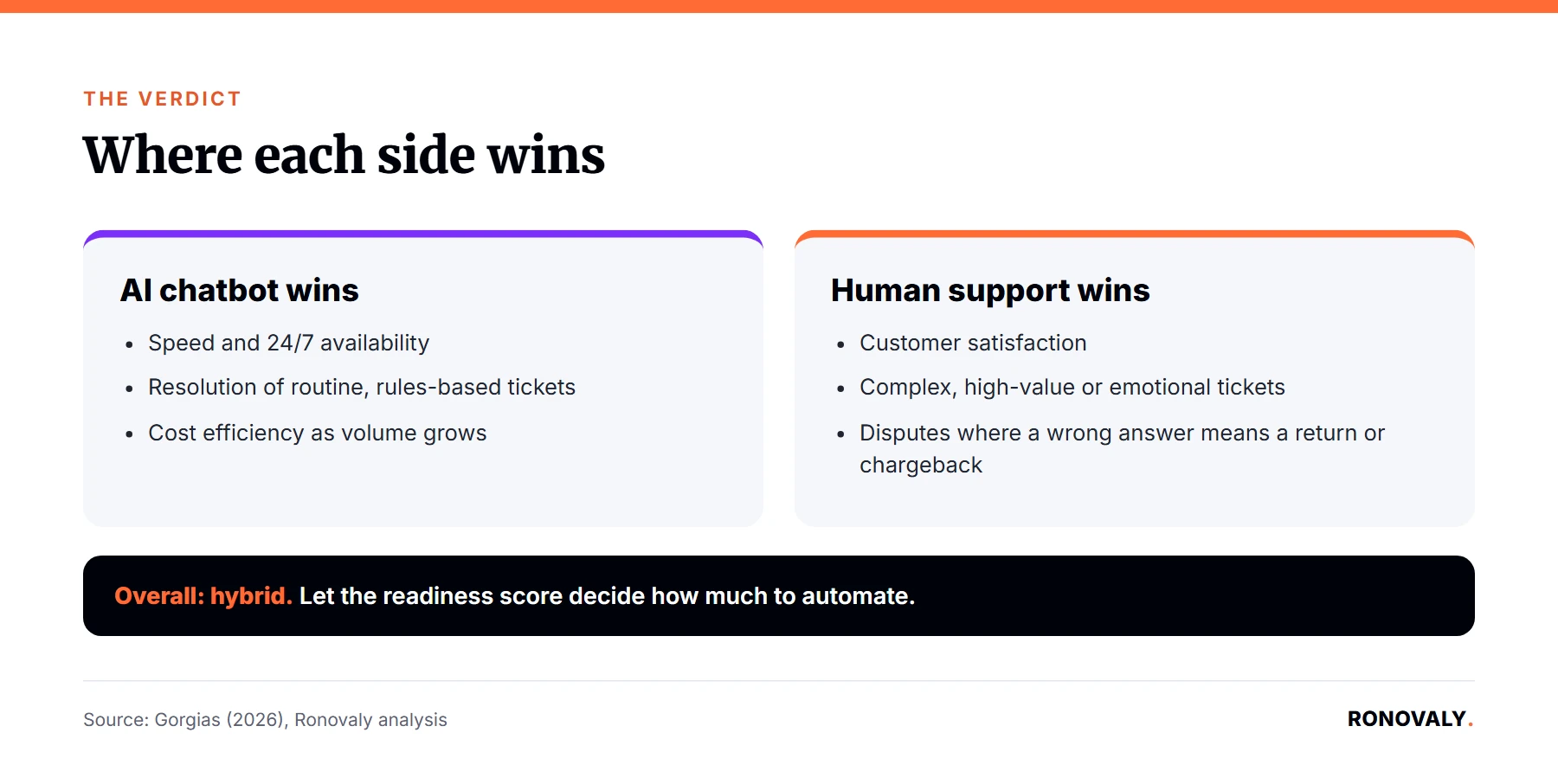
| Overall | Hybrid, scored by the matrix above |
In short, there is no universal winner between AI chatbot and human support for Shopify stores, and the benchmark data does not support pretending there is one. Instead, score your store on ticket volume, product complexity, order value, and current CSAT. Then, automate the ticket types the matrix clears you for. Regardless of where your total score lands, keep judgment calls, high-value disputes, and anything already emotionally charged on a human.
First, if you have not audited which of your tickets are actually repetitive versus which need judgment, that audit is the first step in my colleague’s Shopify AI Customer Support setup guide, and it pairs directly with the matrix here. Next, once you have picked a tool, my audit of hidden Shopify AI app stack subscription costs covers exactly where per-resolution AI pricing can surprise you at renewal. Finally, if you are documenting the resulting workflow so a teammate can run it without you, I cover that process in SOPs for Shopify founders.
I’m Alex Carter, and I write about AI tools and automation for Ronovaly. You can read more about how we test these workflows on real stores on our About page, or reach our editorial team through Contact. Every statistic in this piece is fact-checked against its named source before publish.
This post contains affiliate links. If you make a purchase through these links, we may earn a commission at no extra cost to you.