Shopify Magic Review 2026: Is It Worth Using for Your Store?
Shopify Magic Review 2026: Is It Worth Using for Your Store?
Shopify Magic is free on every plan, and for product descriptions alone it’s worth turning on today — the short answer is yes, with real limits you should know before you rely on it for everything. This review is based on what Magic actually does well in 2026, where it falls flat, and which of its features are worth your time versus which ones you should skip in favor of a specialized tool.
This is part of our complete guide to AI tools for Shopify stores. If you’ve outgrown Magic’s product description generator specifically, see our guide to AI product descriptions at scale.
What Is Shopify Magic?
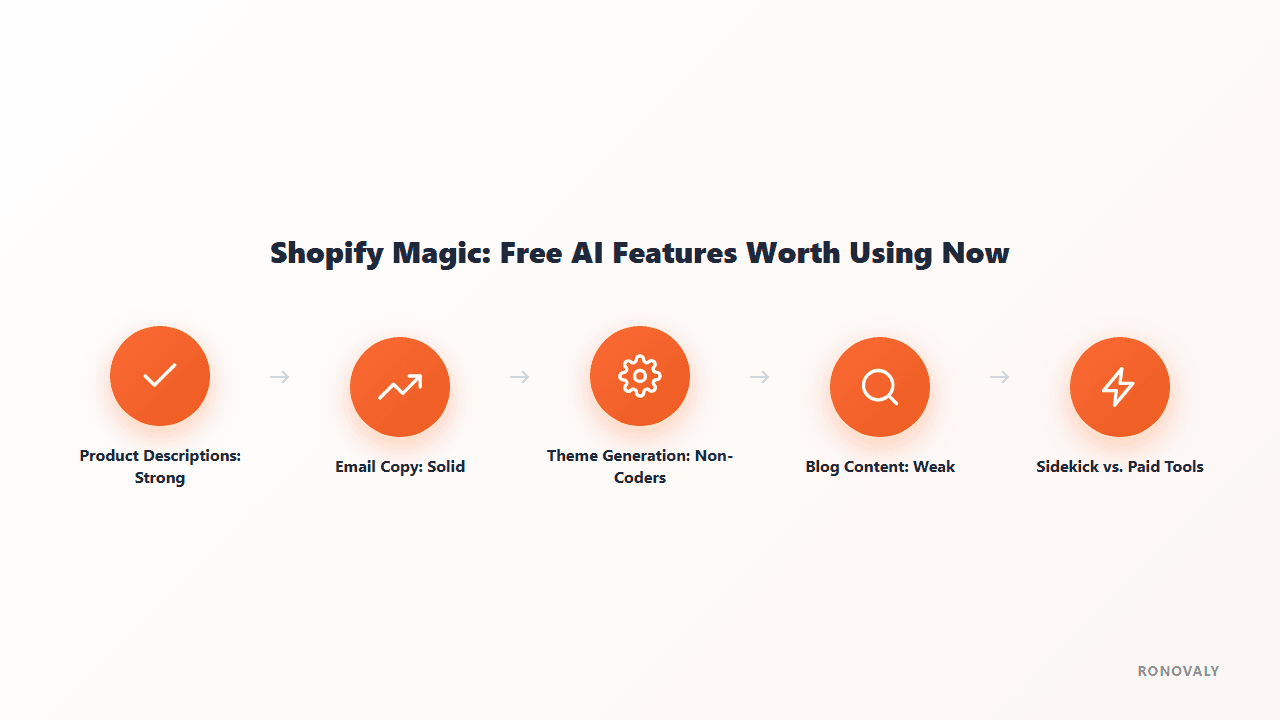
Shopify Magic is a suite of free, AI-powered features built directly into the Shopify admin — available on every plan at no extra cost, regardless of tier. It’s not one tool but a collection of AI assists woven into different parts of Shopify: product descriptions, email copy, blog content, theme generation, and image editing, plus Sidekick, Shopify’s conversational AI assistant that can answer questions about your store’s own data and perform actions on request.
The core value proposition: Magic uses your store’s existing data to generate content in seconds, without a separate subscription or API key. Shopify’s own help center page on Magic lists the full feature set if you want the platform’s official documentation alongside this review.
How to Turn On Shopify Magic
Most Magic features are already active by default across your admin — there’s no separate install or toggle for the suite as a whole. Where you’ll actually use it:
- Product descriptions: open any product page in your admin, and you’ll see a “Generate description” option near the description field.
- Email copy: inside Shopify Email, the campaign editor includes a Magic-generated subject line and body copy option before you finalize a send.
- Sidekick: accessible from a persistent icon in the Shopify admin, ready to answer store-specific questions at any time.
- Theme blocks: inside the theme editor, look for the option to describe a custom block in plain text.
There’s no plan restriction to unlock any of this — a store on Shopify’s entry-level plan sees the same Magic feature set as one on Shopify Plus.

Key Features, Reviewed Honestly

Product Description Generation — Strong
This is Magic’s best feature by a clear margin. Feed it a product title and a few keywords, and it generates a description that adapts tone and highlights key benefits, producing genuinely usable, SEO-friendly copy. For a catalog of 100+ products, the time saved alone justifies turning it on, even if every description gets a light manual edit afterward.
Shopify Magic’s product description generator is consistently rated the strongest feature in the suite because it draws directly on structured product data already in the store — title, category, existing tags — rather than requiring the merchant to write a detailed prompt from scratch. Independent reviews across 2026 report that Magic handles roughly 50 to 60 percent of a typical store’s content needs, with product descriptions and email subject lines as the most reliable outputs. Available on all Shopify plans at no additional cost, the feature is estimated to save the average merchant meaningful weekly time on content creation that would otherwise require either manual writing or a separate paid AI copywriting subscription. The remaining 40 to 50 percent of content needs — deep blog content, complex email sequences, brand-voice-specific copy — are where Magic’s limitations become the clearest signal for which paid tools are actually worth adding.
Practical example: a home goods store in Raleigh, North Carolina, with roughly 320 SKUs used Magic to generate first-draft descriptions for their entire catalog in an afternoon instead of the 15-20 hours a manual rewrite would have taken, then spent about 3 hours doing light edits for brand voice consistency — a fraction of the original time investment.
Email Campaign Copy — Solid
Magic generates subject lines, body copy, and CTAs for marketing emails based on the campaign’s purpose. It’s a reasonable starting point for merchants without a dedicated email strategy, though the output tends toward generic phrasing that benefits from a pass of brand-voice editing before sending.
Theme and Block Generation — Useful for Non-Coders
Describe a custom theme section in plain text, and Magic generates the underlying Liquid code without requiring coding knowledge. This is genuinely useful for merchants who want a custom section but don’t want to hire a developer for something minor.
Blog Content Generation — Weak
This is Magic’s clear weak point. The blog content output tends to be thin and generic, lacking the depth, personal experience, and strategic internal linking that actually performs in search. If you’re serious about content marketing, this is the one Magic feature worth skipping entirely in favor of dedicated research and writing.
Product Image Editing — Fine for Quick Cleanup
Magic can remove backgrounds and touch up product photos directly in the admin without a separate design tool. It’s genuinely convenient for a quick background swap on a phone-shot product photo, though it won’t replace a real product photography workflow for a brand that depends on visual quality as a differentiator.

Shopify Magic vs. Sidekick vs. Third-Party AI Tools
Sidekick is Magic’s conversational layer — an AI assistant trained specifically on Shopify’s own features that can answer store-specific questions and take actions on request, functioning more like an AI co-pilot than a content generator. Magic’s individual features (descriptions, email copy, theme blocks) are task-specific tools you invoke one at a time.
Where Magic and Sidekick both hit a ceiling: they’re limited to the Shopify ecosystem. Neither handles supplier communication, doesn’t generate the kind of strategic, link-rich blog content that ranks, and doesn’t offer the depth of customization that a specialized paid tool provides for its specific job. That’s the practical signal for when to upgrade — once you’ve identified which 40-50% of your content needs Magic doesn’t cover well, that gap tells you exactly which category of paid tool to evaluate next, whether that’s a dedicated product description tool at scale or a specialized email marketing platform.
Is Shopify Magic Worth Using?
Yes, unambiguously, for product descriptions and email copy — it’s free, already installed, and the time savings are immediate with zero setup cost. Independent 2026 testing, including a 60-day hands-on review, reaches the same conclusion: strong on descriptions and email, weak on blog content. The honest caveat: don’t expect it to replace a real content strategy or a specialized tool once your store outgrows generic AI output.
The practical verdict on Shopify Magic in 2026 is that it earns its place as a default-on feature for any Shopify store, specifically for product descriptions, email subject lines, and SEO metadata generation, because the cost is zero and the setup requires no additional account or integration. Its clearest weakness is blog content generation, which produces thin, generic output unsuitable for serious content marketing without substantial manual rewriting. The most efficient way to evaluate Magic is to turn on every feature for two weeks, track which outputs get used with minimal editing versus which get discarded or heavily rewritten, and treat the discarded categories as a direct shopping list for which specialized paid tool to evaluate next rather than trying to force Magic to do a job it’s not built for.
FAQ
Is Shopify Magic really free?
Yes — Shopify Magic is included on every Shopify plan at no additional cost, unlike most AI writing or design tools that require a separate subscription. There’s no tier restriction; a store on the entry-level plan has access to the same Magic features as one on Shopify Plus.
What is Shopify Sidekick and how is it different from Magic?
Sidekick is Shopify’s conversational AI assistant, trained specifically on Shopify’s own features and your store’s data, designed to answer questions and take actions on request. Magic refers to the broader suite of task-specific AI features (product descriptions, email copy, theme blocks) that you invoke individually. Sidekick is closer to an AI co-pilot; Magic’s other features are closer to point-solution content generators.
Is Shopify Magic good enough for blog content?
No — this is consistently rated Magic’s weakest feature. The output tends to be thin, generic, and lacks the depth, personal experience, and strategic internal linking that actually performs in search rankings. For serious content marketing, dedicated research and writing (or a specialized content tool) outperforms Magic’s blog generator significantly.
Should I use Shopify Magic instead of a paid AI copywriting tool?
Start with Magic since it’s free and already available — use it for two weeks and note which outputs need heavy editing versus which are usable as-is. The categories requiring heavy editing are your signal for where a paid, specialized tool is worth the investment. Most stores end up using Magic for descriptions and email while adding a dedicated tool for blog content or advanced personalization.
Does Shopify Magic work on every Shopify plan?
Yes — Magic’s core features are available regardless of subscription tier, from the entry-level plan through Shopify Plus. This is different from most competing AI tools in the Shopify ecosystem, which typically gate advanced features behind higher-priced plans.
Key Takeaways
- Shopify Magic is free on every plan — turn it on for product descriptions and email copy immediately, there’s no downside.
- Product descriptions are Magic’s strongest feature; blog content generation is its clear weak point.
- Sidekick is the conversational AI layer; Magic’s other features are task-specific generators you invoke individually.
- Use Magic for two weeks, track what needs heavy editing, and let that gap tell you which paid tool to evaluate next.
- Magic handles roughly half of a typical store’s content needs — the other half is where specialized tools earn their cost.
For the full AI stack comparison, revisit the complete guide to AI tools for Shopify stores, or go deeper on product descriptions at scale once you’ve outgrown Magic’s default output.
This post contains affiliate links. If you make a purchase through these links, we may earn a commission at no extra cost to you.