ChatGPT DTC Content System: How to Avoid Generic Brand Copy
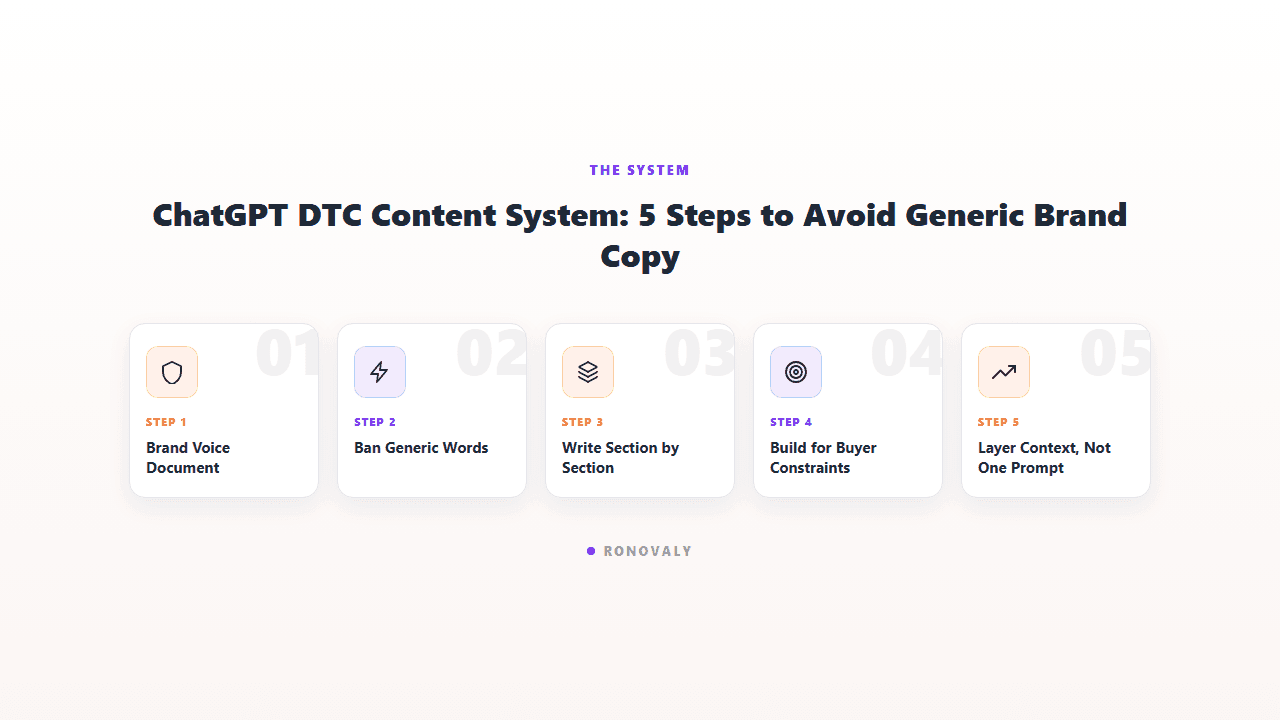
ChatGPT sounds generic by default for one reason: vague instructions produce vague output. Most founders give it a topic instead of a system. “Write a blog post about our new candle scent” gives ChatGPT nothing to set your brand apart from every other candle brand it has seen. The 5-step system below fixes that. It isn’t a better single prompt. It’s a repeatable structure that forces specific output every time.
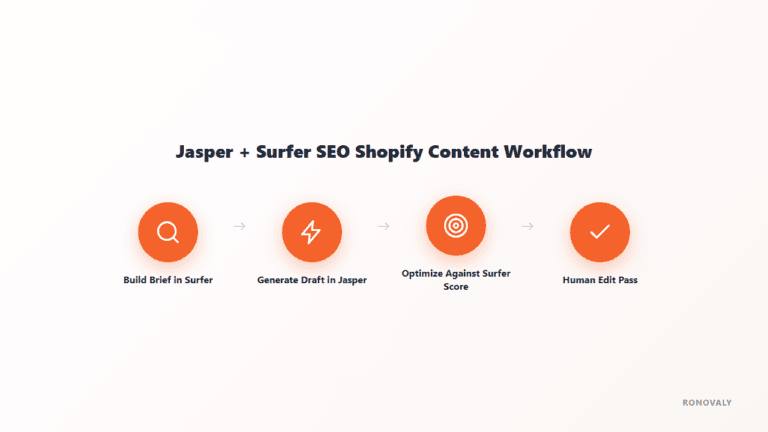
This is part of the AI productivity stack for Shopify founders. If you already run the Jasper + Surfer SEO workflow for competitive long-form content, this is the lighter version for everyday brand content. Think social captions, email copy, and product story pages that don’t need a full SEO pass.
Why ChatGPT Output Sounds Generic by Default
The model isn’t bad at brand voice. It just can’t tell your voice from anyone else’s unless you spell it out, every time. Without clear guidelines, it falls back on the average of everything it has seen. That reads as competent, safe, and interchangeable with every other brand.
This matters more now that AI search has grown. Research on why AI recommends some brands and not others found that brands with consistent, specific, repeated positioning show up in AI answers. Brands with vague, lofty messaging often don’t appear at all. So generic content doesn’t just read poorly to people. It also fails to build the clear, repeated signal that gets a brand cited by AI in the first place.
What You’ll Need
- A written brand voice document. Not a feeling you carry in your head, but an actual file you paste into every prompt.
- A list of words and phrases you’ve noticed feel generic or overused in your industry
- 45-60 minutes to build the system once; each piece of content after that takes minutes, not hours

Step 1: Build a Brand Voice Document ChatGPT Can Actually Use
Most founders know their brand voice by feel but have never written it down clearly enough for ChatGPT to use. The fix is a short, concrete document: tone words, clear do’s and don’ts, and 3-5 sample sentences that sound unmistakably like you. Paste it into every content prompt. Don’t trust the model to remember your brand from an earlier chat. It won’t.
A usable brand voice document is short, concrete, and ready to paste. The best format has three parts. First, tone words: specific adjectives, not “professional and friendly.” Second, clear rules on what to avoid. Third, 3-5 sample sentences that show the voice instead of describing it. Put the document right into every content prompt: “Use the following brand voice guidelines for all output: [document], now write a [content type] about [topic].” Each new chat starts without that context unless you supply it again.

Step 2: Ban the Words That Make Everything Sound the Same
A short list of words shows up far too often in generic AI output, in every industry: delve, landscape, evolving, nuanced, perspective, paradigm, comprehensive, supercharge, framework, synergy, transformative, holistic. None of them is wrong. They’re just so overused in AI content that seeing them signals the text wasn’t crafted with care. Add a ban list to your prompt: “Do not use any of the following words: [list].”
Independent testing on avoiding generic AI output confirms the same core list holds across industries and uses, not just content marketing. Pair the ban list with a structure rule: reject the stock AI essay shape. Tell it not to open with a long scene-setting intro. Tell it not to end with a generic summary. And tell it not to hedge every claim with “it’s important to note.” These patterns are as easy to spot as the overused words, and just as easy to ban.
Step 3: Write Section by Section, Not the Whole Piece at Once
Writing a full 1,500-word piece in one prompt tends to go generic by the middle and end. Over a long single output, the model loses the detail of your opening instructions. Write section by section instead. Draft one H2 at a time, and paste a short voice reminder before each: “Continue in [Brand]’s voice, keep sentences under 15 words, no corporate jargon.” Don’t count on one instruction at the top to hold for the whole piece.
This takes a little longer per piece than one-shot output. But a section-by-section piece needs far less editing afterward, so it’s rarely a real tradeoff. Forbes’ reporting on writing with ChatGPT reaches the same conclusion from another angle: the real cost of generic AI content shows up in editing, not in writing time.

Step 4: Build for Buyer Constraints, Not Generic Topics
The content that works best for DTC brands, with both human readers and AI systems that recommend products, answers a specific buying constraint rather than a broad topic. “Best gift for a runner under $100” beats “great gifts for athletes.” “Waterproof backpack for commuting” beats “backpacks we love.” The best version names the buyer, the use case, the constraint, and the proof, all in one section. A generic prompt won’t produce that on its own.
When you prompt ChatGPT for this kind of content, give it the actual constraint, not the broad category: “Write a product story for [specific product] targeted at [specific buyer] solving [specific constraint], including [specific proof point].” The more specific the input, the less room the model has to go generic.
Step 5: Layer Context Instead of One Giant Prompt
Don’t cram everything into one dense paragraph. Give context in three layers. Immediate context: what’s happening now, meaning the product, launch, or moment this content is for. Background context: what led here, meaning why the product exists and what problem it solves. Outcome context: what success looks like, meaning what you want the reader to do or feel. Layered context tends to give more specific output than the same facts in one unstructured block.
Common Mistakes
Assuming one good prompt will work forever. Brand voice documents need updates as your brand grows. A guide written at launch often needs a refresh once you have real customer language and reviews to draw from.
Skipping the ban list because it feels unnecessary. The overused-word pattern shows up in AI output on almost any topic. Banning those words takes 10 seconds and makes a clear difference.
Writing full pieces in one shot to save time. The time you save up front is lost in editing. Section-by-section writing with voice reminders gives content that needs far less revision.
Writing generic topics instead of specific constraints. “5 tips for better skincare” is a topic. “Skincare routine for sensitive skin after switching climates” is a constraint. The constraint version is the one more likely to convert and to get cited by AI search.
Never testing whether the system works. Compare a piece made with the full system against your last few generic-feeling pieces. If you can’t tell the difference, you’re skipping a step.
FAQ
Why does ChatGPT sound generic even when I give it a topic?
A topic alone gives the model nothing to set your voice apart from a competitor’s. Generic output is what vague instructions produce by default. The fix isn’t one better prompt. It’s a paste-ready brand voice document, a banned-word list, and a constraint-based topic.
How long does it take to build this content system?
The brand voice document and ban list take 45-60 minutes, once. After that, each piece takes minutes instead of hours, because you reuse the system instead of rebuilding it.
Does this content system work for product descriptions too?
It can. But for simple product descriptions at scale, Shopify Magic or a dedicated tool is usually faster, since it’s built for that format. This system shines for brand stories, social captions, and email copy, where voice and detail matter more than product data.
Why does brand specificity matter for AI search, not just human readers?
AI systems look for patterns across everything published about a brand: product pages, reviews, press, and your own content. Brands with consistent, specific, repeated positioning show up more often in AI recommendations. Brands with vague messaging often don’t appear at all, no matter how much they publish.
Can I use this same system with Claude or other AI models instead of ChatGPT?
Yes. The core idea (specific input gives specific output, vague input gives generic output) applies to all major models, not just ChatGPT. The exact prompt may need small tweaks, but the five steps work with any model.
Key Takeaways
- Generic ChatGPT output is a symptom of vague prompts, not a fixed limitation of the model — specificity fixes it consistently.
- A short, paste-ready brand voice document with real example sentences beats a long aspirational one every time.
- Ban the overused AI-content vocabulary explicitly; it’s a 10-second addition with a measurable effect on output.
- Write section by section with voice reminders instead of generating full pieces in one shot.
- Build content around specific buyer constraints, not general topics — it performs better with both human readers and AI search systems.
For the more structured, SEO-focused version of AI-assisted content, see the Jasper + Surfer SEO workflow. For the AI search angle mentioned throughout, see AI SEO for Shopify.
This post contains affiliate links. If you make a purchase through these links, we may earn a commission at no extra cost to you.