AI Dynamic Pricing Shopify Small Brands: FAQ (2026)
AI dynamic pricing shopify small brands questions all come down to one line: volume and margin. In other words, your order flow has to be high enough to test a price change. Your margin also has to be thick enough to absorb the tool’s own fee. As a result, below that line, dynamic pricing usually costs more than it earns. I get asked about this constantly by founders in the $500K-$5M ARR range. They see a competitor’s price move in real time, and they assume they need the same setup. In fact, most of them don’t, at least not yet.
This FAQ is a decision framework built from the pricing, margin and consumer-survey data cited below. It covers what dynamic pricing costs on Shopify today. It also names which tools fit a small catalog versus an enterprise one, plus the honest trust risk that visible price changes carry. Importantly, I built the break-even table below from real, dated vendor pricing and margin benchmarks. As a result, it reflects sourced constraints, not one store’s anecdote.
Key Takeaways
- A small brand’s pricing math depends on four factors together: SKU count, margin percent, price elasticity, and competitive density. No single factor decides it alone.
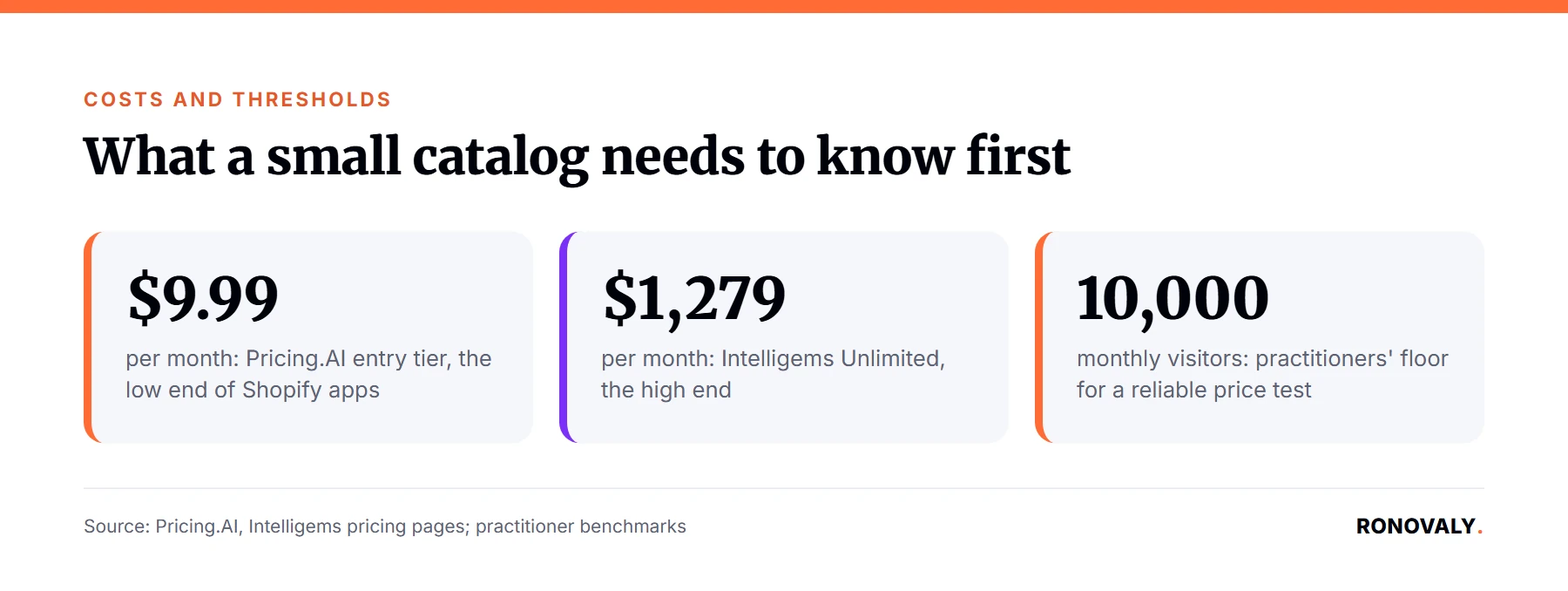
- Specifically, Shopify dynamic pricing apps range from $9.99 a month (Pricing.AI’s entry tier) to $1,279 a month (Intelligems’ Unlimited plan).
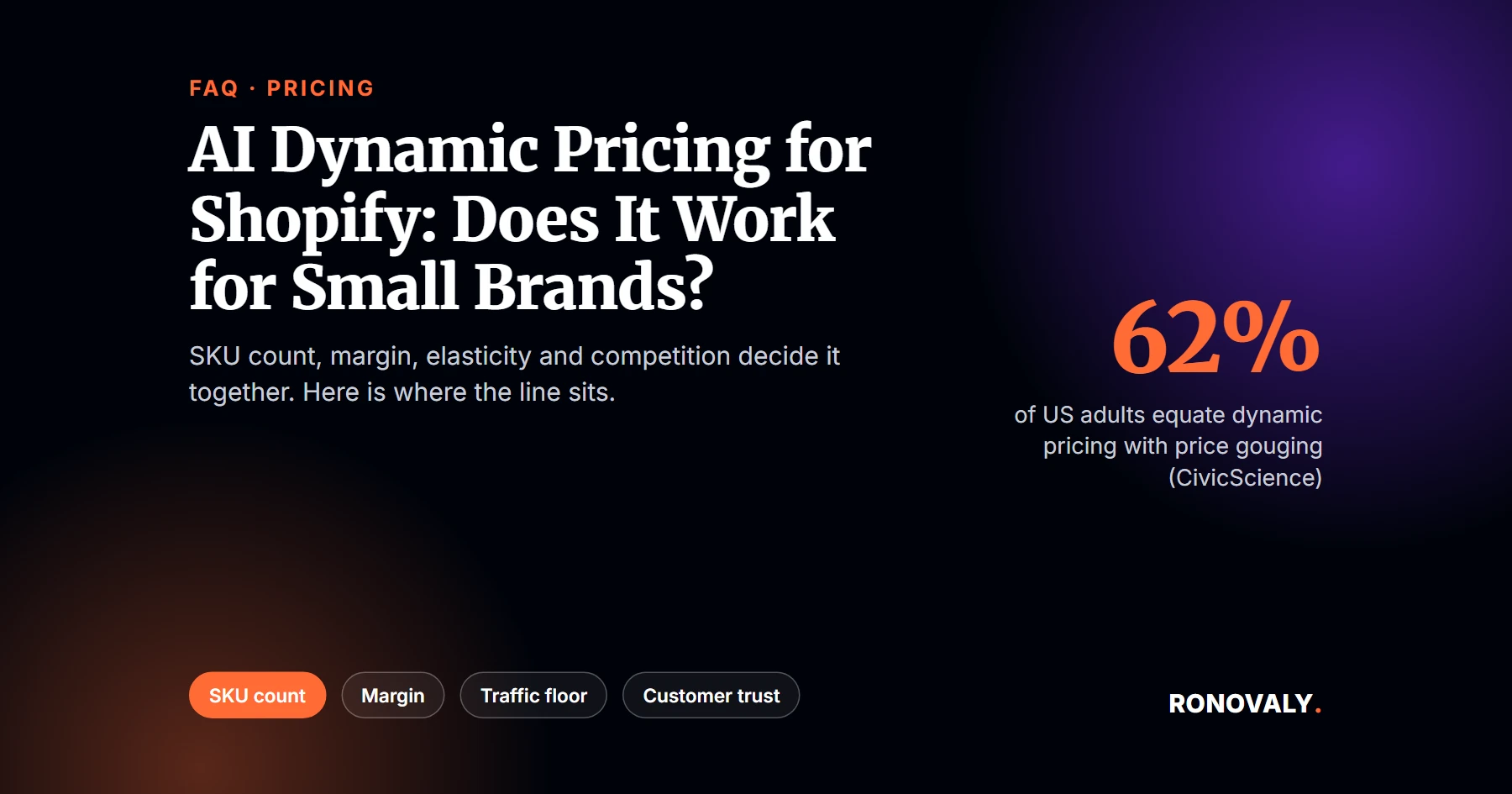
- In fact, 62 percent of US adults equate dynamic pricing with price gouging, per CivicScience (2023). Notably, 56 percent say they would not buy at all once a price moves with demand.
- Reliable price A/B testing needs real traffic. Specifically, practitioners put the floor around 10,000 monthly visitors before a test can detect anything short of a 30 percent swing.
- Enterprise tools like Wiser publish no self-serve pricing. Instead, they are built for catalogs in the thousands of SKUs, not one small storefront.
Getting Started with AI Dynamic Pricing for Shopify
AI Dynamic Pricing Shopify Small Brands: Does It Actually Work?
It works, but only above a specific volume and margin threshold. In other words, it is not a universal upgrade. Below that threshold, the tool’s subscription and the noise in your own sales data tend to cancel out any gain it finds.
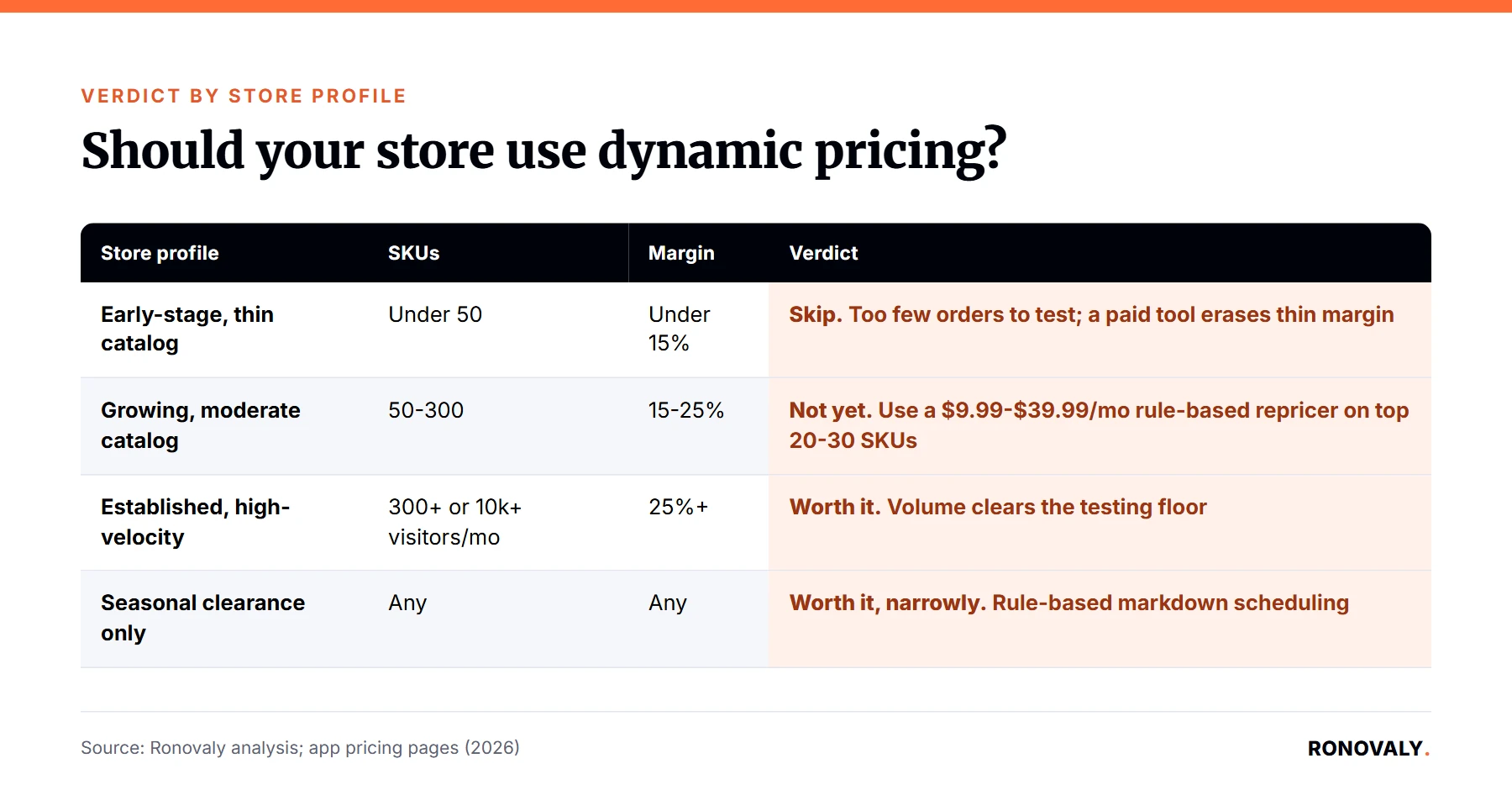
I built the table below from four factors that actually move the outcome. These are how many SKUs you price, what margin you protect, and whether your elasticity signal is even measurable yet. The fourth is how many competitors actively reprice against you. Each row reflects a real, sourced constraint, not a guess.
| Store profile | SKU count | Margin | Elasticity signal | Competitive density | Verdict |
|---|---|---|---|---|---|
| Early-stage, thin catalog | Under 50 | Under 15% | Not enough order history to measure | 0-2 active competitors | Skip. Orders are too few to test reliably, and a $99 to $1,279 monthly tool erases a thin margin fast. |
| Growing, moderate catalog | 50-300 | 15-25% | Some signal, but noisy on low sellers | 3-5 active competitors | Not yet. Start with a $9.99 to $39.99 monthly rule-based repricer instead, on your top 20-30 SKUs only. |
| Established, high-velocity | 300+ SKUs or 10,000+ monthly visitors | 25%+ | Clear signal across a stable core catalog | 5+ active competitors, prices move weekly | Worth it. Volume clears the testing floor, so a paid tool becomes cost-justified against real order flow. |
| Any size, seasonal clearance-only | Any | Any | Not needed for time-based markdowns | Any | Worth it, narrowly. Simple rule-based markdown scheduling suits seasonal clearance at any scale. |
The floor comes from two real constraints. First, Intelligems gates unlimited price testing behind a $1,279-a-month plan, per its own pricing page (fetched 2026-09-04). That plan only pencils out once order volume can absorb the cost as a share of revenue. Second, with fewer than 10,000 monthly visitors, reliable A/B testing needs a swing of more than 30 percent to register at all, per Convertize’s guide to A/B testing sample size (fetched 2026-09-04). Below both lines, you are paying for a signal your traffic cannot produce yet.
Who should use dynamic pricing, and who should skip it?
Dynamic pricing suits high-velocity goods, active competitors who reprice often, and seasonal inventory needing fast clearance. It also suits thin-margin categories where small gains compound, per Shopify’s own dynamic pricing guidance (fetched 2026-09-04). It is not a fit for a small, stable catalog where prices rarely need to move.
Good fit for:
– Categories where 3 or more competitors actively reprice, so you have something real to react to.
– Stores clearing 10,000+ monthly visitors, so a test can reach significance in weeks, not months.
– Sellers running seasonal or perishable inventory that genuinely needs fast, rules-based markdowns.
Not a good fit for:
– A boutique catalog under 50 SKUs with loyal, price-insensitive repeat buyers. You will spend more on the tool than you recover.
– A store still building its first 6 months of clean order history. There is simply no elasticity signal to price against yet.
How much do Shopify dynamic pricing apps cost?
Shopify dynamic pricing apps span roughly $9.99 a month for a basic rule-based repricer. At the top, a full price-testing platform runs $1,279 a month. Notably, the gap between tiers is mostly about testing power, not the underlying pricing logic. Picking the wrong tier for your size is the single most common mistake I see.
At the low end, Pricing.AI‘s Shopify App Store listing runs a free tier for up to 200 price changes a month. From there, it steps up to $9.99, $19.99, and $39.99 a month as change volume scales. Notably, every paid tier includes unlimited rule creation (Shopify App Store, fetched 2026-09-04). Meanwhile, Prisync starts at $99 a month for competitor monitoring plus rule-based repricing, per Shopify’s own dynamic pricing roundup (fetched 2026-09-04). At the high end, Intelligems‘ Unlimited plan costs $1,279 a month, discounted from a $2,894 list rate. It also requires a 3-month minimum commitment before real, unlimited testing unlocks (Intelligems pricing page, fetched 2026-09-04).
Wiser, built for enterprise price intelligence across catalogs as large as 15,000 SKUs, publishes no self-serve pricing at all. Instead, it routes every prospect to a sales call (Wiser pricing page, fetched 2026-09-04). If a vendor will not show you a number, assume the tool is priced for a team much larger than yours.
What’s the difference between dynamic pricing and price A/B testing?
Dynamic pricing automatically adjusts a live price based on rules or an algorithm reacting to a signal, like a competitor’s move or demand. Price A/B testing, in contrast, shows two fixed prices to different visitor groups over a set window. You then measure which one converts and profits better, and choose the winner yourself.
Intelligems is explicitly an A/B testing tool, not a real-time repricer. Its Smart Pricing module runs controlled experiments, capped at one test a month on its base tier (Intelligems pricing page, fetched 2026-09-04). Prisync and Pricing.AI, on the other hand, apply rules or competitor-triggered changes continuously, with no formal test window. If you want a defensible answer before committing to a new price, start with testing. If you want prices that shift automatically day to day, that is dynamic repricing proper.
How Dynamic Pricing Works for a Small Catalog
How many SKUs or how much traffic do I need before dynamic pricing is worth it?
You need enough order volume to clear statistical noise. Specifically, with fewer than 10,000 monthly visitors, you would need a price swing of more than 30 percent just to detect a real winner, per Convertize’s guide to A/B testing sample size (fetched 2026-09-04). Above that floor, the exact sample you need still depends on your baseline conversion rate and how small a lift you want to catch, so treat 10,000 as the point where testing becomes possible, not automatically reliable.
Catalog size matters for a different reason. A pricing vendor’s own elasticity guide estimates roughly 95 percent of a typical retail catalog is “long-tail.” That means low-competition SKUs with high loyalty and low price sensitivity (Quicklizard, fetched 2026-09-04, vendor commentary, not an independent figure). On a catalog under 50 SKUs, nearly all of them may fall into that low-sensitivity bucket. As a result, there is often little room for an algorithm to find a meaningfully better price. On a larger catalog, the same long-tail math still applies. However, a handful of high-velocity, competitively priced items generate enough signal on their own to justify testing.
Should a small brand start with rule-based repricing or full AI-driven pricing?
Start with rule-based repricing. Specifically, it is cheaper and transparent, and it does not require the order volume a real algorithmic test demands. Move to a more automated approach only once you can prove the simpler version actually works.
A rule-based tool like Pricing.AI or Prisync lets you set explicit conditions you can audit line by line. For example, “match the lowest of 3 named competitors, floor at 20 percent margin” is a rule anyone on your team can check. In contrast, a full AI-driven system optimizes across more signals at once. That makes it more powerful, but also harder to explain when a customer asks why a price moved. For a store still building its first year of clean pricing data, the simpler system is also the more defensible one.
Can a small Shopify store use the same tools as enterprise retailers like Wiser?
Technically, sometimes. Practically, usually not, and not because of access. Wiser is built around workflows for catalogs in the thousands of SKUs. In addition, it publishes no self-serve pricing, and instead requires a sales call before you see a number (Wiser pricing page, fetched 2026-09-04).
That structure alone tells you the target customer. Specifically, it is a team large enough to justify a custom contract, not a solo founder repricing 80 products. Therefore, a small brand is almost always better served by a self-serve, transparently priced tool like Pricing.AI or Prisync. That said, you can reassess later, once volume genuinely outgrows what a $9.99-to-$99-a-month tool can handle.
What profit margin do I need before dynamic pricing makes sense?
There is no universal minimum. Still, the practical floor is a margin thick enough to absorb the tool’s cost and any short-term price drops a competitive-matching rule might trigger. Accordingly, most small brands should treat anything under roughly 20 percent margin as too thin to automate safely.
For context, median gross margin across 11 publicly traded DTC and CPG brands sits at 56.6 percent, per each company’s latest SEC 10-K filing (Eightx, fetched 2026-09-04). However, that figure is gross margin for companies large enough to be public, not net margin for a private $500K-$5M ARR store. Treat it as a ceiling, not a typical number. A private brand’s real net margin is almost always thinner, once marketing, fulfillment, and returns are counted. That is exactly why a margin floor matters more for you than it does for a public brand with more cushion.
Common Problems & Risks With Dynamic Pricing
Will customers notice price changes, and how do they usually react?
Yes, customers notice, and the reaction skews negative by default. Notably, in a CivicScience survey, 62 percent of US adults said dynamic pricing is akin to price gouging, with 37 percent strongly agreeing (CivicScience, fetched 2026-09-04, published 2023).
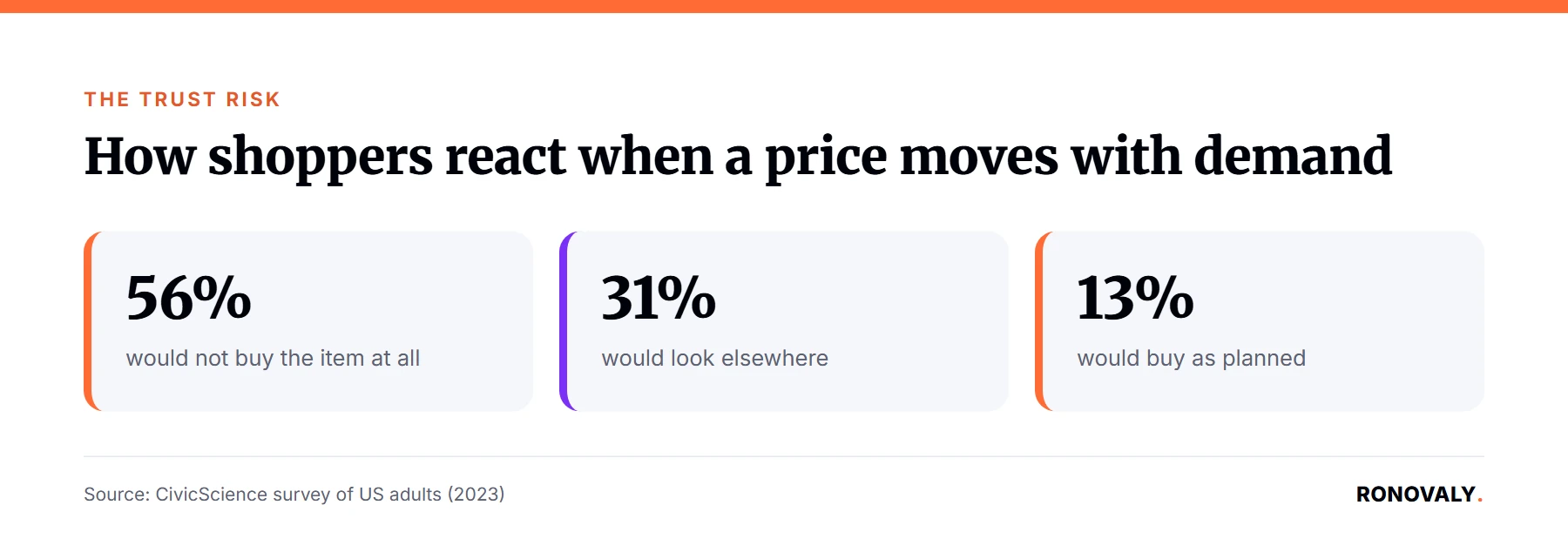
When told a product’s price changes with demand, 56 percent said they would not buy the item at all. Meanwhile, 31 percent said they would look elsewhere. Only 13 percent said they would buy as planned, per the same CivicScience survey. In short, silent, unexplained price movement is a real conversion risk, not just a brand-perception one. This is exactly why a small brand should pilot on a narrow slice of SKUs first.
What’s the real risk of dynamic pricing backfiring on customer trust?
Price-fairness backlash is a documented consumer pattern, not a fringe reaction. Specifically, it is the tendency for shoppers to punish a brand once they perceive a price as demand-manipulated rather than value-set, even when the price itself is reasonable.
A 17-country YouGov survey found that “fair” ratings for demand-based pricing typically ran only 33 to 40 percent, across categories like live events and travel. In contrast, “unfair” views reached as high as 57 to 64 percent in markets like Britain and Canada (YouGov, fetched 2026-09-04, April 2023 fieldwork). That data covers ticketing and travel, not Shopify retail specifically. Even so, it shows the same backlash pattern appears broadly, whenever pricing looks demand-triggered instead of value-driven. For a small brand whose pitch often rests on trust, that risk runs higher than it does for an airline nobody expects to love them anyway.
How do I test dynamic pricing without alienating existing customers?
Pilot on new-customer-facing or low-repeat-purchase SKUs first. Never test on the items your most loyal buyers reorder. Keep any increase small, and cap how often prices change. In addition, never let the same returning customer see two different prices for the identical item in a short window.
Shopify’s own guidance warns that prices that “jump too erratically” frustrate customers, and that guardrails matter more than algorithm sophistication (Shopify, fetched 2026-09-04). In practice, that means starting with a floor and a ceiling on any rule. It also means reviewing every change weekly for the first month, instead of trusting the tool to run unsupervised from day one.
Advanced Topics
How long does it take to see results from dynamic pricing?
Expect at least one full A/B test cycle. Specifically, that usually means 2 to 4 weeks of stable traffic, once you clear the 10,000-visitor floor above (Convertize guidance, fetched 2026-09-04). Otherwise, anything faster than that is a signal the result is not trustworthy yet, no matter what a vendor’s dashboard claims.
If your store does not clear that traffic threshold, skip the formal test entirely. Instead, apply simple, rules-based competitor matching. Subsequently, review the outcome manually after a full month of sales, since a proper statistical test is not achievable at that volume yet.
Are there legal or compliance risks with dynamic pricing?
Dynamic pricing itself is legal in the US for consumer retail. Still, it sits close to two areas worth watching. In particular, these are price discrimination based on protected characteristics, and deceptive rules around fake “was” prices. Neither risk is unique to AI pricing, but automation makes both easier to trigger at scale without noticing.
The safest practice is to price by objective signals only, like inventory level, competitor price, or time-based clearance. In contrast, never price by a shopper’s browsing history or demographic profile. Additionally, keep any “compare at” price accurate to a real prior selling price. If your rules reference only inventory, competition, and time, you are on far safer ground than a system that personalizes price by shopper.
Related Resources
- Rebuy vs LimeSpot: a comparison of the two leading Shopify personalization apps, useful if your pricing decision is really a personalization decision in disguise.
- How DTC Brands Use AI Analytics: the analytics layer that shows whether a pricing change actually moved CAC and LTV, not just revenue.
- Shopify’s own pricing guidance: Shopify, “6 Best Dynamic Pricing Software Solutions”, the official reference on when dynamic pricing suits a business.
- Intelligems pricing page: official pricing, for the current cost of price A/B testing once your traffic clears the threshold above.
- CivicScience consumer research: dynamic pricing sentiment data, the source behind the trust-risk numbers here.
- McKinsey’s dynamic pricing practice overview: McKinsey, “Dynamic Pricing in e-Commerce”, a broader enterprise-retail perspective for context, not a small-brand-specific source.
Still Have Questions?
Didn’t find your specific case above? Reach our editorial team through Contact. We update this FAQ as vendor pricing and consumer research change, since both move fast.
Next Steps
Run the break-even table against your own store before you install anything. If you land in the skip or not-yet rows, save the money and put that budget toward traffic or retention instead. If you clear the worth-it threshold, start with a rule-based tool on a narrow SKU slice first. Watch customer response for a full month. Only then consider a full price-testing platform like Intelligems.
I’m Sarah Blake, and I write about e-commerce growth and conversion for Ronovaly. You can read more about how we test these workflows on real stores on our About page. Every statistic in this piece is fact-checked against its named source before publish.
This post contains affiliate links. If you make a purchase through these links, we may earn a commission at no extra cost to you.